

I was reading in Discover some theories that might make it possible to explore the question of what existed before the Big Bang. There are three models that I won't get into to any great degree here, mainly because, I'll confess, I can follow high level theoretical physics only to a certain degree and then I admit, I honestly don't have a clue what's being discussed. As I science fiction writer, I only have to understand them enough to present higher level physics in a plausible way to readers who have no idea whether I'm right or wrong in what I'm talking about. One of the theories plays into the Bitterwood books--it's the notion that there's a higher dimensional space that an infinite number of universes float through. From time to time, these universes smash into each other in the higher dimension and the energy generated from the collision produces a big bang that forms a new universe. There are two upsides to this theory. First, it means that universes exists as part of an endless cycle of creation and recreation--the big bang isn't a beginning, just part of an ongoing process. The amazing thing about this theory, unlike a zillion other "before the universe began" theories, is that it's testable. If our universe was generated by the collision of other universes, the theory predits gravity waves that would still be detectable. We don't yet have the technology to detect gravity waves (which are also predicted by relativity), but this is mainly an engineering problem and one day we will, and can confirm or refute the evidence for this theory. A third upside to the theory is that I can play with this higher dimension "outside" of space by calling it "underspace" and letting my characters travel through it in fiction. I'm sure any competent scientist can explain why this is an absurd premise, but they can write their own novels.
The article introduced the idea of what happened before the Big Bang by discussing a monk who asks his monk-boss (this probably isn't the actual title the church uses), "What was God doing before he created the earth?" The monk-boss answers, "Designing hell for those who ask too many questions." This reminded me of a paradox that used to bug me when I was a kid in church.
If I asked how long God had been around, I was assured it was forever. God's timeline was infinite, stretching into forever both forward and backward. But, this creates a paradox: How long did God wait before he created the world? Forever. Which is the mental equivilent of saying he never got around to creating the world. You can imagine how this provided a certain level of consternation to me when I was ten.
Of course, the same paradox exists in the colliding universe theory... how much time passed before they collided? Eternity. But, with the colliding universe theory, new worlds are being made all the time, for no reason at all, just random collisions. With the God theory, nothing but God existed forever, then he made a planet and a universe for it to float in, then he's going to destroy it all and everyone will live forever in heaven or hell. So, there's a forever before the earth, a few thousand years of earth, followed by a forever without the earth, not by chance, but due to the willful decisions of an omniscient being. Somehow the intentionality provides a dividing line in my mind. One premise strikes me as plausible, while the other strikes me as absurd, even though they effectively provide the same results.
I'm writing this from Stellarcon in High Point, by the way, sitting in a lobby through which klingons, pirates, stormtroopers, and multiple Darth Vaders are wandering. Perhaps it's this strangely surreal setting that has launched my current round of odd musings...
Saturday, March 15, 2008


Thursday, March 06, 2008
Heretic Pride
Long time readers of my blog know I'm a big fan of the Mountain Goats... the band, not the animal. They just put out a new album last month, and it's the first album in ages that doesn't have a unifying theme. The last album, Get Lonely, was an album full of songs about an emotionally crippled man, possibly homeless, who spends a lot of time on the edges of society before finally offing himself in the final track. Before that, the Sunset Tree explored John Darnielle's personal story of his relationship with his abusive stepfather. We Shall All Be Healed was the story of a bunch of tweakers (meth users), and the whole trend of "theme" albums was really launched by Tallahassee, where John shed the low-fi sound of his earlier albums for higher production values as he told the story of an unhappy couple who stayed together only by staying drunk. Each of these albums were full of songs that were best understood in the context of the other songs, and everything worked together to form one overall story arc.
With Heretic Pride, the unifying theme is gone, but the ghosts of these previous albums live on. As I listen to this album, I keep finding myself plugging the songs into the story lines of earlier works.
"Sax Rohmer #1" would fit quite neatly onto the Tallahassee album; it's all about things decaying and spinning out of control as "every moment leads toward it's own sad end," yet the narrator insists in the chorus, "I am coming home to you with my own blood in my mouth." It easily fits into what John refers to as his "alpha" series, songs about a drunken dysfunctional couple.
"San Bernidino" reminds me of We Shall All Be Healed both musically and lyrically, while "Autoclave" reminds me of The Sunset Tree --"I am this great unstable mass of blood and foam and no one in her right mind would make my heart her home."
I wasn't a huge fan of Get Lonely, but my favorite track on Heretic Pride, "Marduk T-Shirt Men's Room Incident" would be perfectly at home on that album with it's narrator telling a girl in a bathroom who has obviously just survived some horrible experience:
It's an odd song that seems to offer hope in the fact that a human life is a rather ephemeral thing; our worst moments drift off into time little remembered or mourned, so there's no point for us to let them weigh us down. It's almost as if our very insignificance is a key to a type of holiness. Or, perhaps I'm reading too much into this. Of course, one reason I've been a fan of the Mountain Goats through a string of over ten albums is that John's songs possess that marvelous quality of seeming to be full of meaning--they reward listening and relistening in a way that lesser artist can't quite achieve. I've probably listened to The Coroner's Gambit album well over a hundred times, and every time I always seem to find some new poetic key that unfolds a new message. I listen to the mountain goats with the same faithful ferver that some men read the Bible.
Still, as much as I love the mountain goats, I was willing to pan their last album as mopey and overly produced. Hopefully my willingness to give them a thumbs down will give extra weight to the thumbs up I'm giving Heretic Pride. I've been listening to it non-stop since I picked it up last week, and I have a feeling that the next mix album I make of MG material will be heavy with tracks from Heretic Pride. As I type this, I'm listening to track 8, "Lovecraft in Brooklyn." What other songwriter could pull of a climax to a song like this?
Ah, good stuff. And I can't think of any other album this song fits on. Ultimately, it's songs like this that really pull Heretic Pride over the line into greatness.
With Heretic Pride, the unifying theme is gone, but the ghosts of these previous albums live on. As I listen to this album, I keep finding myself plugging the songs into the story lines of earlier works.
"Sax Rohmer #1" would fit quite neatly onto the Tallahassee album; it's all about things decaying and spinning out of control as "every moment leads toward it's own sad end," yet the narrator insists in the chorus, "I am coming home to you with my own blood in my mouth." It easily fits into what John refers to as his "alpha" series, songs about a drunken dysfunctional couple.
"San Bernidino" reminds me of We Shall All Be Healed both musically and lyrically, while "Autoclave" reminds me of The Sunset Tree --"I am this great unstable mass of blood and foam and no one in her right mind would make my heart her home."
I wasn't a huge fan of Get Lonely, but my favorite track on Heretic Pride, "Marduk T-Shirt Men's Room Incident" would be perfectly at home on that album with it's narrator telling a girl in a bathroom who has obviously just survived some horrible experience:
"Stay formless,
weightless,
blameless,
nameless."
It's an odd song that seems to offer hope in the fact that a human life is a rather ephemeral thing; our worst moments drift off into time little remembered or mourned, so there's no point for us to let them weigh us down. It's almost as if our very insignificance is a key to a type of holiness. Or, perhaps I'm reading too much into this. Of course, one reason I've been a fan of the Mountain Goats through a string of over ten albums is that John's songs possess that marvelous quality of seeming to be full of meaning--they reward listening and relistening in a way that lesser artist can't quite achieve. I've probably listened to The Coroner's Gambit album well over a hundred times, and every time I always seem to find some new poetic key that unfolds a new message. I listen to the mountain goats with the same faithful ferver that some men read the Bible.
Still, as much as I love the mountain goats, I was willing to pan their last album as mopey and overly produced. Hopefully my willingness to give them a thumbs down will give extra weight to the thumbs up I'm giving Heretic Pride. I've been listening to it non-stop since I picked it up last week, and I have a feeling that the next mix album I make of MG material will be heavy with tracks from Heretic Pride. As I type this, I'm listening to track 8, "Lovecraft in Brooklyn." What other songwriter could pull of a climax to a song like this?
Woke up afraid of my own shadow,
like, genuinely afraid.
Headed for the pawnshop
to buy myself a switchblade.
Someday something's coming
from way out beyond the stars
to kill us while we stand here;
it will store our brains in mason jars.
And then the girl behind the counter asks "How do you feel today?"
and I say "I feel like Lovecraft in Brooklyn!"
Ah, good stuff. And I can't think of any other album this song fits on. Ultimately, it's songs like this that really pull Heretic Pride over the line into greatness.
Saturday, February 09, 2008
Does religious bigotry equal racism or sexism?
Since Romney withdrew, I've probably heard about a dozen pundits and read at least that many columnists who have said that religious bigotry is the last remaining predjudice. Americans are willing to vote for a black man or a woman, the pundits say, but they won't vote for a Mormon. I made the same point myself a few articles back. Having grown up in a Pentacostal church, I can assure you that members of that faith wouldn't vote for a Mormon--nor, I should note, would they vote for an atheist or a Catholic, a Hindu, Buddhist or Muslim. Possibly they'd vote for a Jew and most protestant denominations. Definitely not a scientologist.
However, polls show that vast majorities of American's won't vote for atheists. As an atheist, I'm more or less resigned to the notion that I have to vote for people who profess a faith. Still, I doubt I'd vote for a scientologist. Nor would I vote for a president who professed a disbelief in evolution, as Mike Huckabee has. Is this bigotry? Sure, as defined by the dictionary. It states that bigotry is the "stubborn and complete intolerance of any creed, belief, or opinion that differs from one's own." But, of course, under that definition, everyone is a bigot--liberals are stubbornly in opposition to conservatism, conservatives are completely opposed to liberalism. I suppose there are a few mushy people in the middle who are so devoid of opinion that they regard all opinions as equal. I HATE those people!
But does religious bigotry equal racism? It seems to me to be a very dumb parallel. You are born into your race. You have no choice but to live your life black, white, or some shade in between. (I will avoid a Micheal Jackson joke here.) Hating people based on their physical attributes is fundamentally unfair because they didn't choose these physical attributes. (I suppose there are some physical attributes you control--an intense dislike of all people who tattoo "White Power" on their forehead could be justified.) But, religion isn't like the color of your skin. As an adult, you have the power to choose your creed, beliefs, and opinions--and other people, I would argue, should be free to scorn you for these.
Please note, I'm not advocating or justifying violence between people of different faiths. If you're a Muslim and I'm an atheist, I still feel we can chat politely at parties, work side by side at most jobs, and educate our children in schools that stay neutral on the matter. I also agree that there should be no legal religious test for holding an office in America. If you want to take your oath of office on a copy of Dianetics, well, the law shouldn't prevent that. But the choices of voters are a different matter than a legal test. I see nothing wrong with deciding that someone who thinks there were dinosaurs on the ark, or that L. Ron Hubbard was tapped into a higher truth, shouldn't be president. Nor do I feel victimized that the majority of people think it's written into the constitution somewhere that this is a Christian nation and think that all atheists are tools of Satan. You're entitled to your opinion. Which is, of course, the ultimate beauty of America--we're all entitled to our own goofy beliefs, and free to regard those who've drawn different conclusions as idiots. And thus the great wheel of America turns....
However, polls show that vast majorities of American's won't vote for atheists. As an atheist, I'm more or less resigned to the notion that I have to vote for people who profess a faith. Still, I doubt I'd vote for a scientologist. Nor would I vote for a president who professed a disbelief in evolution, as Mike Huckabee has. Is this bigotry? Sure, as defined by the dictionary. It states that bigotry is the "stubborn and complete intolerance of any creed, belief, or opinion that differs from one's own." But, of course, under that definition, everyone is a bigot--liberals are stubbornly in opposition to conservatism, conservatives are completely opposed to liberalism. I suppose there are a few mushy people in the middle who are so devoid of opinion that they regard all opinions as equal. I HATE those people!
But does religious bigotry equal racism? It seems to me to be a very dumb parallel. You are born into your race. You have no choice but to live your life black, white, or some shade in between. (I will avoid a Micheal Jackson joke here.) Hating people based on their physical attributes is fundamentally unfair because they didn't choose these physical attributes. (I suppose there are some physical attributes you control--an intense dislike of all people who tattoo "White Power" on their forehead could be justified.) But, religion isn't like the color of your skin. As an adult, you have the power to choose your creed, beliefs, and opinions--and other people, I would argue, should be free to scorn you for these.
Please note, I'm not advocating or justifying violence between people of different faiths. If you're a Muslim and I'm an atheist, I still feel we can chat politely at parties, work side by side at most jobs, and educate our children in schools that stay neutral on the matter. I also agree that there should be no legal religious test for holding an office in America. If you want to take your oath of office on a copy of Dianetics, well, the law shouldn't prevent that. But the choices of voters are a different matter than a legal test. I see nothing wrong with deciding that someone who thinks there were dinosaurs on the ark, or that L. Ron Hubbard was tapped into a higher truth, shouldn't be president. Nor do I feel victimized that the majority of people think it's written into the constitution somewhere that this is a Christian nation and think that all atheists are tools of Satan. You're entitled to your opinion. Which is, of course, the ultimate beauty of America--we're all entitled to our own goofy beliefs, and free to regard those who've drawn different conclusions as idiots. And thus the great wheel of America turns....
Sunday, February 03, 2008
More political blather
A few months back, I said that Ron Paul was the first Republican candidate I could imagine voting for. He's still in the race, but stalled at about 5% support, which is actually a lot better than I thought he'd do. And, there's a vague chance I might actually get to vote for him. If Romney doesn't drop out of the race, then the Republican nomination might actually roll on to the convention, meaning NC would actually have a voice in the primary process for the first time since I've been a resident of the state. Still, that would mean I'd have to register as a Republican, and I just can't see myself swallowing that kool-aid. And, while Ron Paul is very closely aligned with many of my political views, the has two big strikes against him:
1. There are charges, based on things that were written in a weekly newsletter that he used to publish, that he's a racist. The charge of racism gets flung around a lot in politics. Bill and Hillary are getting slapped the label, which shows how trivial the word has become. Still, I have read some of the quotes, and they are bothersome. Paul's defense is that he doesn't remember writing them, that he thinks they were the words of some staffer writing as him. I'll buy this... most politicians write very few of their own words. Still, that just puts Paul back into the "just another politician" camp and removes some of the edge from his talk about personal responsibility.
2. The whole gold standard thing. Paul is an advocate of returning to the gold standard. He feels that the value of money is completely arbitrary as long as its valued against other currencies instead of an actual, physical commodity. Which is true--except that it's arbitrary when valued against the actual, physicial commodities as well. Gold has no inherent god-given value that magically allows it to determine the true worth of a dollar. The value of gold floats on the arbitrary whims of humanity as much as the value of currencies float. So, I'm afraid I lump gold standard advocates in the same box in my head that holds flat-earthers and creationists.
One thing I will say in Paul's defense: He's anti-abortion, but at least he has the philisophical integrity to then also be anti-death penalty. "Pro-life" politicians who would fry half our prison population and who passionately advocate war drive me crazy.
However, all this talk about Paul is pointless in a way, because he's definitely not going to be a candidate for either party. If he runs as a libertarian, he'll pull down the cool 1% they normally get. Maybe his higher visibility might boost the take to 2% or, dare I dream it? 3%!
The all or nothing nature of the american political system galls me. I've lived 43 years and never once had a politician representing me, and doubt I will in the next 43 years either. The only thing that I can draw a little joy in is that a lot of the Republican chattering class is about to find themselves in the same boat. The most vocal elements of the Republican noise machine--the unholy trinity of Rush Limbaugh, Ann Coulter, and Sean Hannity, loathe John McCain. Coulter said this week she'd vote for Hillary before she'd vote for McCain. Assuming that they are too be believed (a dubious assumption, I know), then a McCain victory would be fun just to either see the mental contortions these vapid talkers go through to convince thier listeners that there were pro-McCain all along, or else see if they remain firmly anti-McCain and wind up blamed for a Republican defeat in the fall.
Finally, in a wierd instance of media bias this morning, I noticed two headlines stating that Clinton and Obama were now tied going into Tuesday's primary. But, when I looked at the actual articles, Clinton had a 4 point lead on Obama, 47-43. Now, sure, that's within the margin of error. But, it's not a tie. The headlines would be less biased in saying that Clinton has a slight lead.
1. There are charges, based on things that were written in a weekly newsletter that he used to publish, that he's a racist. The charge of racism gets flung around a lot in politics. Bill and Hillary are getting slapped the label, which shows how trivial the word has become. Still, I have read some of the quotes, and they are bothersome. Paul's defense is that he doesn't remember writing them, that he thinks they were the words of some staffer writing as him. I'll buy this... most politicians write very few of their own words. Still, that just puts Paul back into the "just another politician" camp and removes some of the edge from his talk about personal responsibility.
2. The whole gold standard thing. Paul is an advocate of returning to the gold standard. He feels that the value of money is completely arbitrary as long as its valued against other currencies instead of an actual, physical commodity. Which is true--except that it's arbitrary when valued against the actual, physicial commodities as well. Gold has no inherent god-given value that magically allows it to determine the true worth of a dollar. The value of gold floats on the arbitrary whims of humanity as much as the value of currencies float. So, I'm afraid I lump gold standard advocates in the same box in my head that holds flat-earthers and creationists.
One thing I will say in Paul's defense: He's anti-abortion, but at least he has the philisophical integrity to then also be anti-death penalty. "Pro-life" politicians who would fry half our prison population and who passionately advocate war drive me crazy.
However, all this talk about Paul is pointless in a way, because he's definitely not going to be a candidate for either party. If he runs as a libertarian, he'll pull down the cool 1% they normally get. Maybe his higher visibility might boost the take to 2% or, dare I dream it? 3%!
The all or nothing nature of the american political system galls me. I've lived 43 years and never once had a politician representing me, and doubt I will in the next 43 years either. The only thing that I can draw a little joy in is that a lot of the Republican chattering class is about to find themselves in the same boat. The most vocal elements of the Republican noise machine--the unholy trinity of Rush Limbaugh, Ann Coulter, and Sean Hannity, loathe John McCain. Coulter said this week she'd vote for Hillary before she'd vote for McCain. Assuming that they are too be believed (a dubious assumption, I know), then a McCain victory would be fun just to either see the mental contortions these vapid talkers go through to convince thier listeners that there were pro-McCain all along, or else see if they remain firmly anti-McCain and wind up blamed for a Republican defeat in the fall.
Finally, in a wierd instance of media bias this morning, I noticed two headlines stating that Clinton and Obama were now tied going into Tuesday's primary. But, when I looked at the actual articles, Clinton had a 4 point lead on Obama, 47-43. Now, sure, that's within the margin of error. But, it's not a tie. The headlines would be less biased in saying that Clinton has a slight lead.
Saturday, February 02, 2008
A guest message from IGMS Editor Ed Schubert
To Readers of Science Fiction and Fantasy everywhere,
When you have something great, you want everyone to know. So you tell people about it. You share it. You pass it along to friends everywhere. Well, that’s what we’re doing with InterGalactic Medicine Show. We want to make sure everyone has had a chance to check out what we’re doing, so we’re offering up a sampling of our stories – for free.
During the month of February we are going to make one story from each of our first four issues available at no charge. Two stories will be set free on February 1st, and two more on February 15th. Just visit www.intergalacticmedicineshow.com and explore the table of contents; the free stories will be clearly marked.
Issue one’s free story will be “Trill and The Beanstalk” by Edmund R. Schubert, issue two’s will be “Yazoo Queen” by Orson Scott Card (from his Alvin Maker series), issue three’s “Xoco’s Fire” by Oliver Dale, and issue four’s “Tabloid Reporter To The Stars” by Eric James Stone. Each story is fully illustrated by artists who were commissioned to create artwork to accompany that tale -- as is every story published in IGMS.
“Tabloid Reporter To The Stars” will also be featured in the upcoming InterGalactic Medicine Show anthology from Tor, which will be out this August (we wanted you to get a sneak peek of the anthology, too). However, the other three stories aren’t available anywhere except the online version of IGMS.
It’s really quite simple. Great stories. Custom illustrations. Free. We’re pleased with and proud of the magazine we’re publishing; now we’re passing it along to our friends and telling them about it. We hope you’ll enjoy it and do the same.
Edmund R. Schubert
Editor, Orson Scott Card’s InterGalactic Medicine Show
www.intergalacticmedicineshow.com
When you have something great, you want everyone to know. So you tell people about it. You share it. You pass it along to friends everywhere. Well, that’s what we’re doing with InterGalactic Medicine Show. We want to make sure everyone has had a chance to check out what we’re doing, so we’re offering up a sampling of our stories – for free.
During the month of February we are going to make one story from each of our first four issues available at no charge. Two stories will be set free on February 1st, and two more on February 15th. Just visit www.intergalacticmedicineshow.com and explore the table of contents; the free stories will be clearly marked.
Issue one’s free story will be “Trill and The Beanstalk” by Edmund R. Schubert, issue two’s will be “Yazoo Queen” by Orson Scott Card (from his Alvin Maker series), issue three’s “Xoco’s Fire” by Oliver Dale, and issue four’s “Tabloid Reporter To The Stars” by Eric James Stone. Each story is fully illustrated by artists who were commissioned to create artwork to accompany that tale -- as is every story published in IGMS.
“Tabloid Reporter To The Stars” will also be featured in the upcoming InterGalactic Medicine Show anthology from Tor, which will be out this August (we wanted you to get a sneak peek of the anthology, too). However, the other three stories aren’t available anywhere except the online version of IGMS.
It’s really quite simple. Great stories. Custom illustrations. Free. We’re pleased with and proud of the magazine we’re publishing; now we’re passing it along to our friends and telling them about it. We hope you’ll enjoy it and do the same.
Edmund R. Schubert
Editor, Orson Scott Card’s InterGalactic Medicine Show
www.intergalacticmedicineshow.com
Sunday, January 27, 2008
Fever Dreams, or, my most rambling post ever
Thursday I came down with a cold. I went to work that day, but have spent most of the time since flat on my back. My most annoying symptom has been an inability to feel as if I have a "normal" body temperature. I'm either burning up or I feel like I'm buried in a snow bank. My covers have been piled on, tossed off, tangled and mangled in every way imaginable.
I can't look at any given 8 hour stretch and say I've slept. Instead, I seem to be passing out for a few hours here and there, then rising in a state of discomfort to read, cruise the internet, or jot out strange notes on the pad by my bedside concerning the plot for my third Bitterwood book. Snippets of dialogue keep popping into my head. Bitterwood burns a library in one scene (the sky-dragons have a love of libraries and books). Jandra is shocked. Bitterwood growls, "No good has ever come to this world by a book." Given his backstory of having been indoctrinated by the Bible-toting prophet Hezekiah, his attitude is understandable, though, I hope, still unnerving to the average person reading the book. Bitterwood is an interesting hero because he's so unheroic. In today's culture, it's pretty slanderous to call someone a book burner.
The book I was reading during my fevered tossing was "The God Delusion" by Richard Dawkins. I probably would have ditched it midway through if I'd had the energy to get up and go to the library. It was a bit too much preaching to the choir for me; I already think that all the arguments for the existence of God, or for God's intervention in human affairs, are laughable. The notion that the universe was created for us by a being like us is absurd in the face of the astonishing age of the universe and this world, and the unimaginable size of the universe. Wouldn't an intelligent designer have made better use of his resources? If people are important to him, why put them only on one planet in nine around the sun? Why take 4 billion years to do it? If we took the "argument by design" seriously (which is to say, the universe looks designed, so there must be a designer), then we also have to conceded that human life is just a stray mark on the master blueprints. 99.999999999999999999999999999999% of everything that ever existed has no direct interaction with human life whatsoever.
Still, I'm glad I pushed through to the end of Dawkin's book, because that was where I found my biggest point of disagreement. He argues that it's a form of child abuse to raise children as religious, and especially to teach them about hell and a judgmental, vengeful god. I'm not unsympathetic to his argument. But, my gut reaction is, what's the alternative? If parents believe in these things, how are we to stop them from teaching their children? Pass laws? Take at risk children away from their homes? Then what? Raise them in reeducation camps? 90% of the atheists I know came from religious households. Despite Dawkin's understandable concerns, I just think there's a greater social danger in attempting to intervene in childrearing than there is in letting the children be raised as their parents wish and attempting to change the minds of the adults they become.
Finally, in a completely unrelated topic, I followed the SC primaries this weekend and was happy to see Obama win. I'm not certain I'm going to vote this year; the libertarian party has been decertified in NC. Yet, I'm still following politics closely, and the presidential races for both Dems and Republicans are fascinating to me. On the Republican side, it looks as if the nomination will boil down to selecting a candidate who is disliked by at least 60% of the party. In national polls, none of them are able to pull much above 25%. All face some core of rabid opposition. McCain is loathed by the part of the base that cares about immigration. Romney faces some opposition from religious conservatives who will tell you they oppose him for flipflopping on abortion, but who actually stay home and let Hillary Clinton into office before risking the wrath of God by voting for a Mormon. Guiliani is opposed by this same segment for not flipflopping on abortion and gay rights. And Huckabee, who best represents the core that most strongly opposes Romney and Guiliani, is rabidly opposed by the fiscal conservatives. I really have no idea how this nomination is going to play out. My gut says Romney is likeliest to win the nomination since he's got the most money and can stay in until the last dog is hung. But, if he is the nominee, I predict a third party run by some figure from the religious right that will peel off 2% or 3% of fundamentalist voters, leaving Romney to carry maybe ten states in the general election. (By the way, I do think a Morman could be elected president--but only running as a democrat, since fundamentalist christians aren't as significant a proportion of their base.)
But, I started that last paragraph talking about Obama, not Romney. If history is to be made in this election, and we do elect either a black president of a female president, it seems to me that the more honorable, uplifting historic change would be the election of Obama. His victory would be a clear message that any man, regardless of the color of his skin, can grow up to be president in America. With Hillary, the message simply seems muddier. It seems to imply that any woman can become president, assuming she marries a man who is president first. There are plenty of other female senators. If this was Barbara Boxer as a serious contender, it would seem historic to me. As it is, it seems like not so much that Hillary is going to make history as the first female president, as she is going to be pointing a path toward future strategies for getting around term limits. It's already common in the house for spouses to pursue the seats of departed members. I predict we'll see more and more political couples rise as a two for one deal--Bob and Libby Dole if they were twenty years younger, for instance. The candidate's pick of a spouse will be examined as closely as the pick of a running mate. Indeed, it doesn't matter who Clinton chooses as her "real" running mate. The true second person on the ticket will be Bill himself. This can either be an argument for or against electing Hillary, I suppose.
I can't look at any given 8 hour stretch and say I've slept. Instead, I seem to be passing out for a few hours here and there, then rising in a state of discomfort to read, cruise the internet, or jot out strange notes on the pad by my bedside concerning the plot for my third Bitterwood book. Snippets of dialogue keep popping into my head. Bitterwood burns a library in one scene (the sky-dragons have a love of libraries and books). Jandra is shocked. Bitterwood growls, "No good has ever come to this world by a book." Given his backstory of having been indoctrinated by the Bible-toting prophet Hezekiah, his attitude is understandable, though, I hope, still unnerving to the average person reading the book. Bitterwood is an interesting hero because he's so unheroic. In today's culture, it's pretty slanderous to call someone a book burner.
The book I was reading during my fevered tossing was "The God Delusion" by Richard Dawkins. I probably would have ditched it midway through if I'd had the energy to get up and go to the library. It was a bit too much preaching to the choir for me; I already think that all the arguments for the existence of God, or for God's intervention in human affairs, are laughable. The notion that the universe was created for us by a being like us is absurd in the face of the astonishing age of the universe and this world, and the unimaginable size of the universe. Wouldn't an intelligent designer have made better use of his resources? If people are important to him, why put them only on one planet in nine around the sun? Why take 4 billion years to do it? If we took the "argument by design" seriously (which is to say, the universe looks designed, so there must be a designer), then we also have to conceded that human life is just a stray mark on the master blueprints. 99.999999999999999999999999999999% of everything that ever existed has no direct interaction with human life whatsoever.
Still, I'm glad I pushed through to the end of Dawkin's book, because that was where I found my biggest point of disagreement. He argues that it's a form of child abuse to raise children as religious, and especially to teach them about hell and a judgmental, vengeful god. I'm not unsympathetic to his argument. But, my gut reaction is, what's the alternative? If parents believe in these things, how are we to stop them from teaching their children? Pass laws? Take at risk children away from their homes? Then what? Raise them in reeducation camps? 90% of the atheists I know came from religious households. Despite Dawkin's understandable concerns, I just think there's a greater social danger in attempting to intervene in childrearing than there is in letting the children be raised as their parents wish and attempting to change the minds of the adults they become.
Finally, in a completely unrelated topic, I followed the SC primaries this weekend and was happy to see Obama win. I'm not certain I'm going to vote this year; the libertarian party has been decertified in NC. Yet, I'm still following politics closely, and the presidential races for both Dems and Republicans are fascinating to me. On the Republican side, it looks as if the nomination will boil down to selecting a candidate who is disliked by at least 60% of the party. In national polls, none of them are able to pull much above 25%. All face some core of rabid opposition. McCain is loathed by the part of the base that cares about immigration. Romney faces some opposition from religious conservatives who will tell you they oppose him for flipflopping on abortion, but who actually stay home and let Hillary Clinton into office before risking the wrath of God by voting for a Mormon. Guiliani is opposed by this same segment for not flipflopping on abortion and gay rights. And Huckabee, who best represents the core that most strongly opposes Romney and Guiliani, is rabidly opposed by the fiscal conservatives. I really have no idea how this nomination is going to play out. My gut says Romney is likeliest to win the nomination since he's got the most money and can stay in until the last dog is hung. But, if he is the nominee, I predict a third party run by some figure from the religious right that will peel off 2% or 3% of fundamentalist voters, leaving Romney to carry maybe ten states in the general election. (By the way, I do think a Morman could be elected president--but only running as a democrat, since fundamentalist christians aren't as significant a proportion of their base.)
But, I started that last paragraph talking about Obama, not Romney. If history is to be made in this election, and we do elect either a black president of a female president, it seems to me that the more honorable, uplifting historic change would be the election of Obama. His victory would be a clear message that any man, regardless of the color of his skin, can grow up to be president in America. With Hillary, the message simply seems muddier. It seems to imply that any woman can become president, assuming she marries a man who is president first. There are plenty of other female senators. If this was Barbara Boxer as a serious contender, it would seem historic to me. As it is, it seems like not so much that Hillary is going to make history as the first female president, as she is going to be pointing a path toward future strategies for getting around term limits. It's already common in the house for spouses to pursue the seats of departed members. I predict we'll see more and more political couples rise as a two for one deal--Bob and Libby Dole if they were twenty years younger, for instance. The candidate's pick of a spouse will be examined as closely as the pick of a running mate. Indeed, it doesn't matter who Clinton chooses as her "real" running mate. The true second person on the ticket will be Bill himself. This can either be an argument for or against electing Hillary, I suppose.
Free download of DEADSTOCK
Solaris has made Jeffrey Thomas's SF novel DEADSTOCK available as a free download to support the upcoming release of the second book in that series, BLUE WAR. I enjoyed the book last year and think it's worth checking out. The first chapter, which I believe had been available as a free download before now, was actually not the strongest starting point for the book. It makes sense in a logical, cronolical plot sequence as the opening, but is is weakened by the fact it doesn't introduce the protagonist, Jeremy Stake, who's the real selling point of this book. But, now that the whole book is available online for free, you no longer have to trust me on this. Just read the first two chapters. I suspect you'll either keep reading the whole book, or run out to the store and buy a copy. The link to download it is here.
I'm hoping that this is just the first of many books Solaris makes available for free from their back catalogue. Baen Books has been following this model for a few years now, and it certainly hasn't damaged the sales of their authors.
I'm hoping that this is just the first of many books Solaris makes available for free from their back catalogue. Baen Books has been following this model for a few years now, and it certainly hasn't damaged the sales of their authors.
Saturday, January 19, 2008
Laura's snow

It snowed today, the first decent snow this part of North Carolina has seen in two years. There was a little dusting of snow once last year, and a smattering of icy weather that sent cars off the road in Raleigh, but I'm not counting those. Two years ago, as Laura was in the final months of her life, we had a really cold winter--but no snow. One of the things she told me she wanted to see that winter was one more good, solid snowfall, something that would drape the world in white for at least an hour or two.
It never came. When it was cold, it was dry. When there were clouds, it was warm. January, February, and March rolled by, and I tried to encourage her, telling her that I'd seen April snowfalls before. But, of course, the only white on the ground in April were the flowers painting the spring fields.
Since then, any time I hear a forecast of snow, I can't help but think of Laura. I tried to be tuned in to her needs. Any time she expressed even a faint craving for some food, I'd hop in the car to go get it. When spring came early, she talked about wanting a new flower bed and her father and I made her one. But, snow was something I couldn't bring her, and it's tough to look out over the blanket of white tonight without feeling at least a little melancholly. This is the kind of snow she wanted to see.
It's a little peace and beauty settling over the world, a little tranquility, at least until dawn. I'm glad I've learned the right way to look at it.
Friday, January 11, 2008
Silent As Dust

My short story "Silent as Dust" went live this week at Intergalactic Medicine Show. It's my own rather stange take on a ghost story, and it is, in my humble opinion, perhaps the finest story I've yet put into print. IGMS is a paid subscription site, but individual issues only cost $2.50. You can read the first 500 words of the story for free by clicking here.
While you're there, be sure to click on the artwork for a fullsize view of the illustration. The detail is wonderful. Nick Greenwood is the artist, and if you follow the link you'll find other illustrations by him. Excellent stuff.
Monday, January 07, 2008
Bedroom renovation
Last year when I moved in, I renovated a lot of rooms, but ran out of time and money before I could work on the bedroom. It was a pretty bleak space. The walls were exposed cinderblock painted white, and the carpet was this dingey gray stuff that looked like it was probably 50 years old.
 The white walls...
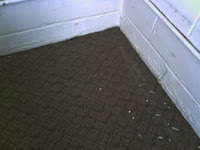 The bad carpet....
Since I have time off from work to work on the final draft of Dragonforge, I thought I'd go ahead and make a final assault on the place. I had originally thought about putting up more drywall, but while I was looking at paints, I kept noticing that there are a lot of paints made to give your walls a fake stone or masonry texture. I already had a real masonry texture! So, I decided to paint the room a brick color, brown with a hint of red (or, red with a hint of brown). The photo below doesn't really capture the color that well, since the flash makes it too light, and without the flash it looks too dark. But, you probably know what color most bricks are. It's that color.
 The white walls...
 The bad carpet....
Since I have time off from work to work on the final draft of Dragonforge, I thought I'd go ahead and make a final assault on the place. I had originally thought about putting up more drywall, but while I was looking at paints, I kept noticing that there are a lot of paints made to give your walls a fake stone or masonry texture. I already had a real masonry texture! So, I decided to paint the room a brick color, brown with a hint of red (or, red with a hint of brown). The photo below doesn't really capture the color that well, since the flash makes it too light, and without the flash it looks too dark. But, you probably know what color most bricks are. It's that color.
 The floor is laminate flooring I got for .69 a square foot at Lowe's. My roommate Duanne helped me put it down (also, he helped with painting). I'm glad I didn't tackle the task alone, because the laminate was a lot harder to install than it seemed in the store. Since it's locking together on the ends and the sides, you really have to lock in an entire strip at once, which might be possible if you're ten feet tall and have four arms. If my room had been any bigger, it probably would have required three people.
In any case, the room looks much better now than it did. Before it had sort of a prison cell vibe. Now it's warm and surprisingly outdoorsy... the brick color makes you feel like you're on the outside of the house. The room also looks larger.
Unless I put in an oven, this is the last major indoor renovation I'm planning for a while. Now I'll be focusing my energies outside.
Tuesday, December 25, 2007
...and a happy new year!
Another Christmas rolls around, and I find myself happy at the thought that, starting tomorrow, I can once again listen to the news or read a newspaper without some prominent article reminding me about the plight of the unfornate at Christmas. As an atheist, I don't celebrate Christmas, and usually just try to keep a low profile and enjoy it, if not celebrate it. I'm happy other people find happiness in the day, I recognize it's good for the economy, and I'm not one to complain about a paid day off. Plus, I like eggnog, and this is the only time of the year most stores carry it.
But, one thing I've gotten weary of over the years is the nagging, scolding tone of the news this time of year. It's become such a cliche that, when the holiday rolls around, reporters go out in search of the most miserable people they can find in order to remind us of the less fortunate at christmas. Sometimes, there's a happy spin to it--a mystery donor gives some poor kid a kidney or something, or some comunity group chips in to buy a homeless man a christmas tree.
Just once, I'd like to see a reporter stand in front of a mansion and deliver us a story reminding us that christmas also comes to the more fortunate among us. A heartwarming story about a man who gives his teenage son a sport car that costs more than the GNP of Bali, or perhaps his own professional baseball team. A christmas morning where the children run outside and find actual reindeer from Lapland have been flown in by their father on his private freight helicoptor, along with three feet of snow and new snowmobiles, even though they live in Miami. That would be a Christmas story I haven't read before.
Ah well. I can dream.
But, one thing I've gotten weary of over the years is the nagging, scolding tone of the news this time of year. It's become such a cliche that, when the holiday rolls around, reporters go out in search of the most miserable people they can find in order to remind us of the less fortunate at christmas. Sometimes, there's a happy spin to it--a mystery donor gives some poor kid a kidney or something, or some comunity group chips in to buy a homeless man a christmas tree.
Just once, I'd like to see a reporter stand in front of a mansion and deliver us a story reminding us that christmas also comes to the more fortunate among us. A heartwarming story about a man who gives his teenage son a sport car that costs more than the GNP of Bali, or perhaps his own professional baseball team. A christmas morning where the children run outside and find actual reindeer from Lapland have been flown in by their father on his private freight helicoptor, along with three feet of snow and new snowmobiles, even though they live in Miami. That would be a Christmas story I haven't read before.
Ah well. I can dream.
Thursday, December 20, 2007
Things Edmund Schubert Knows About Writing
Ed Schubert has started producing his articles on writing now. Check out his Sideshow Freaks blog for a variety of interesting topics. I particularly liked this point from his article on using metaphors:
Another advantage of using metaphors, similes, and analogies is this: they help people remember your keys points. By using one of these comparative devices, you are subliminally telling people (by placing extra emphasis on it) what your most important points are.
This is a very good point, with the counterpoint being that there are times where you will deliberately be toning down your writing, keeping it simple and free of metaphors, just so when you reach the point you most want the reader to carry away, the sudden elevation of language will have the intended impact. I've read stories where practically every paragraph has some sort of simile in it, and I find such stories almost unreadable. It's like watching a movie where all the extras are in the background waving their arms and shouting "look here!" while the main actors are trying to deliver their dialogue.
Anyway, you can read more of his excellent advice here.
Another advantage of using metaphors, similes, and analogies is this: they help people remember your keys points. By using one of these comparative devices, you are subliminally telling people (by placing extra emphasis on it) what your most important points are.
This is a very good point, with the counterpoint being that there are times where you will deliberately be toning down your writing, keeping it simple and free of metaphors, just so when you reach the point you most want the reader to carry away, the sudden elevation of language will have the intended impact. I've read stories where practically every paragraph has some sort of simile in it, and I find such stories almost unreadable. It's like watching a movie where all the extras are in the background waving their arms and shouting "look here!" while the main actors are trying to deliver their dialogue.
Anyway, you can read more of his excellent advice here.
Wednesday, December 19, 2007
One more thing Lisa Shearin knows about writing...
I hope to update my blog soon! I've been in a real time crunch, getting the second draft of DRAGONFORGE onto paper. (Well, onto magnetic particles on my hard drive, actually.) I'm done with that draft, and now comes draft three! Still, I've got a lot of time off coming soon, and plenty of stuff to talk about here and at my Bitterwood blog.
In the meantime, check out Lisa Shearin's latest blog posts in the "Things I know about writing series." In fact, it's worth checking out her whole blog. Lots of interesting insights into her experiences as a novelist.
In the meantime, check out Lisa Shearin's latest blog posts in the "Things I know about writing series." In fact, it's worth checking out her whole blog. Lots of interesting insights into her experiences as a novelist.
Wednesday, December 05, 2007
You gotta want it bad
Lisa Shearin is live with her second article about writing, You Gotta Want It Bad.
From the article:
Some authors are literal overnight successes -- they hit pay dirt and even the "big time" with the first book they've ever written. We've seen their stories -- six- and seven-figure advances, press coverage out the wazoo; heck, sometimes even Oprah.
Then there's me -- and 99.99% of writers. The first book we have published isn't our first or second. Mine was my third.
From the article:
Some authors are literal overnight successes -- they hit pay dirt and even the "big time" with the first book they've ever written. We've seen their stories -- six- and seven-figure advances, press coverage out the wazoo; heck, sometimes even Oprah.
Then there's me -- and 99.99% of writers. The first book we have published isn't our first or second. Mine was my third.
Thursday, November 29, 2007
Five things Lisa Shearin has learned about writing
Novelist Lisa Shearin has posted the first of her writing articles based on my challenge. She starts with an article on how to approach your novel in managable chunks. I particularly liked this thought:
"Some people are intimidated away from writing a book because they think we authors have the whole book in our heads when we start. Heck, most of us don't have the whole book in our heads when we finish."
Read the whole article at her blog here.
"Some people are intimidated away from writing a book because they think we authors have the whole book in our heads when we start. Heck, most of us don't have the whole book in our heads when we finish."
Read the whole article at her blog here.
Monday, November 26, 2007
Five things Andy Remic has learned about writing
In my last post, I challenged four other authors to blog about five things they've learned about writing. The first of these articles is now live at the blog of Andy Remic, author of War Machine. His article includes this seasonally appropriate bit of advice on plotting: Your story should be like a Christmas tree. You’ve got your central plotline, the trunk, which starts at the base with lots of different branches arcing away, so maybe A needs to find B, take it to C and destroy it with Z. From this trunk, as the novel progresses, secondary plotlines evolve and are completed, all branching from the main plotline; as you reach the end of the novel, the secondary plotlines must be shorter and shorter, as the pace increases, and then you reach the glittering star- or the climax- of the story J. Check out the whole article at Wired, Weird, and Wonderful.
Sunday, November 25, 2007
You Never Write Alone
Most fiction writers write alone. Sure, you might occasionally go out to a coffee shop with a laptop or a notepad and scribble down a few lines. Yet, for the most part, writing requires an active concentration and a certain amount of stillness to allow you to hear the unspoken words inside you. Even if you are sitting in the coffee shop writing your stories, it’s a good bet you’ve tuned out all the voices and distractions around you. When you are writing, there is nothing in the world but you and your words as they seep out one by one.
I remember hanging out with my artist friend Eric Buchanan in his studio in the years after college. He would paint while a half dozen friends came by. Everyone would sit around chatting and Eric would talk but keep painting. I was very envious. I cannot imagine carrying on a conversation while writing. Harlan Ellison may sit in the windows of book stores and write short stories, but writing isn’t going to be a public event for most authors.
Yet, the title of this article is, “You Never Write Alone.” Kind of at odds with my opening paragraphs, yes? So what do I mean?
Two things: First, and most importantly, all fiction writers must learn that there is one more person involved in the creative process other than themselves and their fictional cast. That unseen person is the reader. The sooner you become aware of the reader’s presence, the better your writing will be.
One eye-opening thing that happened to me at Odyssey ten years ago was the response I was getting from a room full of twenty people. Some of the readers in the room seemed to get me, and liked my stories. But, the majority always seemed to miss some point I was making. They were confused by the character’s motivations, or bewildered by the setting, or just couldn’t follow the leaps of logic in the plot. I could read my own story and have all these things make sense, but I was failing to put what I knew about the characters and the setting onto the page in a clear and easily grasped way that readers could understand.
Looking back, I believe my biggest problems were that I was trying to be coy, or subtle, or clever with my writing. I had an innate fear of simplicity and directness. Subtlety and cleverness are fine qualities for a writer to strive for, but they are also pitfalls that many a fine story has fallen into. One bit of advice I read years ago was, “Never be afraid to be too obvious.” It’s advice I try to follow. If you are too obvious, an editor can understand what you are saying, see that it’s worth saying, and tell you, “You’re being too obvious here. Tone it down.” If you are being too subtle, however, you aren’t going to get feedback telling you what it is that the editor doesn’t get. It may be you’ve placed a very subtle clue to your character’s motivations on page three of your thirty page manuscript. So subtle that the editor doesn’t get it, and ten pages into your story decides that your characters are behaving in a random and unconvincing fashion and simply moves on to the next story.
It is vital to understand that you are writing to be read. You don’t need to talk down or pander to your unseen reader, but you shouldn’t be afraid to offer them any help you can in order to understand your story as quickly as possible. College literature classes have skewed many young writers because they expose writers to stories that require footnotes and multiple readings to understand, and hold this up as the pinnacle of fine writing. But, most readers in the wild, outside the confines of a classroom, aren’t looking for a novel they have to read multiple times to fathom. They want a story where they know who the characters are, what they are doing, why they are doing it, and where they are doing it. Get all this onto the page as directly as possible and you will have a larger pool of potential readers than if you purposefully craft prose that is obscure, arcane, and downright unintelligible.
Of course, it may be that you wish to target fans of the downright unintelligible, as James Joyce did with Finegan’s Wake or Burroughs’s did with Naked Lunch. You are free to choose the unseen reader you most want to engage. If that unseen reader is a literature professor, there’s no shame in that.
My unseen reader has changed over the years. It began as a teacher, then a college professor—they were being paid to read my writing when I was a student, and I wanted to write stories that pleased them. Then, my unseen writers started to include close friends. Of course, my friends often knew what the story was about because I talked to them about the writing it before I ever wrote it. My unseen reader expanded when I joined the Writer’s Group of the Triad in Greensboro. Suddenly, strangers were reading my writing, and I was getting very different feedback than I had from my friends.
The more people who read my work, the more I found myself adjusting my writing strategies. I kept honing my style to fix the points that readers kept stumbling over. I began making my plots more linear. And, I kept building my circle of readers. While with the WGOT, I’m guessing 50 people over the years read my words and gave me feedback. Oddyssey added another 20 people to this, then maybe 20 more in the online critique group that followed. I later went to boot camp, which added another 15 readers to my circle, and began posting stories on Zoetrope.com and roped in another 30 or 40 readers. Codexwriters.com added dozens more.
Now, when I write, I may be sitting alone in a room, but I have the comments, criticisms, and kind words of about 200 people echoing in my ears. I cannot possibly name them all here, but I maintain strict POV within scenes because Rick Fisher used to catch each and every time I didn’t. Elizabeth Lustig used to hand back my pages to me filled with red ink. I still find myself in the middle of fifty words sentences from time to time and try to imagine how she would fix it. I remember Harlan Ellison delivering a scathing critique of one of my stories because I’d been purposefully obscure in the opening paragraph. He told me I wasn’t good enough to pull it off and he was right; his words still push me to strive for clarity. Suanne Warr wrote a blog post about Bitterwood where she said she’d found the multiple POV’s distracting. I thought it was a good point, so I made the choice to limit the number of POV characters in Dragon Forge to only a half dozen or so before I got too far into it.
Currently, as I rewrite Dragon Forge, I keep sending out chapters to a fairly large group of people. Some have read Bitterwood, some haven’t. Feedback I got from my live critique group of Alex Wilson, Suanne Warr, William Ferrus, Mike Jasper and Jud Nirenberg has already reshaped the draft I’ve been sending to my second draft readers of Laurel Amberdine, Cathy Bollinger, Ada Brown, Guy Stewart, and Oliver Dale. Slowly a consensus is building as to what’s working and what isn’t, and soon I’ll be starting a third draft where I try to address their concerns and put in more of the stuff they liked.
While the individual reader feedback still resonates with me, it’s the collective reader I write for—and that collective reader just gets better the more people I get feedback from. Now that I’m published, I get have the advantage of having my stories reviewed and blogged about. I check Amazon all the time to see if some new feedback has been posted on my books.
For the beginning author, your best source of feedback is other writers in training. They are all over the internet. Unless you are the world’s least competent googler, you can find something that suits your needs pretty quickly. You can probably also find a live critique group in your area that meets frequently. If you live in the Research Triangle Area and are looking for a group, let me know. We’ve got open slots in the one I attend.
The key, I think, is not to get locked into just one group. You want feedback from as varied a population as possible. If the same five or six people keep reading your work, you will have a harder time moving forward than you will if fifty or sixty people read your work. And when I say, “your work,” I don’t mean one story. To grow as a writer, you need to write a lot of stories, and have them read by a lot of people. Your goal here is to allow your style to develop over a body of work, not to keep revising the same story a dozen times based on the feedback of a dozen people.
Finally, there is one final important presence in the life of writers—their peers. It’s vital, if you are a new writer, to get out and talk to other new writers who are blazing their own paths to success. Some people will say that you should go and get the advice of old pros. While I found advice from Orson Scott Card and Harlan Ellison helpful, I also realized that so many of the bridges they crossed to reach success have long since burned. If you are at the beginning of your career, it’s useful to talk to other writers near the beginning of their careers. They are going to often have more realistic and practical advice than authors who’ve had years to build a fan base.
Speaking of the realistic and practical advice of my peers, I’ve sent out a challenge to some of them to see if they would be interested in sharing their wisdom, and several have graciously stepped up to the plate. So, in the coming weeks, check out the blogs of Lisa Shearin, author of the fantasy series that launched with Magic Lost, Trouble Found; Edmund Schubert, editor of Orson Scott Card’s Intergalactic Medicine Show; Ken Scholes, author of a five book fantasy series from Tor; and Andy Remic, author of War Machine and many other fine tales of future combat. I’ve hung out with most of these people at cons or other events, and think you’ll find their insights illuminating.
I remember hanging out with my artist friend Eric Buchanan in his studio in the years after college. He would paint while a half dozen friends came by. Everyone would sit around chatting and Eric would talk but keep painting. I was very envious. I cannot imagine carrying on a conversation while writing. Harlan Ellison may sit in the windows of book stores and write short stories, but writing isn’t going to be a public event for most authors.
Yet, the title of this article is, “You Never Write Alone.” Kind of at odds with my opening paragraphs, yes? So what do I mean?
Two things: First, and most importantly, all fiction writers must learn that there is one more person involved in the creative process other than themselves and their fictional cast. That unseen person is the reader. The sooner you become aware of the reader’s presence, the better your writing will be.
One eye-opening thing that happened to me at Odyssey ten years ago was the response I was getting from a room full of twenty people. Some of the readers in the room seemed to get me, and liked my stories. But, the majority always seemed to miss some point I was making. They were confused by the character’s motivations, or bewildered by the setting, or just couldn’t follow the leaps of logic in the plot. I could read my own story and have all these things make sense, but I was failing to put what I knew about the characters and the setting onto the page in a clear and easily grasped way that readers could understand.
Looking back, I believe my biggest problems were that I was trying to be coy, or subtle, or clever with my writing. I had an innate fear of simplicity and directness. Subtlety and cleverness are fine qualities for a writer to strive for, but they are also pitfalls that many a fine story has fallen into. One bit of advice I read years ago was, “Never be afraid to be too obvious.” It’s advice I try to follow. If you are too obvious, an editor can understand what you are saying, see that it’s worth saying, and tell you, “You’re being too obvious here. Tone it down.” If you are being too subtle, however, you aren’t going to get feedback telling you what it is that the editor doesn’t get. It may be you’ve placed a very subtle clue to your character’s motivations on page three of your thirty page manuscript. So subtle that the editor doesn’t get it, and ten pages into your story decides that your characters are behaving in a random and unconvincing fashion and simply moves on to the next story.
It is vital to understand that you are writing to be read. You don’t need to talk down or pander to your unseen reader, but you shouldn’t be afraid to offer them any help you can in order to understand your story as quickly as possible. College literature classes have skewed many young writers because they expose writers to stories that require footnotes and multiple readings to understand, and hold this up as the pinnacle of fine writing. But, most readers in the wild, outside the confines of a classroom, aren’t looking for a novel they have to read multiple times to fathom. They want a story where they know who the characters are, what they are doing, why they are doing it, and where they are doing it. Get all this onto the page as directly as possible and you will have a larger pool of potential readers than if you purposefully craft prose that is obscure, arcane, and downright unintelligible.
Of course, it may be that you wish to target fans of the downright unintelligible, as James Joyce did with Finegan’s Wake or Burroughs’s did with Naked Lunch. You are free to choose the unseen reader you most want to engage. If that unseen reader is a literature professor, there’s no shame in that.
My unseen reader has changed over the years. It began as a teacher, then a college professor—they were being paid to read my writing when I was a student, and I wanted to write stories that pleased them. Then, my unseen writers started to include close friends. Of course, my friends often knew what the story was about because I talked to them about the writing it before I ever wrote it. My unseen reader expanded when I joined the Writer’s Group of the Triad in Greensboro. Suddenly, strangers were reading my writing, and I was getting very different feedback than I had from my friends.
The more people who read my work, the more I found myself adjusting my writing strategies. I kept honing my style to fix the points that readers kept stumbling over. I began making my plots more linear. And, I kept building my circle of readers. While with the WGOT, I’m guessing 50 people over the years read my words and gave me feedback. Oddyssey added another 20 people to this, then maybe 20 more in the online critique group that followed. I later went to boot camp, which added another 15 readers to my circle, and began posting stories on Zoetrope.com and roped in another 30 or 40 readers. Codexwriters.com added dozens more.
Now, when I write, I may be sitting alone in a room, but I have the comments, criticisms, and kind words of about 200 people echoing in my ears. I cannot possibly name them all here, but I maintain strict POV within scenes because Rick Fisher used to catch each and every time I didn’t. Elizabeth Lustig used to hand back my pages to me filled with red ink. I still find myself in the middle of fifty words sentences from time to time and try to imagine how she would fix it. I remember Harlan Ellison delivering a scathing critique of one of my stories because I’d been purposefully obscure in the opening paragraph. He told me I wasn’t good enough to pull it off and he was right; his words still push me to strive for clarity. Suanne Warr wrote a blog post about Bitterwood where she said she’d found the multiple POV’s distracting. I thought it was a good point, so I made the choice to limit the number of POV characters in Dragon Forge to only a half dozen or so before I got too far into it.
Currently, as I rewrite Dragon Forge, I keep sending out chapters to a fairly large group of people. Some have read Bitterwood, some haven’t. Feedback I got from my live critique group of Alex Wilson, Suanne Warr, William Ferrus, Mike Jasper and Jud Nirenberg has already reshaped the draft I’ve been sending to my second draft readers of Laurel Amberdine, Cathy Bollinger, Ada Brown, Guy Stewart, and Oliver Dale. Slowly a consensus is building as to what’s working and what isn’t, and soon I’ll be starting a third draft where I try to address their concerns and put in more of the stuff they liked.
While the individual reader feedback still resonates with me, it’s the collective reader I write for—and that collective reader just gets better the more people I get feedback from. Now that I’m published, I get have the advantage of having my stories reviewed and blogged about. I check Amazon all the time to see if some new feedback has been posted on my books.
For the beginning author, your best source of feedback is other writers in training. They are all over the internet. Unless you are the world’s least competent googler, you can find something that suits your needs pretty quickly. You can probably also find a live critique group in your area that meets frequently. If you live in the Research Triangle Area and are looking for a group, let me know. We’ve got open slots in the one I attend.
The key, I think, is not to get locked into just one group. You want feedback from as varied a population as possible. If the same five or six people keep reading your work, you will have a harder time moving forward than you will if fifty or sixty people read your work. And when I say, “your work,” I don’t mean one story. To grow as a writer, you need to write a lot of stories, and have them read by a lot of people. Your goal here is to allow your style to develop over a body of work, not to keep revising the same story a dozen times based on the feedback of a dozen people.
Finally, there is one final important presence in the life of writers—their peers. It’s vital, if you are a new writer, to get out and talk to other new writers who are blazing their own paths to success. Some people will say that you should go and get the advice of old pros. While I found advice from Orson Scott Card and Harlan Ellison helpful, I also realized that so many of the bridges they crossed to reach success have long since burned. If you are at the beginning of your career, it’s useful to talk to other writers near the beginning of their careers. They are going to often have more realistic and practical advice than authors who’ve had years to build a fan base.
Speaking of the realistic and practical advice of my peers, I’ve sent out a challenge to some of them to see if they would be interested in sharing their wisdom, and several have graciously stepped up to the plate. So, in the coming weeks, check out the blogs of Lisa Shearin, author of the fantasy series that launched with Magic Lost, Trouble Found; Edmund Schubert, editor of Orson Scott Card’s Intergalactic Medicine Show; Ken Scholes, author of a five book fantasy series from Tor; and Andy Remic, author of War Machine and many other fine tales of future combat. I’ve hung out with most of these people at cons or other events, and think you’ll find their insights illuminating.
Sunday, November 18, 2007
Embrace your demons
This is perhaps the most presumptuous of these five essays. My first three articles were mostly a collection of writing techniques--build your story out of scenes, recognize the value of writing a bad story, and learn to write your first drafts quickly. This time, I'm not going to talk about how to write as much as I'm going to talk about why to write and what to write about. The why and what questions are going to be answered differently by everyone. Everybody is going to have slightly different reasons why they write. And, there is no "wrong" subject to write about. Anything you want to put on paper is fair game.
Still, I feel like any writer is going to benefit from pausing for a moment to consider why they are writing what they are writing. You can be a very talented writer with a real flare for poetic prose, but if you are only picking trivial subjects to write about, you might find your career going nowhere.
My earliest attempts to write SF and Fantasy showed some technical promise. I could plot; I could write dialogue; I had good instincts for writing action and knowing how to draw the reader along from one event to the next. But, all of those early stories feel hollow to me now. They are mostly "nifty idea" stories. Wouldn't it be nifty if all reality was computer generated? Wouldn't it be nifty if the Greek gods were working at the local television station? Wouldn't it be nifty to find life on Mars? In retrospect, these weren't the most original ideas, though I don't know that originality is as big a selling point as beginning writers may think it is. But, the real problem I see with these stories when I look at them now is that they are, for the most part, shallow. I don't feel anything when I read them. Writing them took no emotional effort, and I wasn't risking revealing anything about myself by writing any of these stories.
One thing that used to worry me as a beginning writer was the question, "Are people going to think I'm writing about myself?" My protagonists were a fairly shallow bunch because their problems were surface problems: How to I find the murderer? How do I fix my space ship? My characters didn't possess any deep emotional problems. One thing that used to hold me back was the question, "What if my mother reads this?"
After I had written some of these shallow stories, Orson Scott Card visited the writer's group I was a member of and said something that I thought was profound. He said that the people who wrote stories only because they wanted to be writers weren't likely to accomplish much. He thought that the really good writers were people who were writing as if they were on some higher mission--they were trying to change the world with their words. This was eye-opening, and I felt like he'd really pegged me. I was writing mainly because I wanted to be a writer. I wasn't trying to change the world with my stories.
In the following years, I decided I would start writing protagonists who championed aspects of my world views. My stories took on a decidedly political slant, reflecting my libertarian leanings. I also started writing stories that were atheist manifestos, ridiculing every aspect of religion.
Those stories sucked, for the most part. They weren't as petty as my earliest writing, but they were still shallow. They were intellectual arguments pounded into something roughly resembling fiction. I was putting my opinions out there so the world could benefit from my wisdom, but the stories were still insufferably trivial. I was writing about things I spent a lot of time thinking about, but my stories didn't have any heart.
Then, in 1998, I went to Odyssey and ran into the buzz saw that is Harlan Ellison. Harlan tosses out critiques like they were hand-grenades. I left Odyssey convinced that no one would ever want to read my little political and religious diatribes. I came home certain I had no talent, and that no word I ever wrote would be published.
It was the single most important event on my path to becoming a writer. In the aftermath of hurricane Ellison, my writing portfolio looked like New Orleans after Katrina. Everything I'd written before, three novels and about 50 short stories, had been blown over. I didn't think anything could be salvaged. Yet, after a few weeks, I found that I wanted to write more stories. I knew I would never sell them. The new ideas I was having were twisted and unmarketable but I didn't care. I was having this vision of a guy running around a flooded city looking for the perfect place to shoot up heroin and die. Another idea I had was of a city of immortals where life had become so utterly meaningless that people had to commit atrocious acts such as rape and murder just to feel the slightest emotion. Another story I had in mind had a terrorist protagonist; it made perfect sense in his world to change things by blowing up a truck in a busy location. I don't think I could have written these stories before Odyssey. I was still invested then in writing stories I could sell, even though I wasn't, you know, selling them. But, post Odyssey, I figured, what the hell. My Mom isn't going to be reading these stories because they aren't going to ever be published.
I don't expect readers here to be familiar with every short story I've ever published, but all of those dark and disturbing visions went on to become my earliest professional sales. Before Odyssey, I had been writing stories for the intellectual challenge. After I had surrendered hope of publication, I began writing stories for the same reason some people pick at scabs. I was no longer writing about my beliefs. I was writing stories about my demons. I was writing about subjects that made me uncomfortable, ideas that kept me awake at night. Before, I wrote stories about atheism. Now, I was writing about that haunting feeling I sometimes get late at night when I know with all my heart that I'm going to die and I will simply vanish from this world and nothing waits on the other side. Or, worse: something does wait on the other side.
I'm a man who has suffered through two divorces and lost a third love to cancer. So, again and again, I write about love, despite my inner fears that people will read these stories and think, "Wow, no wonder women leave him." As a boy, I witnessed the casting out of demons in my fundamentalist church, and remember the preacher warning how the demons might try to get into us if our faith wasn't strong enough. I reached down and found this terror when I wrote "Eater," a story about demon possession (as yet unpublished). The horror the hero feels as his own soul is pushed out through his pores originated in my nightmares thirty plus years ago.
I don't purposefully set out to offend, disturb, or shock with my writing. Yet, I find that my most powerful writing comes when I turn my stories over to the demons within me and let them create scenarios that disturb, offend, and shock me.
An ex-wife once recommended that I seek therapy to deal with the emotional trauma of my fundamentalist upbringing. It's possible that there might be lasting psychological damage from telling a ten year old he's at risk of demon possession, or telling a twelve year old that he is permanently and irrevocably damned. To which I can only say, "Thank God for lasting psychological damage!"
The worst things that have ever happened to me become the soil in which the best stories I've ever written have grown. I've been lucky enough not to banish the devils that visit me in the dark moments; I've learned to embrace them, to kiss them on the lips in gratitude for the stories they bring me.
Your angels may bring you pleasant dreams, but it's your demons that will bring you art.
Still, I feel like any writer is going to benefit from pausing for a moment to consider why they are writing what they are writing. You can be a very talented writer with a real flare for poetic prose, but if you are only picking trivial subjects to write about, you might find your career going nowhere.
My earliest attempts to write SF and Fantasy showed some technical promise. I could plot; I could write dialogue; I had good instincts for writing action and knowing how to draw the reader along from one event to the next. But, all of those early stories feel hollow to me now. They are mostly "nifty idea" stories. Wouldn't it be nifty if all reality was computer generated? Wouldn't it be nifty if the Greek gods were working at the local television station? Wouldn't it be nifty to find life on Mars? In retrospect, these weren't the most original ideas, though I don't know that originality is as big a selling point as beginning writers may think it is. But, the real problem I see with these stories when I look at them now is that they are, for the most part, shallow. I don't feel anything when I read them. Writing them took no emotional effort, and I wasn't risking revealing anything about myself by writing any of these stories.
One thing that used to worry me as a beginning writer was the question, "Are people going to think I'm writing about myself?" My protagonists were a fairly shallow bunch because their problems were surface problems: How to I find the murderer? How do I fix my space ship? My characters didn't possess any deep emotional problems. One thing that used to hold me back was the question, "What if my mother reads this?"
After I had written some of these shallow stories, Orson Scott Card visited the writer's group I was a member of and said something that I thought was profound. He said that the people who wrote stories only because they wanted to be writers weren't likely to accomplish much. He thought that the really good writers were people who were writing as if they were on some higher mission--they were trying to change the world with their words. This was eye-opening, and I felt like he'd really pegged me. I was writing mainly because I wanted to be a writer. I wasn't trying to change the world with my stories.
In the following years, I decided I would start writing protagonists who championed aspects of my world views. My stories took on a decidedly political slant, reflecting my libertarian leanings. I also started writing stories that were atheist manifestos, ridiculing every aspect of religion.
Those stories sucked, for the most part. They weren't as petty as my earliest writing, but they were still shallow. They were intellectual arguments pounded into something roughly resembling fiction. I was putting my opinions out there so the world could benefit from my wisdom, but the stories were still insufferably trivial. I was writing about things I spent a lot of time thinking about, but my stories didn't have any heart.
Then, in 1998, I went to Odyssey and ran into the buzz saw that is Harlan Ellison. Harlan tosses out critiques like they were hand-grenades. I left Odyssey convinced that no one would ever want to read my little political and religious diatribes. I came home certain I had no talent, and that no word I ever wrote would be published.
It was the single most important event on my path to becoming a writer. In the aftermath of hurricane Ellison, my writing portfolio looked like New Orleans after Katrina. Everything I'd written before, three novels and about 50 short stories, had been blown over. I didn't think anything could be salvaged. Yet, after a few weeks, I found that I wanted to write more stories. I knew I would never sell them. The new ideas I was having were twisted and unmarketable but I didn't care. I was having this vision of a guy running around a flooded city looking for the perfect place to shoot up heroin and die. Another idea I had was of a city of immortals where life had become so utterly meaningless that people had to commit atrocious acts such as rape and murder just to feel the slightest emotion. Another story I had in mind had a terrorist protagonist; it made perfect sense in his world to change things by blowing up a truck in a busy location. I don't think I could have written these stories before Odyssey. I was still invested then in writing stories I could sell, even though I wasn't, you know, selling them. But, post Odyssey, I figured, what the hell. My Mom isn't going to be reading these stories because they aren't going to ever be published.
I don't expect readers here to be familiar with every short story I've ever published, but all of those dark and disturbing visions went on to become my earliest professional sales. Before Odyssey, I had been writing stories for the intellectual challenge. After I had surrendered hope of publication, I began writing stories for the same reason some people pick at scabs. I was no longer writing about my beliefs. I was writing stories about my demons. I was writing about subjects that made me uncomfortable, ideas that kept me awake at night. Before, I wrote stories about atheism. Now, I was writing about that haunting feeling I sometimes get late at night when I know with all my heart that I'm going to die and I will simply vanish from this world and nothing waits on the other side. Or, worse: something does wait on the other side.
I'm a man who has suffered through two divorces and lost a third love to cancer. So, again and again, I write about love, despite my inner fears that people will read these stories and think, "Wow, no wonder women leave him." As a boy, I witnessed the casting out of demons in my fundamentalist church, and remember the preacher warning how the demons might try to get into us if our faith wasn't strong enough. I reached down and found this terror when I wrote "Eater," a story about demon possession (as yet unpublished). The horror the hero feels as his own soul is pushed out through his pores originated in my nightmares thirty plus years ago.
I don't purposefully set out to offend, disturb, or shock with my writing. Yet, I find that my most powerful writing comes when I turn my stories over to the demons within me and let them create scenarios that disturb, offend, and shock me.
An ex-wife once recommended that I seek therapy to deal with the emotional trauma of my fundamentalist upbringing. It's possible that there might be lasting psychological damage from telling a ten year old he's at risk of demon possession, or telling a twelve year old that he is permanently and irrevocably damned. To which I can only say, "Thank God for lasting psychological damage!"
The worst things that have ever happened to me become the soil in which the best stories I've ever written have grown. I've been lucky enough not to banish the devils that visit me in the dark moments; I've learned to embrace them, to kiss them on the lips in gratitude for the stories they bring me.
Your angels may bring you pleasant dreams, but it's your demons that will bring you art.
Friday, November 16, 2007
Momentum Matters!
Momentum matters in two ways.
First, momentum is important in drafting a story. Nothing has killed more of the stories I’ve started than simply stopping in the middle, then ignoring the story for a few days. Days turn into weeks, then into months, and before I know it, I won’t remember why I ever wanted to write that particular story in the first place. My hard drive is littered with these aborted stories. I write a few pages, setting up the characters and plot, maybe even finish the opening scene. Then, I’ll get stuck. I won’t know what happens next. Sometimes I’ll have doubts about the characters I’ve chosen. Once I know I wasn’t happy with my knowledge of a setting and went to a library and got a book about the city, then never came back to the story after I read the book.
One could make the argument that it makes sense to abandon works where you’ve lost enthusiasm for the characters or lost faith in the premise. The story may not have been worth wasting your time on anyway. This is, bluntly, a load of hooey.
Every good story I’ve ever written passed through a phase where it was a bad story. (See the previous article.) Especially on a novel, it would require almost superhuman skill to sit and type out 120,000 words and not have moments of severe doubt and second guessing. My advice: Never look back. Keep typing. Press ahead as quickly as you can, moving the story forward. You will never really know what the first chapter of your book should be until you’ve written the last chapter. First drafts aren’t the time to worry about the fact that your characters are inconsistent, or that your plot has holes, or that your characters aren’t able to speak in anything but clichés. Or rather, it is a good time to worry about it, but it’s not the best time to go back to try to fix it. Keep moving forward. Make note of what you want to change. Fix it in the second draft.
For instance, in Dragon Forge, I have a character named Burke the Machinist. The first time he appeared, he had an unnamed teenage son. A few chapters later, I thought the son would be more interesting if he was actually a she, so I made her his daughter disguised as a boy so she could join him on the frontline of the battle. Later in the story, though, I fleshed out Burke's back story and decided that the events of his life required his daughter to be older, probably 19. Also, the daughter had gotten bolder and more assertive as I wrote her, so it no longer seemed realistic she would fight in disguise. She’d just be herself and let others think whatever they wanted to about a woman fighting on the front lines. Then, very late in the story, I wrote a scene where Anza, the daughter, moved through an entire scene without saying a word, communicating only with gestures. It was so fun writing her communications with the other characters without having her speak, I decided that was going to be a permanent part of her character. Making her mute set her apart from the other cast members, and gave her an extra air of mystery. Now, as I rewrite the book, I'm enjoying the challenge of making the scenes where she had conversations with her father unfold her end being conveyed only in body language.
If I had gone back and revised previous chapters every time I reimagined her character, I would never have finished my first draft. Anza changed from little more than a prop at the start of the book to a fully formed supporting protagonist at the end. I make these changes all the time as I’m writing. I just write the later chapters of the first draft as if the early chapters already have the important information about the character in it.
I generally don’t show people my first drafts until I’ve written the last word. That’s almost always true with short stories. I occasionally share chapters from novels as I move forward, but not often. On my first drafts, I don’t even stop to reread the chapter I just wrote before moving on to the next one. Rereading is only going to lead to rewriting. It’s more important for me to get two or three chapters out in a week than it is to spend to or three weeks working to make a chapter sparkle.
This flips in the drafts I send to publishers, of course. Two or three weeks is a long time to spend on a chapter, but on my current rewrite of Dragon Forge I’m spending a fair amount of time on each chapter before I move on to the next. I reread each chapter three or four times—and before I turn it into Solaris, I’ll be reading it three or four more times and tweaking and sharpening each pass.
In the rewrite phase, I think walking away from the project for a while is actually useful. But, you aren’t going to get to the rewrite phase if you don’t get that first draft phase behind you. Momentum matters!
A second way that momentum matters, of course, is in your actual story telling. I’ve read a lot of unpublished novels by my peers over the years. For me, the single biggest problem that sucks the life out of most novels is when I reach a point in the book where I just don’t feel like the story is going anywhere. The characters are meandering around aimlessly. I’m not sure what they want or how they are working to get it. I get bored and start asking questions. After a few more pages, I’ve asked enough questions that I doubt the skill of the author and no longer trust them to finish the story in a satisfying matter.
This may not be a problem in all literary endeavors. Naked Lunch certainly doesn’t care about maintaining a feeling that the story is moving forward. Neither does Winesburg, Ohio or James Joyce’s Ulysses. Still, if you are an author looking to break into print for the first time, especially in SF or fantasy, a lack of forward progress in the story can be fatal. The people reading your story in the slush pile won’t muddle through more than a few pages where nothing important is happening. If the beginning of your book was gripping, maybe you have a little buffer. Perhaps you’ll get a chapter or two of leeway where you story doesn’t progress in any meaningful way. But, why take that risk?
Not every novel needs to be a page turner, and you certainly don’t have to make each chapter end in a cliffhanger. When I say a novel needs to feel as if it’s moving forward, it doesn’t have to be action propelling the book. A conversation where the characters learn more about each other can advance the story. A long and detailed setting description can advance the story. Even a long monologue on the meaning of life can advance the story. And, at the risk of being contradictory, all three of these things could also sap every last bit of forward momentum in your tale if handled clumsily.
How will you know if your protagonist’s ten page monologue on the absence of God is fascinating or boring? Write a lot of stories. Get them critiqued. Eventually, after you’ve had a few hundred thousand words critiqued by a couple of hundred people, you’ll know what's working and what’s not. However, this is getting into the subject of my fifth article in this series, so I’ll wrap up here. One secret to maintaining momentum is knowing when to stop!
First, momentum is important in drafting a story. Nothing has killed more of the stories I’ve started than simply stopping in the middle, then ignoring the story for a few days. Days turn into weeks, then into months, and before I know it, I won’t remember why I ever wanted to write that particular story in the first place. My hard drive is littered with these aborted stories. I write a few pages, setting up the characters and plot, maybe even finish the opening scene. Then, I’ll get stuck. I won’t know what happens next. Sometimes I’ll have doubts about the characters I’ve chosen. Once I know I wasn’t happy with my knowledge of a setting and went to a library and got a book about the city, then never came back to the story after I read the book.
One could make the argument that it makes sense to abandon works where you’ve lost enthusiasm for the characters or lost faith in the premise. The story may not have been worth wasting your time on anyway. This is, bluntly, a load of hooey.
Every good story I’ve ever written passed through a phase where it was a bad story. (See the previous article.) Especially on a novel, it would require almost superhuman skill to sit and type out 120,000 words and not have moments of severe doubt and second guessing. My advice: Never look back. Keep typing. Press ahead as quickly as you can, moving the story forward. You will never really know what the first chapter of your book should be until you’ve written the last chapter. First drafts aren’t the time to worry about the fact that your characters are inconsistent, or that your plot has holes, or that your characters aren’t able to speak in anything but clichés. Or rather, it is a good time to worry about it, but it’s not the best time to go back to try to fix it. Keep moving forward. Make note of what you want to change. Fix it in the second draft.
For instance, in Dragon Forge, I have a character named Burke the Machinist. The first time he appeared, he had an unnamed teenage son. A few chapters later, I thought the son would be more interesting if he was actually a she, so I made her his daughter disguised as a boy so she could join him on the frontline of the battle. Later in the story, though, I fleshed out Burke's back story and decided that the events of his life required his daughter to be older, probably 19. Also, the daughter had gotten bolder and more assertive as I wrote her, so it no longer seemed realistic she would fight in disguise. She’d just be herself and let others think whatever they wanted to about a woman fighting on the front lines. Then, very late in the story, I wrote a scene where Anza, the daughter, moved through an entire scene without saying a word, communicating only with gestures. It was so fun writing her communications with the other characters without having her speak, I decided that was going to be a permanent part of her character. Making her mute set her apart from the other cast members, and gave her an extra air of mystery. Now, as I rewrite the book, I'm enjoying the challenge of making the scenes where she had conversations with her father unfold her end being conveyed only in body language.
If I had gone back and revised previous chapters every time I reimagined her character, I would never have finished my first draft. Anza changed from little more than a prop at the start of the book to a fully formed supporting protagonist at the end. I make these changes all the time as I’m writing. I just write the later chapters of the first draft as if the early chapters already have the important information about the character in it.
I generally don’t show people my first drafts until I’ve written the last word. That’s almost always true with short stories. I occasionally share chapters from novels as I move forward, but not often. On my first drafts, I don’t even stop to reread the chapter I just wrote before moving on to the next one. Rereading is only going to lead to rewriting. It’s more important for me to get two or three chapters out in a week than it is to spend to or three weeks working to make a chapter sparkle.
This flips in the drafts I send to publishers, of course. Two or three weeks is a long time to spend on a chapter, but on my current rewrite of Dragon Forge I’m spending a fair amount of time on each chapter before I move on to the next. I reread each chapter three or four times—and before I turn it into Solaris, I’ll be reading it three or four more times and tweaking and sharpening each pass.
In the rewrite phase, I think walking away from the project for a while is actually useful. But, you aren’t going to get to the rewrite phase if you don’t get that first draft phase behind you. Momentum matters!
A second way that momentum matters, of course, is in your actual story telling. I’ve read a lot of unpublished novels by my peers over the years. For me, the single biggest problem that sucks the life out of most novels is when I reach a point in the book where I just don’t feel like the story is going anywhere. The characters are meandering around aimlessly. I’m not sure what they want or how they are working to get it. I get bored and start asking questions. After a few more pages, I’ve asked enough questions that I doubt the skill of the author and no longer trust them to finish the story in a satisfying matter.
This may not be a problem in all literary endeavors. Naked Lunch certainly doesn’t care about maintaining a feeling that the story is moving forward. Neither does Winesburg, Ohio or James Joyce’s Ulysses. Still, if you are an author looking to break into print for the first time, especially in SF or fantasy, a lack of forward progress in the story can be fatal. The people reading your story in the slush pile won’t muddle through more than a few pages where nothing important is happening. If the beginning of your book was gripping, maybe you have a little buffer. Perhaps you’ll get a chapter or two of leeway where you story doesn’t progress in any meaningful way. But, why take that risk?
Not every novel needs to be a page turner, and you certainly don’t have to make each chapter end in a cliffhanger. When I say a novel needs to feel as if it’s moving forward, it doesn’t have to be action propelling the book. A conversation where the characters learn more about each other can advance the story. A long and detailed setting description can advance the story. Even a long monologue on the meaning of life can advance the story. And, at the risk of being contradictory, all three of these things could also sap every last bit of forward momentum in your tale if handled clumsily.
How will you know if your protagonist’s ten page monologue on the absence of God is fascinating or boring? Write a lot of stories. Get them critiqued. Eventually, after you’ve had a few hundred thousand words critiqued by a couple of hundred people, you’ll know what's working and what’s not. However, this is getting into the subject of my fifth article in this series, so I’ll wrap up here. One secret to maintaining momentum is knowing when to stop!
Saturday, November 10, 2007
The best way to write a good story is to first write a bad story
This second bit of writing advice may also be obvious, but my personal experience tells me not everybody gets it. When I say that the best way to write a good story is to first write a bad story, I mean it in two ways.
First, beginning writers are often too easily discouraged. I've had writers come to a writer's group and witnessed their faces fall as they were told that their plot was implausible, their characters were all worn out stereotypes, and their dialogue read like it had been written by someone who had never actually heard English spoken before. They came to the meeting thinking they would be praised for their amazing talent, and left utterly discouraged. Many people never return to critique groups after their first critique.
Now, I've been to some critique groups where there have been rules in place that always require members to say at least one thing positive about a story. (You really know how to use an exclamation mark!) Personally, I think this is a silly rule. A true writer isn't going to be permanently discouraged by a savage critique. I actually felt something approaching elation on my first truly harsh critique. I knew, in my heart, that my first novel wasn't very good. The plot veered all over the place, it had passages of dialogue where characters would break into two or three page monologues, and my characters were little more than names and brief physical descriptions. My friends mostly told me it was pretty good; but one friend named Ken Ward told me it read like it had been written by someone who had never read a novel. He pointed out the places where the characters acted dumb. He wrote snarky notes in the margins when I slipped into cliches. He expressed exasperation with the clumsy scene jumps and the passages that just didn't seem to even belong in the book at all. I confess, I was depressed at how much work lay ahead of me if I was going to fix that novel. But, I was happy to now have a clear catalogue of my most grating writing mistakes. As it turned out, I didn't try to fix that book. I decided I'd tackle a new book, one that avoided some of the structural pitfalls of the first--i.e., I had a plot in mind when I started the second book, and at least one character with an actual life story and motivation to drive things along.
And that second book still sucked! Seriously, I didn't know what the hell I was doing. But, I went to the critique groups, I patiently listened to the catalogue of new mistakes I was making, then, a year later, I started my third book--Bitterwood, which, roughly a decade later, made it into bookstores.
Writing is the only art form I know where people approach it with the notion that their first time out they are going to succeed. I don't think people sit down at pianos and expect to compose a melody the first time they touch the keys. Moving to sports, I can't believe that many people bowl in the high 200s their very first game. In all other areas of life, you start bad and you get better with practice. Writing is no different. It's not a waste of your time to write a bad novel. Writing a bad novel teaches you things; you discover you have the discipline to actually sit and type out 60,000 words or more, for instance. Even writing a bad novel, you are going to be thinking about how your characters interact with one another. You're going to (I hope) be writing dialogue, and describing settings, and figuring out motives. You may do some of these things well, you may do some of these things painfully bad. Let people read it, find out what you're good at and what your bad at, then write a second book that keeps the good stuff and improves the bad stuff. And if this book sucks but you love writing, write a third bad book, then a fourth one. There is no human activity that doesn't improve with practice and experience. You are going to be a better writer by the time you reach your fifth novel than you were when you wrote your first one. (Though there may be a point of diminishing returns; that's perhaps a subject for a different essay, however.)
The second way in which the key to writing a good story is to write a bad story is this: Much of the real craft of writing comes in rewriting. People who read my first drafts are probably fairly shocked at the contrast between my unpolished writing and my published works. I can read through and tweak a story a dozen times, and every time find new things to tweak or chop or expand upon. These revising passes are where my writing really comes to life. My rewrites are like a sculptor adding increasingly fine and polished details onto his carving of a human face. But, before I can do this fine detail work, I first need a block of rough marble to get to work on. This is my first draft.
First drafts are the act of creating something from nothing. I pull characters, settings, conflicts, and dialogue out of the black box of the mind and constantly stop and wonder "What the hell was this doing in there?" I used to write only when I had inspiration; if I didn't feel like I had a brilliant idea, I would just do something else. This is a dangerous pitfall you must learn to avoid if you want to be a truly productive writer. To be truly productive, you must be able to sit down on a regular basis and crank out a story even if you don't know what that story is going to be. Set arbitrary deadlines, tell yourself you're going to have a story completed by your birthday, or New Years, or some other date that seems significant to you and just start typing. Let yourself meander. Let your characters be stereotypes, and your plot twists be worn out ones, if that's what it takes to get the words onto the page. You have to get that first draft out of you with your internal critic holding his tongue. Let yourself write a draft you'd be embarrassed to show anyone. Then, revise it to a point where you're no longer embarrassed. Then, let people read it. Then, revise it again. Repeat the cycle until you are happy, or until you decide it's time to just set this particular story aside and move on.
I wrap up here, since it's time for me to return to my own rewriting now, the second draft of Dragon Forge. That book had an interesting history that I've never revealed before now. I'm calling what I'm working on my second draft; in reality, it's probably much closer to my fourth draft. My first draft was roughly a year ago; I wrote a 20 or 30 page outline for a Bitterwood sequel set seven years after the events of the first book. Bitterwood wasn't in it; it followed the adventures of a more adult Jandra and a teenage Zeeky, mostly. But, the outline wasn't one I was thrilled about. It was lacking something; in the end, I realized that the main thing it was lacking was a tormented character. Bitterwood was interesting to write because Bitterwood, the man, is so miserable. His darkness fascinated me as an author, and my sequel didn't have that underlying darkness in it. So, I trashed it and wrote a second outline, this one closer to 50 pages. This outline was set only a few weeks after the first book, and still had Bitterwood slinking around in a bad mood. Jandra, who was a well adjusted adult in my first outline, is still dealing with the repercussions of events in the first book; she's not exactly a dark character, but she does have some ghosts haunting her. And, I envisioned a new dragon character, Graxen, who would be a young, angsty yet likable protagonist and who, as a new character, would serve as a good gateway character for new readers. He solved a problem I felt bogged down my first outline--so much of the story depended on backstory I worried it would alienate people picking up the book who hadn't read the first book.
So, my second outline was really my second draft; it was just the story told in the broadest way, without actual scenes. My first draft was really my third pass at the story--the first one where I wrote out scenes and dialogue, but my third time of thinking out the character motivations, plot twists, etc. Now, I'm polishing the book further, and most of my readers right now are responding positively. No one ever saw that lifeless first outline, but I couldn't be writing the good story I'm writing now if I hadn't written that bad outline and figured out what it was missing. Some good drafts do occasionally spring out of me on the first try, but for the most part my good stories stand triumphantly atop the bones of the bad stories that preceeded them.
First, beginning writers are often too easily discouraged. I've had writers come to a writer's group and witnessed their faces fall as they were told that their plot was implausible, their characters were all worn out stereotypes, and their dialogue read like it had been written by someone who had never actually heard English spoken before. They came to the meeting thinking they would be praised for their amazing talent, and left utterly discouraged. Many people never return to critique groups after their first critique.
Now, I've been to some critique groups where there have been rules in place that always require members to say at least one thing positive about a story. (You really know how to use an exclamation mark!) Personally, I think this is a silly rule. A true writer isn't going to be permanently discouraged by a savage critique. I actually felt something approaching elation on my first truly harsh critique. I knew, in my heart, that my first novel wasn't very good. The plot veered all over the place, it had passages of dialogue where characters would break into two or three page monologues, and my characters were little more than names and brief physical descriptions. My friends mostly told me it was pretty good; but one friend named Ken Ward told me it read like it had been written by someone who had never read a novel. He pointed out the places where the characters acted dumb. He wrote snarky notes in the margins when I slipped into cliches. He expressed exasperation with the clumsy scene jumps and the passages that just didn't seem to even belong in the book at all. I confess, I was depressed at how much work lay ahead of me if I was going to fix that novel. But, I was happy to now have a clear catalogue of my most grating writing mistakes. As it turned out, I didn't try to fix that book. I decided I'd tackle a new book, one that avoided some of the structural pitfalls of the first--i.e., I had a plot in mind when I started the second book, and at least one character with an actual life story and motivation to drive things along.
And that second book still sucked! Seriously, I didn't know what the hell I was doing. But, I went to the critique groups, I patiently listened to the catalogue of new mistakes I was making, then, a year later, I started my third book--Bitterwood, which, roughly a decade later, made it into bookstores.
Writing is the only art form I know where people approach it with the notion that their first time out they are going to succeed. I don't think people sit down at pianos and expect to compose a melody the first time they touch the keys. Moving to sports, I can't believe that many people bowl in the high 200s their very first game. In all other areas of life, you start bad and you get better with practice. Writing is no different. It's not a waste of your time to write a bad novel. Writing a bad novel teaches you things; you discover you have the discipline to actually sit and type out 60,000 words or more, for instance. Even writing a bad novel, you are going to be thinking about how your characters interact with one another. You're going to (I hope) be writing dialogue, and describing settings, and figuring out motives. You may do some of these things well, you may do some of these things painfully bad. Let people read it, find out what you're good at and what your bad at, then write a second book that keeps the good stuff and improves the bad stuff. And if this book sucks but you love writing, write a third bad book, then a fourth one. There is no human activity that doesn't improve with practice and experience. You are going to be a better writer by the time you reach your fifth novel than you were when you wrote your first one. (Though there may be a point of diminishing returns; that's perhaps a subject for a different essay, however.)
The second way in which the key to writing a good story is to write a bad story is this: Much of the real craft of writing comes in rewriting. People who read my first drafts are probably fairly shocked at the contrast between my unpolished writing and my published works. I can read through and tweak a story a dozen times, and every time find new things to tweak or chop or expand upon. These revising passes are where my writing really comes to life. My rewrites are like a sculptor adding increasingly fine and polished details onto his carving of a human face. But, before I can do this fine detail work, I first need a block of rough marble to get to work on. This is my first draft.
First drafts are the act of creating something from nothing. I pull characters, settings, conflicts, and dialogue out of the black box of the mind and constantly stop and wonder "What the hell was this doing in there?" I used to write only when I had inspiration; if I didn't feel like I had a brilliant idea, I would just do something else. This is a dangerous pitfall you must learn to avoid if you want to be a truly productive writer. To be truly productive, you must be able to sit down on a regular basis and crank out a story even if you don't know what that story is going to be. Set arbitrary deadlines, tell yourself you're going to have a story completed by your birthday, or New Years, or some other date that seems significant to you and just start typing. Let yourself meander. Let your characters be stereotypes, and your plot twists be worn out ones, if that's what it takes to get the words onto the page. You have to get that first draft out of you with your internal critic holding his tongue. Let yourself write a draft you'd be embarrassed to show anyone. Then, revise it to a point where you're no longer embarrassed. Then, let people read it. Then, revise it again. Repeat the cycle until you are happy, or until you decide it's time to just set this particular story aside and move on.
I wrap up here, since it's time for me to return to my own rewriting now, the second draft of Dragon Forge. That book had an interesting history that I've never revealed before now. I'm calling what I'm working on my second draft; in reality, it's probably much closer to my fourth draft. My first draft was roughly a year ago; I wrote a 20 or 30 page outline for a Bitterwood sequel set seven years after the events of the first book. Bitterwood wasn't in it; it followed the adventures of a more adult Jandra and a teenage Zeeky, mostly. But, the outline wasn't one I was thrilled about. It was lacking something; in the end, I realized that the main thing it was lacking was a tormented character. Bitterwood was interesting to write because Bitterwood, the man, is so miserable. His darkness fascinated me as an author, and my sequel didn't have that underlying darkness in it. So, I trashed it and wrote a second outline, this one closer to 50 pages. This outline was set only a few weeks after the first book, and still had Bitterwood slinking around in a bad mood. Jandra, who was a well adjusted adult in my first outline, is still dealing with the repercussions of events in the first book; she's not exactly a dark character, but she does have some ghosts haunting her. And, I envisioned a new dragon character, Graxen, who would be a young, angsty yet likable protagonist and who, as a new character, would serve as a good gateway character for new readers. He solved a problem I felt bogged down my first outline--so much of the story depended on backstory I worried it would alienate people picking up the book who hadn't read the first book.
So, my second outline was really my second draft; it was just the story told in the broadest way, without actual scenes. My first draft was really my third pass at the story--the first one where I wrote out scenes and dialogue, but my third time of thinking out the character motivations, plot twists, etc. Now, I'm polishing the book further, and most of my readers right now are responding positively. No one ever saw that lifeless first outline, but I couldn't be writing the good story I'm writing now if I hadn't written that bad outline and figured out what it was missing. Some good drafts do occasionally spring out of me on the first try, but for the most part my good stories stand triumphantly atop the bones of the bad stories that preceeded them.
Thursday, November 08, 2007
Stories are made out of scenes; scenes are made out of nouns
This post may fall into the category of "pretty darn obvious." Still, I've been participating in writer's groups and critique circles for fifteen years at this point, and I've read a LOT of unpublished and unpublishable writing. Heck, the majority of stories I've written are unpublished and unpublishable.
The number one problem I've encountered over the years in reading unpublished stories is a pretty simple one: I get to the bottom of the first or second page and I don't have a clue what is going on. Often, I get to the end of the first sentence and know that I'm in for a rough ride. Writing fiction isn't exactly the same as writing a lead paragraph for a newspaper article, but some of the principles are the same. If I'm reading your story, I want to know the following things as quickly as artistically possible: Who is your lead character? Where is she at this moment? What is her problem?
Yet, again and again, I pick up stories where these simple bits of information remains elusive. One common pitfall is the first person voice. The story starts off with someone telling the story: "I was sitting in the chair thinking about my grandmother, etc, etc." Time and again, I'll be two or three pages into the story and find that the only thing I know about the narrator is that he or she calls herself "I" a lot. I won't know her name, I won't be certain of her sex, her age is a mystery, I'm unclear as to what time period she's living in, and, while I sometimes have learned her back story, I have no picture of where she is in the here and now.
A few years ago, I figured out that one quality my writing possessed that people were responding to was a sense of immediacy. I wasn't interested in the character's long and complex history so much as I was interested in what their immediate problem was. I could write a good moment in a character's life, and people responded to it. On the other hand, when I would write fuzzy, sceneless prose with backstories and flashbacks, I would lose readers. So, I printed out in large, bold letters these two words:
The number one problem I've encountered over the years in reading unpublished stories is a pretty simple one: I get to the bottom of the first or second page and I don't have a clue what is going on. Often, I get to the end of the first sentence and know that I'm in for a rough ride. Writing fiction isn't exactly the same as writing a lead paragraph for a newspaper article, but some of the principles are the same. If I'm reading your story, I want to know the following things as quickly as artistically possible: Who is your lead character? Where is she at this moment? What is her problem?
Yet, again and again, I pick up stories where these simple bits of information remains elusive. One common pitfall is the first person voice. The story starts off with someone telling the story: "I was sitting in the chair thinking about my grandmother, etc, etc." Time and again, I'll be two or three pages into the story and find that the only thing I know about the narrator is that he or she calls herself "I" a lot. I won't know her name, I won't be certain of her sex, her age is a mystery, I'm unclear as to what time period she's living in, and, while I sometimes have learned her back story, I have no picture of where she is in the here and now.
A few years ago, I figured out that one quality my writing possessed that people were responding to was a sense of immediacy. I wasn't interested in the character's long and complex history so much as I was interested in what their immediate problem was. I could write a good moment in a character's life, and people responded to it. On the other hand, when I would write fuzzy, sceneless prose with backstories and flashbacks, I would lose readers. So, I printed out in large, bold letters these two words:
HERE
NOW
I taped these to the walls above my computer and have tried to abide by them ever since. I never write without being able to answer the question, "Where is my character? What is happening to him now?" Even if the scene is one where a lot of backstory will be revealed, this backstory is revealed in the frame work of a scene. One of my most successful stories, "Final Flight of the Blue Bee," the first story I ever sold reprint rights to and foreign rights to, has a tremendous amount of story that happens forty years before the current story. The present story is taking place in New York City. The action is unfolding in a hotel room, then atop the Empire State Building. To reveal the back story, however, I didn't use the typical flashbacks where the character slips into memory. I simply cut between two parallel storylines. In my odd numbered scenes, the events of the present day unfolded. In my even numbered scenes, the events of the past unfolded--but they unfolded in moments that had immediacy. They took place in specific locations, with a specific set of characters, and were written as if they were unfolding now. The reader had no problem, hopefully, shifting gears between the past and present. Keeping all the events immediate and specific helped keep the reader engaged. If I had fallen into a memory based flashback, or into a page long speeches explaining the past, I would have risked losing the reader.
So, it seems very simple and obvious, right? Build your story out of scenes. Each scene unfolds in a definitive place, in a specific timeframe, to identifiable characters. Each scene exists to accomplish something--we get introduced to an important character; we learn a clue to the mystery; we discover a terrible secret; we get to see a character tested by conflict, either internal or external. In my novel Bitterwood, I can tell you what any given scene was meant to do. The scenes existed to give the reader a piece of information they needed to understand the plot, the settings, or the characters (often all these things at once). If you don't know what you are trying to accomplish in a scene, then the scene may not belong in your story.
Which isn't to say there isn't room in fiction for sidetracks and diversions and meanderings; Fear and Loathing in Las Vegas is one of my favorite novels, and it's almost nothing but diversions and meanderings. But, the strange places that book takes us to work because Hunter Thompson was a masterful enough writer to actually take us places. While he can go off on rambles about history or politics or drugs, these things occur in the context of his here and now.
As long as I've brought Hunter Thompson to the party, we can use him to move into my next point: Scenes are made out of nouns. The opening line of Fear and Loathing in Las Vegas is, "We were somewhere around Barstow on the edge of the desert when the drugs began to take hold." Brilliant! In one sentence with very simple language he's introduced his setting to us--the desert near Barstow--and his problem--he's tripping on drugs. As the page unfolds, he describes his convertible as a Great Red Shark. He talks about bats swooping down from the sky. Images form in your mind as you read--the attorney in the car next to him pours beer onto his chest to facilitate the tanning process. He builds a here and now that intrigues us in his first few hundred words--then swings into a quick bit of backstory explaining how they got into this situation. But, he doesn't use the backstory until he's already hooked us with his setting and characters. We want to read the backstory because the front story is so fascinating.
When you study Thompson's style, it's built of very simple words. Nothing on the first page is going to send anyone running for a dictionary; we may not all know where Barstow is, but we know it's in a desert, and since "Las Vegas" is in the title we can figure it's taking place in the American Southwest. Later he introduces us to a rather formidable catalogue of drugs the two men are carrying; a few of these exotic items might throw a reader, but they are exotic in the best possible way--we know from the context that they are drugs, and the fact that they aren't all familiar drugs gives us insight that these are hard core users on a far different level from your friendly neighborhood pothead.
Hunter Thomson is writing his novel in first person, which provides a special challenge. We know a little bit about the characters from their immediate situation, but the first person voice means he's talking to you as if you already know who he is, and you don't. So, he does a very simple yet brilliant thing: He has the characters pick up a hitchhiker, then they introduce themselves to this new character, providing a formal introduction to the reader. We learn their names, their jobs, their mission, and quick summaries of their world view. Simple, straightforward, and completely effective. I've never read a critique of this novel that complained about the rather naked storytelling device of introducing the hitchhiker as a way of getting this information onto the page. The fact is, it's information the reader wants. He tells it to us in an engaging fashion. And when the plot device of the hitchhiker has fulfilled its usefulness, the hitchhiker runs off into the desert and plays no further significant role in the book.
On the first draft of this post and the previous post, I wrote that "scenes are made from words." Which is true in a very broad sense; every word is important. Your choice of verbs and adjectives are vital. But, I revised "words" to "nouns" as my essay developed. It's nouns that truly paint the pictures in people's heads. And not just any nouns--you want concrete nouns all over your page. Words like love, justice, god, and antidisestablishmentarianism are all nouns, and may all be important things to write about, but they don't build scenes. You build your scenes out of concrete elements, things your characters can touch and taste and feel and see. Your story may be about the absence of God from the universe, but your scene should be full of things like cigars or pines or elephants or t-bone steaks.
Time and again I've read the advice that writers can punch up their style by avoiding the verb "to be," and choosing verbs with a lot of action. But, let's return to Thompson: His opening sentence has three verbs: were, began, take. His verbs are almost invisible in order to let the nouns take center stage and build the scene. Would the opening be improved in any way by more active verbs? "We zoomed toward Barstow on the edge of the desert when the drugs gripped us." Ug. Save your action verbs for actual action. Don't be afraid to let your nouns do the heavy lifting.
Here's a simple exercise: Grab your favorite book, go to the first page, and circle all the nouns you see. Good, scenes are built out of familiar, quickly grasped, specific nouns. Thompson first talks about the bats swooping around the car--the juxtaposition of bats and car is interesting to our mental eye. Then, he gets specific about the car--a huge red Chevy convertible. He gives the car a name--the Great Red Shark. If you were to erase all the words on the page but the nouns, you would still have a good chance of building the scene in your mind--drugs, desert, bats, beer, convertible, highway. I'm guessing that your favorite novel will possess the same quality--strip it down to the nouns, and the nouns tell you who, what, when, where. Good nouns are like flashbulbs, popping in the darkness of the mind, lighting up a picture. Here's a trashcan, here's pizza cheese stuck to a cardboard box, here's a raccoon.
I'm sure there are exceptions. The only nouns on the first page of your favorite novel might be utterly bland--man, woman, building, city. And it may be that you are a brilliant enough story teller that you can draw readers into your world even with generic language. But, I would challenge you to think about how much more story you can wring out of the right nouns.
So, here's a second exercise: How much story can you get out of four nouns?
Take "man, woman, building, city" and replace them with more evocative nouns.
"Cop, nurse, Superdome, New Orleans" There are hints here. I can see a story taking shape.
"Shuttle pilot, astronaut, launch pad, Cape Canaveral" Hmm. Throw in a diaper, and you've got something.
"Cowboy, princess, sushi bar, Havana"--Okay, perhaps the story isn't obvious, but you've at least got my attention.
One last note on nouns: I find that one effective tool is to mix something sinister or strange with something fairly mundane. My first sale to Asimov's starts: "There was a shark in the kitchen." It's the juxtaposition of the dangerous thing--the shark--with a familiar setting--a kitchen--the makes the mind sit up and pay attention. A skull in a graveyard is okay; a skull on the coffee table is better. A lion in the zoo provokes a yawn; a lion in a laundromat opens the eyes. A giant lizard attacking Tokyo creates interest; a giant lizard reading to a kindergarten class demands explanation.
Scenes. Nouns. Here. Now. Go write something.
Monday, November 05, 2007
Five things I've learned about writing
I had a 12 hour drive back from World Fantasy and spent a good chunk of that time thinking about writing; not just my immediate projects, but larger lessons I've drawn from my experience to date. Much of this has been prompted by my dinner with fellow Odyssey grads. I'm returning to Odyssey next year as a lecturer, speaking on the subject of style, and I was trying to work out things I would say on the subject but kept spinning out into larger issues. So, in the spirit of the "five things few people know about me" posts I did back in February, I'm going to do a series called "Five things I've Learned About Writing." I'll flesh out all these topics in the coming weeks, and may refine or alter my list. But, right now, five things I think I know about writing that I don't think I fully understood when I went to Odyssey ten years ago would be:
1. Stories are made out of scenes. Scenes are made out of nouns.
2. The best way to write a good story is to first write a bad story.
3. Momentum matters!
4. Embrace your demons.
5. You never write alone.
Some of this probably seems pretty obvious, especially #1. But, I'm constantly discovering really simple things about writing that just shock me that I didn't figure them out years ago.
More soon. Right now, I must get another chapter of Dragon Forge behind me. Because of #3.
1. Stories are made out of scenes. Scenes are made out of nouns.
2. The best way to write a good story is to first write a bad story.
3. Momentum matters!
4. Embrace your demons.
5. You never write alone.
Some of this probably seems pretty obvious, especially #1. But, I'm constantly discovering really simple things about writing that just shock me that I didn't figure them out years ago.
More soon. Right now, I must get another chapter of Dragon Forge behind me. Because of #3.
Wednesday, October 31, 2007
Sci-Fi Chick Winners, and off to World Fantasy
The contest is over at Sci-Fi Chick, and I'm heading out right now to send a signed copy to a winner named Asara. See other winners at Sci-Fi Chick. And, of course, you should check out her blog on a daily basis for other interviews and giveaways. Her site rocks!
Asara is also a blogger. Check out her musings over at Asara's Mental Meanderings.
I'm off to World Fantasy after I stop at the post office. I can't believe how rapidy this week as flying past. I also can't believe I'll be driving when I should be home giving out candy! I have a panel at the con Sunday at 11, Ghost Stories without Ghosts. If you're at the con, come on by.
Asara is also a blogger. Check out her musings over at Asara's Mental Meanderings.
I'm off to World Fantasy after I stop at the post office. I can't believe how rapidy this week as flying past. I also can't believe I'll be driving when I should be home giving out candy! I have a panel at the con Sunday at 11, Ghost Stories without Ghosts. If you're at the con, come on by.
Sunday, October 28, 2007
Too much soup

With the weather finally turning cold, I went to the grocery store Thursday night and bought all the ingredients for chicken soup, the main ingredient, of course, being a chicken. But, it takes a fair amount of water to cook a whole chicken. So, I wound up with with enough soup to feed a dozen people. This is a pretty common problem when you're single--ingredients usually come in family size.
I suppose I could invite friends over for a party or something, but chicken soup doesn't really seem like a party food. For that, I would go with chili. And. there's just something about certain cold evenings that demand chicken soup; nothing else is going to quite fit into that soup shaped hole in your brain to bring you warmth.
Still, I've been eating soup for three straight days now. When is summer getting here again?
Friday, October 19, 2007
Dona Nova store now online!
The classiest things in my house are the paintings on my wall by Dona Nova. Dona is one of my heroes, dedicating her life to art and continually producing work that astonishes me. Now, she's just launched a new online store at www.cafepress.com/donanova. Go, check it out post haste. Having her stuff hanging on your wall instantly makes you smarter, funnier, and hipper. Before I hung "angel of the dinosaurs" in my office, I was just a redneck who could type fast. Now, I'm still a redneck who can type fast, but I strangers who visit my house are left pondering the possibility that I might, just possibly, be smarter than I look. You too, can now enjoy this benefit. Shop till you drop!
Thursday, October 11, 2007
Sci-Fi chick interview and giveaway.
An interview of yours truly went live today over at the Sci Fi Chick. Tomorrow, she's announcing a drawing for a free autographed copy of Bitterwood. In the interview, I give the most details I've given to date about the plot line of Dragon Forge. I'm planning to lock myself in the house all weekend to get as close to the end of the book as humanly possible. I'm not even planning to sleep. I wonder what a case of that Red Bull stuff costs? Nah, Red Bull isn't my style, to be honest. I'm a southern guy. I'll just brew up a gallon or so of iced tea for the needed buzz, enhanced by impending deadline panic!
Wednesday, October 03, 2007
Cancer on the Comics Page
For the last several months, the comic strip "Funky Winkerbean" has been treading into territory that arguably doesn't belong on the comics page. "Funky Winkerbean" is a soap opera strip where the characters age and change, and, as of tomorrow, where one of the character's dies. The character of Lisa Moore battled breast cancer back in 1999; she survived the disease then, but her cancer returned and the series has chronicled her long slow decline.
It's been a tough series for me to follow. The way he draws Lisa Moore as the disease steals her away is disturbingly accurate, and it's impossible for me to turn to the comics pages these days without suddenly finding myself plunged into memories of Laura's losing battle with cancer.
Ironically, Laura herself faithfully read Funky Winkerbean, and thought that Tom Batiuk, the cartoonist, had a sadistic streak a mile long. Over the years, he's dumped every imaginable trauma onto his characters. When Lisa's cancer returned in the months before Laura died, Laura predicted that Lisa was doomed. She read the strip due to the same morbid force that makes people stare at car wrecks.
I find myself wondering if this strip is appropriate for the comic pages. In a graphic novel, sure, this storyline would be fine. But, in the Raleigh paper, this thing is sitting right there with Get Fuzzy, Dilbert, Jump Start, and Garfield. Do readers looking for their daily lagsana joke deserve to be shown the ravages of cancer a quarter inch away? I'm usually reading the strip at lunch. It's tough to be faced with these memories and emotions when I'm really just trying to chill out and catch a little peace before plunging back into work again.
Still, on the whole, I admire the artist for having the courage to follow the story to its grim conclusion. He's not shied away from the horror of dying, but he's not been completely one sided with it either. Lisa made jokes and found moments of joy and happiness in recent weeks, and there was one strip in particular that resonated with me--when they have to put a hospital bed in the living room because she can't walk up the stair any more, she says, "So. This is the new normal." I felt that often as Laura got sicker. We'd reach these little plateau's where she'd dipped into a life threatening condition, only to recover to a less endangered state, though still always having lost a little more strength, a little more hope.
So, tomorrow I'll read the strip, and I'll think of Laura. Mr. Batiuk will have told an important story, and I salute him for the skill and sensitivity he's shown with the story. Still, I hope he refrains from inflicting further disease and death upon his characters going forth. I won't complain if he does a whole year of lasagna jokes.
It's been a tough series for me to follow. The way he draws Lisa Moore as the disease steals her away is disturbingly accurate, and it's impossible for me to turn to the comics pages these days without suddenly finding myself plunged into memories of Laura's losing battle with cancer.
Ironically, Laura herself faithfully read Funky Winkerbean, and thought that Tom Batiuk, the cartoonist, had a sadistic streak a mile long. Over the years, he's dumped every imaginable trauma onto his characters. When Lisa's cancer returned in the months before Laura died, Laura predicted that Lisa was doomed. She read the strip due to the same morbid force that makes people stare at car wrecks.
I find myself wondering if this strip is appropriate for the comic pages. In a graphic novel, sure, this storyline would be fine. But, in the Raleigh paper, this thing is sitting right there with Get Fuzzy, Dilbert, Jump Start, and Garfield. Do readers looking for their daily lagsana joke deserve to be shown the ravages of cancer a quarter inch away? I'm usually reading the strip at lunch. It's tough to be faced with these memories and emotions when I'm really just trying to chill out and catch a little peace before plunging back into work again.
Still, on the whole, I admire the artist for having the courage to follow the story to its grim conclusion. He's not shied away from the horror of dying, but he's not been completely one sided with it either. Lisa made jokes and found moments of joy and happiness in recent weeks, and there was one strip in particular that resonated with me--when they have to put a hospital bed in the living room because she can't walk up the stair any more, she says, "So. This is the new normal." I felt that often as Laura got sicker. We'd reach these little plateau's where she'd dipped into a life threatening condition, only to recover to a less endangered state, though still always having lost a little more strength, a little more hope.
So, tomorrow I'll read the strip, and I'll think of Laura. Mr. Batiuk will have told an important story, and I salute him for the skill and sensitivity he's shown with the story. Still, I hope he refrains from inflicting further disease and death upon his characters going forth. I won't complain if he does a whole year of lasagna jokes.
Sunday, September 30, 2007
Petty and cruel dictator
One of the bigger political stories of the week was the visit to the US by Iranian prez Ahmadinijad. The university that invited him to speak denounced him as a petty and cruel dictator. And, there is a long list of evidence that Iran is run by cruel dictators--but no evidence it's run by Ahmadinijad. A dictator has the power to issue dictates. In Iran that power rests in religious leaders who decide that teenage girls will be stoned to death for getting knocked up, or who make it possible for Ahmadinijad to assert there are no gays in Iran--since if anyone is caught with homosexual tendencies there, they are put to death. Ahmadinijad is just a puppet. The only power he really wields is the power to give speaches and the power to decide whether or not to wear a tie. If the plane he flew over on had fallen from they sky, it wouldn't have altered the governance of Iran in the least.
The most thought provoking thing about his visit for me, however, was the counter-question: can anyone imagine George Bush going to Iran to speak to a college class where he'd face hostile questioning and an audience that would openly laugh at him? Which then led me to this question: Can anyone imagine George Bush going to an American university to speak to an audience that could ask him questions that weren't approved in advance?
The most thought provoking thing about his visit for me, however, was the counter-question: can anyone imagine George Bush going to Iran to speak to a college class where he'd face hostile questioning and an audience that would openly laugh at him? Which then led me to this question: Can anyone imagine George Bush going to an American university to speak to an audience that could ask him questions that weren't approved in advance?
Sunday, September 23, 2007
Noah's Ark
Among the news sites I like to visit, the most conservative site hands down is World Net Daily. They make the Drudgereport look positively left wing in most of their editorial positions. Most WND stories are written from a decidely fundamentalist Christian viewpoint. Peel away the veneer of most liberal causes, they believe, and you will find Satan's fingerprints. This is especially true of science that runs contrary to the Bible. It's a rare week that WND doesn't run some headline trumpeting the overthrow of Darwinism due to new incontrovertible evidence that God alone is responsible for creating all species, and that the earth is only a few thousand years old.
I actually enjoy reading the occassional stabs at overthrowing Darwin and/or all modern astronomy, geology, and physics. I find it makes for a nice thought experiment to involve in the sort of magical thinking that fundamentalists engage in. It's useful for a science fiction and fantasy writer to occassionally stop and ask: What if everything we know is wrong? What if the moon really is made of cheese and we don't know it because the moon landing was faked? In fact, all stories about space travel is faked because the rockets always crash into the crystal sphere that the stars are painted on? We don't need satellites to bounce the TV signals around the world--we just bounce the signals off the sphere? And why haven't the scientists told us this? Why the charade? Because the devil has gotten his fingers into all our politicians, scientists, and teachers and encourages them to twist the truth so as to spread doubt among the ever dwindling pool of the faithful.
Of course, most fundamentalists don't believe in crystal spheres. However, one thing that fundamentalists do believe in passionately is Noah's Ark. They believe the world was completely submerged by flood waters approximately 4000 years ago because God was angry. Every living thing you see now has descended in a few thousand years from the descendants of Noah and the two of every kind of animal that wound up on the ark. It's a pretty hard and fast test: If you doubt this story, you doubt the inerrent word of God. You have to believe in the Ark if you are a "true" Christian (as defined by the WND gang).
This was brought to mind by a recent story at WND called, "Did Noah's Flood Spark Global Warming?" The gist of the story is that a scientist named John Baumgardner, a scientist, says, "Yep! All the evidence points to the fact that the world is still warming up after being cooled by the global flood." It's a pretty daring article for WND, because it argues that global warming is real, and normally it's treated as just a lot of hoodoo meant to trick people into adopting Satanism and communism. But, thanks to a little mental acrobatics, now fundamentalists can accept global warming--but evidence that the world is warming is now just evidence of the litteral truth of the Bible. A long held belief of fundamentalists is that the ultimate evidence of the truth of Noah's Ark is still out there--the Ark itself, hidden in the snows of Mount Arrarat, occasionally photographed by plane or satellite. Perhaps if global warming melts off the snow, they'll be able to find the ark a little easier.
It's interesting the hold that Noah's Ark has on certain people, but this definitely isn't a mindset limited to Christians. I've met my fair share of Goth's, for instance, who take it as an article of faith that vampires are real. Or, if not real now, it actually describes the symptoms of some blood transmitted disease that was once common but is seldom seen now. There are also plenty of people convinced that aliens visit the earth, either in the ancient past, or out among us now.
It's interesting how some fairy tales we here in childhood we learn to recognize as fairy tales, while others, like the UFO myths, persist among some individuals throughout their lives. The world still has its flat-earthers, too, and I think the world is slightly better for their presense. I sometimes hope to one day find an otherwise ordinary person who believes in the reality of, say, the three little pigs. After all, pigs are mammals, and mammals have been proven to have the ability to evolve language, so there's nothing impossible about a talking pig. Some mammals evolve bipedelism and tool use, so it's plausible that a small group of mutant talking pigs could also learn to walk around and use tools to build houses. And, it also makes perfect sense that the pigs wouldn't be very good at their carpentry efforts, and might build structures that wouldn't be very stable, and might even blow down in the slightest breeze. It doesn't violate any laws of physics. Really, it could happen. Probably has, if you think about it enough, given the sheer number of pigs that have existed. And, no doubt the talking, home-constructing pigs made quite an impression on their neighbors, which is why their legend has passed down through so many generations. Now, all I need is a good research grant, and I bet I can even track down archeological evidence of the building sites of the pig's houses.
Unless all that got washed away in the flood.
I actually enjoy reading the occassional stabs at overthrowing Darwin and/or all modern astronomy, geology, and physics. I find it makes for a nice thought experiment to involve in the sort of magical thinking that fundamentalists engage in. It's useful for a science fiction and fantasy writer to occassionally stop and ask: What if everything we know is wrong? What if the moon really is made of cheese and we don't know it because the moon landing was faked? In fact, all stories about space travel is faked because the rockets always crash into the crystal sphere that the stars are painted on? We don't need satellites to bounce the TV signals around the world--we just bounce the signals off the sphere? And why haven't the scientists told us this? Why the charade? Because the devil has gotten his fingers into all our politicians, scientists, and teachers and encourages them to twist the truth so as to spread doubt among the ever dwindling pool of the faithful.
Of course, most fundamentalists don't believe in crystal spheres. However, one thing that fundamentalists do believe in passionately is Noah's Ark. They believe the world was completely submerged by flood waters approximately 4000 years ago because God was angry. Every living thing you see now has descended in a few thousand years from the descendants of Noah and the two of every kind of animal that wound up on the ark. It's a pretty hard and fast test: If you doubt this story, you doubt the inerrent word of God. You have to believe in the Ark if you are a "true" Christian (as defined by the WND gang).
This was brought to mind by a recent story at WND called, "Did Noah's Flood Spark Global Warming?" The gist of the story is that a scientist named John Baumgardner, a scientist, says, "Yep! All the evidence points to the fact that the world is still warming up after being cooled by the global flood." It's a pretty daring article for WND, because it argues that global warming is real, and normally it's treated as just a lot of hoodoo meant to trick people into adopting Satanism and communism. But, thanks to a little mental acrobatics, now fundamentalists can accept global warming--but evidence that the world is warming is now just evidence of the litteral truth of the Bible. A long held belief of fundamentalists is that the ultimate evidence of the truth of Noah's Ark is still out there--the Ark itself, hidden in the snows of Mount Arrarat, occasionally photographed by plane or satellite. Perhaps if global warming melts off the snow, they'll be able to find the ark a little easier.
It's interesting the hold that Noah's Ark has on certain people, but this definitely isn't a mindset limited to Christians. I've met my fair share of Goth's, for instance, who take it as an article of faith that vampires are real. Or, if not real now, it actually describes the symptoms of some blood transmitted disease that was once common but is seldom seen now. There are also plenty of people convinced that aliens visit the earth, either in the ancient past, or out among us now.
It's interesting how some fairy tales we here in childhood we learn to recognize as fairy tales, while others, like the UFO myths, persist among some individuals throughout their lives. The world still has its flat-earthers, too, and I think the world is slightly better for their presense. I sometimes hope to one day find an otherwise ordinary person who believes in the reality of, say, the three little pigs. After all, pigs are mammals, and mammals have been proven to have the ability to evolve language, so there's nothing impossible about a talking pig. Some mammals evolve bipedelism and tool use, so it's plausible that a small group of mutant talking pigs could also learn to walk around and use tools to build houses. And, it also makes perfect sense that the pigs wouldn't be very good at their carpentry efforts, and might build structures that wouldn't be very stable, and might even blow down in the slightest breeze. It doesn't violate any laws of physics. Really, it could happen. Probably has, if you think about it enough, given the sheer number of pigs that have existed. And, no doubt the talking, home-constructing pigs made quite an impression on their neighbors, which is why their legend has passed down through so many generations. Now, all I need is a good research grant, and I bet I can even track down archeological evidence of the building sites of the pig's houses.
Unless all that got washed away in the flood.
Subscribe to:
Posts (Atom)


 Posts
Posts


