

I saw "My Super Ex-Girlfriend" last night, and the Pirates of the Carribean sequel today. PotC came highly recommended, but I was disappointed. I didn't remember enough of the first movie to know who all the players were. And, I couldn't figure out why the characters felt loyalty to Captain Jack Sparrow, who betrays them in pretty horrible ways during the course of the film and shows no concern at all about the other characters. So, at the end of the film, when they are all agreeing to journey into Hell to save him, it felt completely arbitrary and unsupported by the movie's events. Finally, the action sequences dragged on way, way too long. I could have chopped this movie by a good hour just by making the fight sequences tighter.
Conversely, MSEG was a movie that had poor word of mouth and bad reviews, and when we went to the theatre, it was empty. But I found it to be a funny movie with some terrific superhero action. The movie was formulaic, yes, but played well within the confines of the formula. The movie also earned my respect by actually making me like the characters. Even the bad guy is easy to identify with. Seriously, if you want a good superhero movie, I think this beats Superman or X-men hands down this summer. I would rank it just below the Spiderman movies. It's even better than Mystery Men, another funny superhero flick.
One annoyance: Early in the movie, the characters are speculating about what the "G" in G-girl stands for, and I don't think that's ever revealed. A casual movie goer probably won't give a hoot, but I formed a theory from her early superhero feats that the "G" stood for gravity. When the whole thing is forgotten about, I felt robbed.
My "G" is for geek, no doubt, for worrying about such a thing....
Saturday, July 29, 2006


Thursday, July 13, 2006
Faking It, Fifteen Years Later
On the codex forum, a question about what elements of the writer's craft I possessed from the start. Did I have some inate gift for dialogue, plotting, characters, or style, even from the start?
Alas, I understood almost nothing intuitively and have pretty much had to work at everything. One of my more brutal friends read my first novel fifteen years ago and asked, in his critique, "Have you even read a novel?" My plots meandered; my characters were clichés; my dialogues were duds. Also, I had no idea how to use a semi-colon.
Still, I did have three things going for me:
1. A masochistic streak. Harsh criticism did little to discourage me. Indeed, I cherished the most savage assaults on my skills.
2. A complete ignorance of the financial rewards of writing. I started this game never having met an actual fiction writer, and was under the horrible misconception that it was possible to write one novel then quit your day job. Actually, that is possible... but it's also possible to win the lottery, or have wealthy relatives you've never heard of pass away and leave you their fortunes. By the time I learned the truth about the likely money to be made by fiction writers, it was too late; I was hooked on writing.
3. A lack of any other talent. I can't sing, play an instrument, dance, paint, sculpt, or act. So, in my early years, I drifted toward writing as my claim to some sort of creative ability simply because it seemed like the easiest talent to fake. A decade and a half later, I'm still winging it. I don't think I'm any more talented than I used to be; I simply have a better bag of fakery tricks.
These are the things I think I'm good at faking:
1. Sucking. I've learned to write openings that suck the reader in like a vacuum cleaner nozzle. Once in the grip of the suction, a reader will be pulled along the twists and turns of the plot like a dust clump navigating the vacuum cleaner hose. In the end, the reader inevitably smacks into the inescapable conclusion, as the dust is caught in the bag. So, when people tell me my writing sucks, I smile and say, "Thank you. How kind."
2. Lying authoritatively. My entire career as a science fiction writer is built on the fact that most people know even less than I do about science. So, if I write that Einstein's theory of relativity states that if a spaceship is traveling at 99.9% of the speed of light, then all the crew has to do is jump vigorously forward in order to land in an alternate reality, readers of Analog will roll their eyes, and the editor might, in fact, vomit. But, the vast bulk of the remaining reading public has no idea whether this is true or not, and sooner or later the old school editors who know a thing about science pass away and are replaced by English majors. As long as I don't smirk when I present my "jump drive," enough readers will buy into it that the story can then move along to the stuff readers really care about; i.e. characters killing each other in creative ways, or some sort of odd sex. Sometimes these can be combined.
3. Symmetry. Since I started with a list of three things I had going for me when I started writing, it is aesthetically pleasant to end with three items. So, here is the third item. Fifteen years ago, I might have awkwardly presented only two, or, garishly, gone over the line into four.
And that's it. Everything I know about writing, fifteen years on. I never claimed to be a fast learner.
Alas, I understood almost nothing intuitively and have pretty much had to work at everything. One of my more brutal friends read my first novel fifteen years ago and asked, in his critique, "Have you even read a novel?" My plots meandered; my characters were clichés; my dialogues were duds. Also, I had no idea how to use a semi-colon.
Still, I did have three things going for me:
1. A masochistic streak. Harsh criticism did little to discourage me. Indeed, I cherished the most savage assaults on my skills.
2. A complete ignorance of the financial rewards of writing. I started this game never having met an actual fiction writer, and was under the horrible misconception that it was possible to write one novel then quit your day job. Actually, that is possible... but it's also possible to win the lottery, or have wealthy relatives you've never heard of pass away and leave you their fortunes. By the time I learned the truth about the likely money to be made by fiction writers, it was too late; I was hooked on writing.
3. A lack of any other talent. I can't sing, play an instrument, dance, paint, sculpt, or act. So, in my early years, I drifted toward writing as my claim to some sort of creative ability simply because it seemed like the easiest talent to fake. A decade and a half later, I'm still winging it. I don't think I'm any more talented than I used to be; I simply have a better bag of fakery tricks.
These are the things I think I'm good at faking:
1. Sucking. I've learned to write openings that suck the reader in like a vacuum cleaner nozzle. Once in the grip of the suction, a reader will be pulled along the twists and turns of the plot like a dust clump navigating the vacuum cleaner hose. In the end, the reader inevitably smacks into the inescapable conclusion, as the dust is caught in the bag. So, when people tell me my writing sucks, I smile and say, "Thank you. How kind."
2. Lying authoritatively. My entire career as a science fiction writer is built on the fact that most people know even less than I do about science. So, if I write that Einstein's theory of relativity states that if a spaceship is traveling at 99.9% of the speed of light, then all the crew has to do is jump vigorously forward in order to land in an alternate reality, readers of Analog will roll their eyes, and the editor might, in fact, vomit. But, the vast bulk of the remaining reading public has no idea whether this is true or not, and sooner or later the old school editors who know a thing about science pass away and are replaced by English majors. As long as I don't smirk when I present my "jump drive," enough readers will buy into it that the story can then move along to the stuff readers really care about; i.e. characters killing each other in creative ways, or some sort of odd sex. Sometimes these can be combined.
3. Symmetry. Since I started with a list of three things I had going for me when I started writing, it is aesthetically pleasant to end with three items. So, here is the third item. Fifteen years ago, I might have awkwardly presented only two, or, garishly, gone over the line into four.
And that's it. Everything I know about writing, fifteen years on. I never claimed to be a fast learner.
Saturday, July 08, 2006
Weightless
When the world crumbles beneath your feet, you may experience a freefall plunge. With any luck, you might fall far enough to enjoy the feeling that you are weightless.
Thursday, July 06, 2006
Two months
It's been two months since Laura passed away. I intended to come home tonight and write another article about her, or, more honestly, about me, about my thoughts and feelings on life and death two months later. Alas, I don't know I have anything terribly profound to say.
Not having Laura around sucks. I still view the world through the filter of "would she like this?" I'm house-hunting now. I actually went and looked at a house today. And I kept thinking, walking through the dark, empty rooms, "What would Laura think of this?"
Not much, probably. The house wasn't horrible, but it wasn't great either. My questions about the safety of the neighborhood were answered by the clear evidence of the door having been kicked in at some point in the past, and windows busted in. Still, the house was brick, in better condition than I thought, and had a big bathroom, which is a plus for me. I like bathrooms I don't feel cramped in. It also had hardwood floors throughout. So, from the inside, I could imagine myself living there. From the outside, though, I can hear Laura advising me that if I moved there, she wouldn't come visit me.
My problem is, essentially, I can't afford to buy a house anywhere I'd want to live. Correction: I can't buy a house anywhere I want to live within a reasonable commute of where I work. My budget would by me a quite nice house if I wanted to move an hour or more out of any major city. Up close to the Virginia border, there's a small town called Lillington that has a lot of houses that pop up in the MLS in my price range. It's a lovely old town, where I could get the house of my dreams... and a ninety minute one way commute.
Losing Laura was more than just losing her. I also lost a big part of my direction and purpose in life. I had a clear role when she was around: I was here to make her life a little easier and a little more joyful. Now, I don't know. The big picture stuff is still there: I write. I actually am producing quite a bit of work lately. More and more, I'm seeing the window to success opening. The biggest danger to this is my general all around rootlessness. I don't know where I'm going to be living a year from now, and it bums me out. The place I looked at today... I have a hard time imagining living there for five or six years. It would be purely a transitional home. I could buy it for less than I pay in rent, and make the gamble that two years from now I could sell it at a profit: a risky assumption in today's market, especially if interest rates keep going up.
Not having Laura around to talk over these big decisions makes them a good deal tougher. Laura was a terrific counselor. She'd lived in some pretty horrible conditions. Indeed, she's told me some horror stories that make me thing that the house I looked at today would be luxurious compared to one of the houses she lived in in Boone. I think having lived in poverty gave her a good view of the world. She didn't judge people by their net income. I miss the advice she would have been able to give me on decisions about moving to these marginal neighborhoods.
Not having Laura around sucks. I still view the world through the filter of "would she like this?" I'm house-hunting now. I actually went and looked at a house today. And I kept thinking, walking through the dark, empty rooms, "What would Laura think of this?"
Not much, probably. The house wasn't horrible, but it wasn't great either. My questions about the safety of the neighborhood were answered by the clear evidence of the door having been kicked in at some point in the past, and windows busted in. Still, the house was brick, in better condition than I thought, and had a big bathroom, which is a plus for me. I like bathrooms I don't feel cramped in. It also had hardwood floors throughout. So, from the inside, I could imagine myself living there. From the outside, though, I can hear Laura advising me that if I moved there, she wouldn't come visit me.
My problem is, essentially, I can't afford to buy a house anywhere I'd want to live. Correction: I can't buy a house anywhere I want to live within a reasonable commute of where I work. My budget would by me a quite nice house if I wanted to move an hour or more out of any major city. Up close to the Virginia border, there's a small town called Lillington that has a lot of houses that pop up in the MLS in my price range. It's a lovely old town, where I could get the house of my dreams... and a ninety minute one way commute.
Losing Laura was more than just losing her. I also lost a big part of my direction and purpose in life. I had a clear role when she was around: I was here to make her life a little easier and a little more joyful. Now, I don't know. The big picture stuff is still there: I write. I actually am producing quite a bit of work lately. More and more, I'm seeing the window to success opening. The biggest danger to this is my general all around rootlessness. I don't know where I'm going to be living a year from now, and it bums me out. The place I looked at today... I have a hard time imagining living there for five or six years. It would be purely a transitional home. I could buy it for less than I pay in rent, and make the gamble that two years from now I could sell it at a profit: a risky assumption in today's market, especially if interest rates keep going up.
Not having Laura around to talk over these big decisions makes them a good deal tougher. Laura was a terrific counselor. She'd lived in some pretty horrible conditions. Indeed, she's told me some horror stories that make me thing that the house I looked at today would be luxurious compared to one of the houses she lived in in Boone. I think having lived in poverty gave her a good view of the world. She didn't judge people by their net income. I miss the advice she would have been able to give me on decisions about moving to these marginal neighborhoods.
Sunday, July 02, 2006
Grave Visit
I took Simon and Veronica to Laura's grave again today. We left some roses in a vase. Luckily, the vase fit perfectly into a holder that Laura's friend Anke had left there. And, by chance, Anke showed up while we were there with flowers of her own.
I asked Veronica what she would tell her Mom if her Mom was still around. She said she'd tell her that Taylor Hicks won American Idol.
It was actually a more uplifting trip than my previous visits. Anke and I have been discussing headstone designs. I think that if Anke can find the headstone she has in mind, I can talk to her parents and friends and see that enough money is raised to make it come to fruition.
A couple of people have asked me to think of something to put on the headstone. I admit, I'm drawing a blank. There's just too much Laura to capture in twenty five words or less.
I've thought of using the Oscar Wilde quote, "The mystery of love is greater than the mystery of death." But, I don't know. Love for Laura wasn't that great a mystery. She was pretty easy to love.
I asked Veronica what she would tell her Mom if her Mom was still around. She said she'd tell her that Taylor Hicks won American Idol.
It was actually a more uplifting trip than my previous visits. Anke and I have been discussing headstone designs. I think that if Anke can find the headstone she has in mind, I can talk to her parents and friends and see that enough money is raised to make it come to fruition.
A couple of people have asked me to think of something to put on the headstone. I admit, I'm drawing a blank. There's just too much Laura to capture in twenty five words or less.
I've thought of using the Oscar Wilde quote, "The mystery of love is greater than the mystery of death." But, I don't know. Love for Laura wasn't that great a mystery. She was pretty easy to love.
Wednesday, June 28, 2006
Writer-space
I believe in alternate universes. Currently, I inhabit one. I’m in the middle of rewriting my novel Bitterwood. I spend a good deal of my waking life oblivious to the physical world where my body is located. My brain has taken residence in writer-space.
The landscape of writer-space changes with each visit. Sometimes I’ve gone there and spent my time weightless, stuck in a tin can on a journey between planets. Other times, writer-space is nearly identical to the world I ordinarily inhabit, but with some strange, dark twist. Creatures with mean eyes and jagged claws live beneath the floorboards of my house in writer-space. In writer-space, comets plunge toward the Earth, the ocean rises to swallow cities, and giants walk among skyscrapers.
Right now, I spend my time in writer-space watching the dragons that live there. These are marvelous beasts, half snake, half bird, with wingspans longer than school busses. I study their toothy grins. I note the way their ruby red, opalescent scales shimmer as wiry muscles coil and bunch beneath them. I watch them lick blood from their dagger-like claws in the aftermath of a hunt. I’ve gotten close enough to one to smell its carnivore breath, hot and humid. I’ve run my fingertips along its hide, hard and smooth and dry. The fine scales of the wings are light and long like feathers. I hold a feather-scale to the light; it’s translucent, with a hollow core. The beast’s serpentine tail twitches at the tip, like the tail of an anxious tiger. I look into its glowing, golden eyes. It stares back, inquisitive, bright, studying me studying it.
I feel quite small next to a dragon. But, that doesn’t stop me from seizing it by the nose and dragging it back home with me.
I am a hunter; a trapper. My job is to capture the beasts that inhabit writer-space and bring them back. I have to put them into the cage of a book, carving out a new habitat where they can survive, or even thrive. I build windows out of words to allow others to glimpse these creatures, so that anyone who wishes can appreciate them the way I do.
The journey back from writer-space is a treacherous one. There are many obstacles to be overcome. I must leap such pitfalls as phone calls and email. I must navigate the swamp of my day job, and swerve around unseen dangers like coming home to discover that a pipe has burst and flooded three rooms. I have to steel myself, drawing on every last ounce of will, to pull myself away from the siren call of computer solitaire.
Then, with the dangers avoided, I’m left with the long, hard slog of simply writing. One key is pressed, then the next, then the next, then the next, hour after hour, day after day. The pages fill slowly. Building a world a letter at a time is as tedious as building a beach by laying down each grain of sand individually. Yet, bit by bit, page by page, the writing gets done. A hundred words become a thousand. A thousand words grow to a chapter. The chapters multiply and grow, and, months later, a book is delivered from writer-space into the real world, pink and raw and still a bit gooey.
Later, I realize I left my wallet back in writer-space. Those damn dragons have my credit cards. But that’s another story.
The landscape of writer-space changes with each visit. Sometimes I’ve gone there and spent my time weightless, stuck in a tin can on a journey between planets. Other times, writer-space is nearly identical to the world I ordinarily inhabit, but with some strange, dark twist. Creatures with mean eyes and jagged claws live beneath the floorboards of my house in writer-space. In writer-space, comets plunge toward the Earth, the ocean rises to swallow cities, and giants walk among skyscrapers.
Right now, I spend my time in writer-space watching the dragons that live there. These are marvelous beasts, half snake, half bird, with wingspans longer than school busses. I study their toothy grins. I note the way their ruby red, opalescent scales shimmer as wiry muscles coil and bunch beneath them. I watch them lick blood from their dagger-like claws in the aftermath of a hunt. I’ve gotten close enough to one to smell its carnivore breath, hot and humid. I’ve run my fingertips along its hide, hard and smooth and dry. The fine scales of the wings are light and long like feathers. I hold a feather-scale to the light; it’s translucent, with a hollow core. The beast’s serpentine tail twitches at the tip, like the tail of an anxious tiger. I look into its glowing, golden eyes. It stares back, inquisitive, bright, studying me studying it.
I feel quite small next to a dragon. But, that doesn’t stop me from seizing it by the nose and dragging it back home with me.
I am a hunter; a trapper. My job is to capture the beasts that inhabit writer-space and bring them back. I have to put them into the cage of a book, carving out a new habitat where they can survive, or even thrive. I build windows out of words to allow others to glimpse these creatures, so that anyone who wishes can appreciate them the way I do.
The journey back from writer-space is a treacherous one. There are many obstacles to be overcome. I must leap such pitfalls as phone calls and email. I must navigate the swamp of my day job, and swerve around unseen dangers like coming home to discover that a pipe has burst and flooded three rooms. I have to steel myself, drawing on every last ounce of will, to pull myself away from the siren call of computer solitaire.
Then, with the dangers avoided, I’m left with the long, hard slog of simply writing. One key is pressed, then the next, then the next, then the next, hour after hour, day after day. The pages fill slowly. Building a world a letter at a time is as tedious as building a beach by laying down each grain of sand individually. Yet, bit by bit, page by page, the writing gets done. A hundred words become a thousand. A thousand words grow to a chapter. The chapters multiply and grow, and, months later, a book is delivered from writer-space into the real world, pink and raw and still a bit gooey.
Later, I realize I left my wallet back in writer-space. Those damn dragons have my credit cards. But that’s another story.
Monday, June 19, 2006
"To Know All Things That Are In The Earth"
I got an offer from Intergalactic Medicine Show today for my short story "To Know All Things That Are In The Earth." Considering I just wrote the story in February and March, this is a pretty good turnaround. I wrote this story for a contest at Codexwriters. It's the third contest I participated in; the second story I've sold after writing it to fulfill the contest requirements. So, two out of three isn't bad, and I haven't given up on the third story yet. It's called "Echo of the Eye." It's a tough sell because it's not SF or Fantasy, and is actually a very rare story for me, icky-horror. I really don't know if icky-horror is an accurate genre label, but it contains a scene in which roasted eyeballs are devoured, so, ick. Yet, despite the cannibalism, the story is actually not terribly graphic; there's only a teeny bit of blood-splashing, which might hurt it in the gross-out horror market. I have it out now to an anthology called, "Until Somebody Loses an Eye." If they don't buy it, I don't know. The New Yorker?
Saturday, June 17, 2006
Aftermath
Last week I got home and found that a pipe had burst in the ceiling of my apartment. The running water had filled up the plastic casing of my stereo and turned it on, full blast, to Prarie Home Companion. I walked up to the house thinking, "Why am I hearing Garison Kielor?" I'm lucky the house didn't catch fire. Then again, everything was pretty damp. Water from wall to wall.
A week later, the laminate floors are starting to warp, although not in an unsalvagable way. It's fairly mild, so far, and now everything is bone dry, so perhaps all the damage that will be done has been done. By running a dehumidifier and two fans I've got the carpets dry. There is a noticable watermark in the carpet showing the far reaches of the flood... if the water had seeped in a few more feet, you might not be able to tell they were damaged, since the color would be uniform all the way across.
For most of the week, the apartment has had a damp sour odor, not unlike sweaty gym clothes left in a locker for a week. But, either my nose has just stopped noticing the smell, or the fans have finally knocked the last of the stink odor molecules loose.
I find myself grateful for the oddest things. I've been happy all week that the pipes waited until Laura had been gone for a month to fail so catastrophicly. She'd been plagued by plumbing problems for years (or rather, her house had) and dealing with this mess would have been the very last thing she needed. Don't get me wrong; if she'd been given the choice to live another year and deal with replumbing the whole house or dying and avoiding the hassle, I suspect she'd have gladly made the phone call to the plumber. But, still, since she didn't get the choice, at least she avoided this unpleasantness. I won't exactly call it a silver lining to the dark cloud, but maybe it's a white, fluffy cloud in a dark cloud.
In the aftermath of the flood, I ran around picking up everything resting on the floor and moving it to the higher ground of bookshelves, tables, beds. Today, I've been cleaning and sorting. I found an old shopping list from Laura. She'd wanted a veggie loaf (fake meatloaf for vegetarians) from the frozen food section. I had this almost irresistable urge to go out and buy it. I felt very connected to Laura for a moment... more connected than I did when I visited her grave earlier today. I have a hard time looking at the patch of broken ground and feeling that it holds any relevance to Laura's life, or mine.
Speaking of broken ground, I live in Laura's basement, and there are no stairs connecting her house to my apartment. So, we had worn a path into the yard from my front door to her front door. No grass would grow there, even though I put down fresh seed the last two springs. This week, the grass has sprouted, and looks quite handsome, bright green and a few inches tall already.
If I were a writer, I might draw some analogy between the ruts we wear in life, and how new life springs up once we are prevented from walking the same path. It might be a good, symbolic way of illustrating new beginnings, or for making a broad commentary on the ceaseless turning of the vast wheel of life. Alas, I'm no good with words. Maybe someone else can do something with the image.
A week later, the laminate floors are starting to warp, although not in an unsalvagable way. It's fairly mild, so far, and now everything is bone dry, so perhaps all the damage that will be done has been done. By running a dehumidifier and two fans I've got the carpets dry. There is a noticable watermark in the carpet showing the far reaches of the flood... if the water had seeped in a few more feet, you might not be able to tell they were damaged, since the color would be uniform all the way across.
For most of the week, the apartment has had a damp sour odor, not unlike sweaty gym clothes left in a locker for a week. But, either my nose has just stopped noticing the smell, or the fans have finally knocked the last of the stink odor molecules loose.
I find myself grateful for the oddest things. I've been happy all week that the pipes waited until Laura had been gone for a month to fail so catastrophicly. She'd been plagued by plumbing problems for years (or rather, her house had) and dealing with this mess would have been the very last thing she needed. Don't get me wrong; if she'd been given the choice to live another year and deal with replumbing the whole house or dying and avoiding the hassle, I suspect she'd have gladly made the phone call to the plumber. But, still, since she didn't get the choice, at least she avoided this unpleasantness. I won't exactly call it a silver lining to the dark cloud, but maybe it's a white, fluffy cloud in a dark cloud.
In the aftermath of the flood, I ran around picking up everything resting on the floor and moving it to the higher ground of bookshelves, tables, beds. Today, I've been cleaning and sorting. I found an old shopping list from Laura. She'd wanted a veggie loaf (fake meatloaf for vegetarians) from the frozen food section. I had this almost irresistable urge to go out and buy it. I felt very connected to Laura for a moment... more connected than I did when I visited her grave earlier today. I have a hard time looking at the patch of broken ground and feeling that it holds any relevance to Laura's life, or mine.
Speaking of broken ground, I live in Laura's basement, and there are no stairs connecting her house to my apartment. So, we had worn a path into the yard from my front door to her front door. No grass would grow there, even though I put down fresh seed the last two springs. This week, the grass has sprouted, and looks quite handsome, bright green and a few inches tall already.
If I were a writer, I might draw some analogy between the ruts we wear in life, and how new life springs up once we are prevented from walking the same path. It might be a good, symbolic way of illustrating new beginnings, or for making a broad commentary on the ceaseless turning of the vast wheel of life. Alas, I'm no good with words. Maybe someone else can do something with the image.
Tuesday, June 13, 2006
A warning to all mankind!
So, last night I stopped by the Dollar General and noticed they had two-liter generic soda called "Cloverleaf Cola" that was two bottles for a dollar and I thought, "Hey! How bad can it be?"
As near as I can tell, they flavor it with actual cloverleafs. The closest thing I can compare it to, taste-wise, is wilted celery.
I'm posting this in hopes that the youth of America may learn from my mistakes.
As near as I can tell, they flavor it with actual cloverleafs. The closest thing I can compare it to, taste-wise, is wilted celery.
I'm posting this in hopes that the youth of America may learn from my mistakes.
Tuesday, June 06, 2006
One month

These photos are from four years ago. We were at my old house in Stokesdale, the Mountain Goat's "All Hail West Texas" was on the stereo, and the warm breeze blew sunshine through the curtains covering the open window. It feels like yesterday.
A month ago on this day, I stood by Laura's hospital bed, holding her hand as she passed away. It feels like a very long time ago.
Saturday, June 03, 2006
Souls of Living Wood
I read "Souls of Living Wood" last night, the Eugie Foster story in Modern Magic. I hate singling out stories in anthologies I'm in, out of fear of offending other contributors, but, wow, this was a terrific story. I had high hopes for it, since Eugie was a fellow Phobos award winner. The story exceeded my hopes. It has the most unexpected character I've yet encounted in the anthology, or just about anywhere in a long time--a talking house. Of course, the house can't talk to just anyone, but there's a real estate agent who, without giving away too much of the story, has what I can best describe as the oddest superpower I've ever heard of--the ability to talk to houses, and have the houses talk back. It's ideas like this that draw me to science fiction and fantasy. I'm 42 years old; I've read, I dunno, a zillion stories in my life, and it's rare that I run into concepts that I've never seen before. I'm jaded. Finding an original idea gives me a buzzy, drunken feeling as my thoughts crowd around to examine the newcomer. It gets me excited again about the power of words.
Even better, Eugie takes this original idea and builds a terrific, moving story around it. Sometimes, great ideas get stuck in stories that don't live up to their promise, but Eugie follows through with lovely writing, a captivating plot, and strong performances from the other characters in the story, all of whom come to life with an amazing economy of words. The stories only five pages long--I'm guessing the word count is probably only 2,000 words. Quite an accomplishment.
Even better, Eugie takes this original idea and builds a terrific, moving story around it. Sometimes, great ideas get stuck in stories that don't live up to their promise, but Eugie follows through with lovely writing, a captivating plot, and strong performances from the other characters in the story, all of whom come to life with an amazing economy of words. The stories only five pages long--I'm guessing the word count is probably only 2,000 words. Quite an accomplishment.
Friday, June 02, 2006
NYC
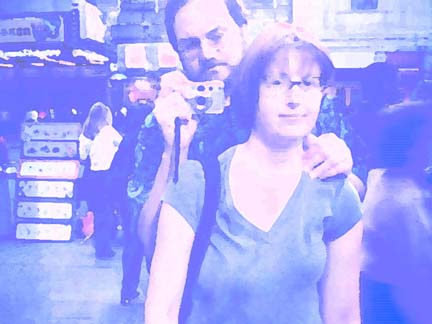
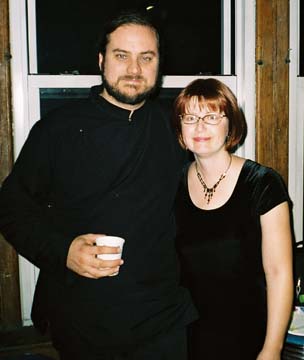
Laura and I took a couple of great trips together. Very early we took a trip to South of the Border, the east coast headquarters for all things tacky. We had a mutual appreciation of low culture, which was good, considering out budgets made low culture much more accessible than high culture.
But, we did take one killer trip to New York City when my novel Nobody Gets the Girl was released. Phobos Books footed the bill for some train tickets, Orbit actually found reasonably priced rooms in a decent location, and when we got there, expecting to be broke within a day from the legendary high cost of living, we discovered that in the non-tourist parts of the city, prices were pretty much the same as they were in NC. So, we spent four days stuffing outselves with the best food we'd ever eaten in Little Italy and China Town, then walking it off by treking from one side of the island to the other in search of museums and other tourist stuff.
The one regret about the trip was that I was using my digital camera, but when we got home I discovered that somehow all the files had become corrupted. Of the hundred or so photo's I'd snapped, only one was even moderately recognizable--a photo I'd snapped of the two of us in a mirrored building, with a busy street scene behind us. The camera had only saved blue and red pixels, no green, so the color was completely messed up, and it had also only saved every other line of the photo, so the original was full of thin blank lines. Fortunately, I'm pretty good with photoshop, so a few paint filters and a bit of color restoration produced a photo that had a soft, watercolor feel to it, hazy as a memory, but still interesting in the details that emerge as I study it. For instance, is it my imagination or does Laura have exactly the same smile as the Mona Lisa?
So, I only had one hazy, off color record of the trip--until fellow Phobos author and Odyssey grad Matt Rotundo came to the rescue recently with a second photo, this taken in Sandra Schulberg's apartment on Halloween, I think. I've spent the evening in a frustrating trip between three stores tonight in search of a function photo kiosk to print the photos, but have returned home, finally, with pictures in hand. I've never in my life assembled a photo album, but I'm going to put one together now. I wish I'd printed out all these photos while Laura was still around to look at them with me... but, then again, when she was around, I wasn't interested in looking at photos. I could look at her.
I've never been the sort of person to sit around dwelling in memory. Other people I know remember the names of their teachers from elementary school. I can't even remember teachers from High School. And I'm not talking about not remembering their names--I have no memory at all of who I might have encountered back then. The VCR of my mind can only record about ten years before it starts overwriting. I've never had memories I wanted so badly to hang onto before. Hopefully, the photo album will help me overcome forgetfulness circa 2016.
Tuesday, May 30, 2006
Only 100,000 to go....
I finally got some editorial feedback from Solaris. Luckily, my plan for expanding the novel and their plan meshed well. Since I'd already rewritten the first three chapters, and am working tonight on number four, it would have been rather heartbreaking if they'd said, "Well, we like it, but take out all the dragons." (There was no chance they were going to say this, realistically, but paranoia takes hold in my quieter moments.
They want a finished product of 120,000 words. I'll be close to 20,000 when I finish chapter four. Only 100,000 more to go....
Read some of Modern Magic tonight. Good stuff so far. I'm up to the Eugie Foster story. She's a fellow Phobos winner, so I have high hopes for it.
I feel really scatterbrained tonight. I've got too much on my plate. I need to:
1. Fill out the author/promotional questionaire Solaris sent me. This means, among other things, I probably need a new authors photo. My last professional photos were of me with long hair. Sigh. Laura paid for those for my birthday present. (The sigh is a wistful memory of Laura by the way... not a regret that I have to pay for my own photos this time.) I also need to start a search for a famous author who will plug Bitterwood. I'm thinking of asking Jack McDevitt, since he wrote me a kind letter about Final Flight of the Blue Bee.
2: Is it my imagination, or does my first item entail three things? Questionaire, photo, author quest. I'm skipping to four.
4: The con game. I only attended Trinoccon and Stellarcon last year. But, now that I have a novel to promote, I need to crank up the activity. Dragon*con is the big one--I need to get my application in immediately! Eugie will be there--she edits the "Daily Dragon" for the con. Maybe she and I can do a mutual "Modern Magic" reading. The sad thing about going to Dragon*con is that Laura went there with me a few years back and we had a really good time. We were indoctrinated into the church of the subgenius together. Hail Bob! I have the strangest sentimental memories....
5: and that last item was really two, if you count trying to arrange a reading.
6: Do the rewrite, idiot! Stop blogging!
7: Learn to write more coherent lists. I should go now.
--James
They want a finished product of 120,000 words. I'll be close to 20,000 when I finish chapter four. Only 100,000 more to go....
Read some of Modern Magic tonight. Good stuff so far. I'm up to the Eugie Foster story. She's a fellow Phobos winner, so I have high hopes for it.
I feel really scatterbrained tonight. I've got too much on my plate. I need to:
1. Fill out the author/promotional questionaire Solaris sent me. This means, among other things, I probably need a new authors photo. My last professional photos were of me with long hair. Sigh. Laura paid for those for my birthday present. (The sigh is a wistful memory of Laura by the way... not a regret that I have to pay for my own photos this time.) I also need to start a search for a famous author who will plug Bitterwood. I'm thinking of asking Jack McDevitt, since he wrote me a kind letter about Final Flight of the Blue Bee.
2: Is it my imagination, or does my first item entail three things? Questionaire, photo, author quest. I'm skipping to four.
4: The con game. I only attended Trinoccon and Stellarcon last year. But, now that I have a novel to promote, I need to crank up the activity. Dragon*con is the big one--I need to get my application in immediately! Eugie will be there--she edits the "Daily Dragon" for the con. Maybe she and I can do a mutual "Modern Magic" reading. The sad thing about going to Dragon*con is that Laura went there with me a few years back and we had a really good time. We were indoctrinated into the church of the subgenius together. Hail Bob! I have the strangest sentimental memories....
5: and that last item was really two, if you count trying to arrange a reading.
6: Do the rewrite, idiot! Stop blogging!
7: Learn to write more coherent lists. I should go now.
--James
Sunday, May 21, 2006
Politics again
It's been a while since I wrote about politics here. Laura and writing have commanded my attention for a month. It's been hard to work up righteous indignation about the news while the news in my own life has been what it's been.
Laura was someone who appreciated that tragedy and triumph tend to come at you all at once. The whole time she was in her steepest decline, or in the immediate aftermath of her death, I couldn't open my mailbox without getting some kind of good news. In the span of a month, I (1) got the contract for Bitterwood (edits of which are going great!), (2) sold my novella Greatshadow to an anthology I didn't technically submit it to, and for a dollar amount larger than what I was expecting, (3) resold my short story "Final Flight of the Blue Bee" to the Russian SF mag ESLI, without ever having submitted to them, either. They contacted me. As my fellow Codexian Eric James Stone observed, in America, you submit to the markets. In Russia, the markets submit to you. What a country! Also during this time, I've gotten fan mail about "Final Flight," always a thrill, and I've finally gotten my contributors copy of "Modern Magic," which is just gorgeous, easily the best looking book I've been in to date. (I hope to soon report on the stories. I have reason to suspect they kick ass.)
But, little by little, politics are seeping back into my awareness. The thing that currently has me annoyed is the proposal to make English the official language of America. The other night, before dinner with Greg, I was standing in front of the restaurant and a man and a woman were standing nearby and I overheard thier conversation. The woman was talking about how it was crazy that immigrants didn't want to learn English, and were forcing banks and doctor's offices to offer thier services bilingually. The guy agreed, and from his comments I got the impression that he was fine with rounding up anyone who couldn't speak English and shooting them. Now, ordinarily, I would get angry at this sort of bigotry, but I was too amused to really get indignant. They were having this conversation while waiting to get a table at a Mexican restaurant. So, let them be racist crackers while standing on the sidewalk--within the hour they would be shelling out their hard earned greenbacks to a restaurant that didn't have a single gringo on staff. And, I suspect the people who run the restaurant--all the way down to the waitstaff--would agree that voting for multiculturism with your money is better than voting for it with your mouth.
I would like to point out that no one has forced banks to provide services in Spanish. This is capitalism at work--immigrants have money. Not competing for their business would be crazy. And, while I'm on the subject of the free market, it seems to me that we shouldn't be afraid of having English and Spanish duke it out head to head in the free market of the culture. If Hollywood starts putting out movies in Spanish and we have to wait around for the English translation, I might feel a tiny bit inconvenienced. But, I don't see that day coming. The fact is, if you live in America, and only speak English, you just aren't going to having any trouble at all functioning. Your bank, your doctor, your grocery store might devote a sliver of their resources to serving Spanish speakers, but you are never going to walk into a bank in North Carolina and be unable to conduct a transaction because of a language barrier. Enshrining this in law speaks to me of a certain cultural insecurity on the part of Americans. A fear that our language isn't all that great, and can't stand up to competition.
Wow, a rant. It's been a while. Perhaps the healing has begun.
Laura was someone who appreciated that tragedy and triumph tend to come at you all at once. The whole time she was in her steepest decline, or in the immediate aftermath of her death, I couldn't open my mailbox without getting some kind of good news. In the span of a month, I (1) got the contract for Bitterwood (edits of which are going great!), (2) sold my novella Greatshadow to an anthology I didn't technically submit it to, and for a dollar amount larger than what I was expecting, (3) resold my short story "Final Flight of the Blue Bee" to the Russian SF mag ESLI, without ever having submitted to them, either. They contacted me. As my fellow Codexian Eric James Stone observed, in America, you submit to the markets. In Russia, the markets submit to you. What a country! Also during this time, I've gotten fan mail about "Final Flight," always a thrill, and I've finally gotten my contributors copy of "Modern Magic," which is just gorgeous, easily the best looking book I've been in to date. (I hope to soon report on the stories. I have reason to suspect they kick ass.)
But, little by little, politics are seeping back into my awareness. The thing that currently has me annoyed is the proposal to make English the official language of America. The other night, before dinner with Greg, I was standing in front of the restaurant and a man and a woman were standing nearby and I overheard thier conversation. The woman was talking about how it was crazy that immigrants didn't want to learn English, and were forcing banks and doctor's offices to offer thier services bilingually. The guy agreed, and from his comments I got the impression that he was fine with rounding up anyone who couldn't speak English and shooting them. Now, ordinarily, I would get angry at this sort of bigotry, but I was too amused to really get indignant. They were having this conversation while waiting to get a table at a Mexican restaurant. So, let them be racist crackers while standing on the sidewalk--within the hour they would be shelling out their hard earned greenbacks to a restaurant that didn't have a single gringo on staff. And, I suspect the people who run the restaurant--all the way down to the waitstaff--would agree that voting for multiculturism with your money is better than voting for it with your mouth.
I would like to point out that no one has forced banks to provide services in Spanish. This is capitalism at work--immigrants have money. Not competing for their business would be crazy. And, while I'm on the subject of the free market, it seems to me that we shouldn't be afraid of having English and Spanish duke it out head to head in the free market of the culture. If Hollywood starts putting out movies in Spanish and we have to wait around for the English translation, I might feel a tiny bit inconvenienced. But, I don't see that day coming. The fact is, if you live in America, and only speak English, you just aren't going to having any trouble at all functioning. Your bank, your doctor, your grocery store might devote a sliver of their resources to serving Spanish speakers, but you are never going to walk into a bank in North Carolina and be unable to conduct a transaction because of a language barrier. Enshrining this in law speaks to me of a certain cultural insecurity on the part of Americans. A fear that our language isn't all that great, and can't stand up to competition.
Wow, a rant. It's been a while. Perhaps the healing has begun.
Saturday, May 20, 2006
Sappy Memories
So, I was driving home last night, full of memories of Laura that left me feeling both sad and happy. I then started mentally combining the two words, and realized that the fusion of sad and happy produces sappy. So, I'm going to post some sappy memories. (And, yes, for the linguisticly picky, I know that sappy isn't literally defined as a mixture of sad and happy, and that the word I really should be using is bittersweet. But, if you want to write about bittersweet memories, get your own blog. I'm sticking with sappy.)
Several things triggered the memory. I had gone out to dinner with Greg in Greensboro, and on the way home I was thinking about how I would tell Laura about the restaurant. Because for the last four years, I've had this Laura box in my head where I would put certain bits of news that would be of interest to her... and now I don't know how to empty that box. For instance, at work this week, I've encountered the normal day to day frustrations, stuff I used to come home and vent about for ten minutes when Laura would ask, "How was your day," and I'd answer, "Well, let me tell you." I miss that. But, back to the restaurant: Laura was vegetarian, so anytime I'd go out to eat without her, I'd always check out the vegetarian selections to see if it might be someplace she could eat at. I got all excited last night at La Fiesta when I saw that they had a very large vegetarian menu--this was going to be someplace she would love! My enthusiasm, naturally, was followed by a strong sense of loss, not just of missing Laura, but for a missed opportunity. I loved making Laura happy, to seek and the little pleasures in life she might partake in. I felt like I'd screwed up by not finding this place sooner. It was my job, dammit, to increase her joy. I'd been slack in my duties.
Later, Greg and I drove past a Sonic restaurant. Another memory. Sometime in March, or maybe even the beginning of April, Laura had been feeling sick, but also felt bored, trapped in the house. She didn't have the stamina to get up and walk anywhere. A trip to Target would have been too much for her--she didn't even feel like going out to eat. But I proposed that we could go for a drive in the country, take a look at the flowers blooming. It turned out to be a very lovely afternoon. The Carolina countryside was very cooperative, with fields of purple and yellow blossoms over rolling hills as we drove around Saxapahaw. We passed over a terrific, rocky river. We stopped at a fruit stand--she stayed in the car but I went in and bought her a bottle of mineral water which she enjoyed. Then, on the meandering path home, we discovered a Sonic in Mebane, and Laura lit up. She wanted some of thier cheesy tater tots. Naturally, I got her some. It was the last thing I ever saw her really ravenous for, except maybe pickles.
Ah, yes, pickles. If there was a secret to Laura and me making it as a couple, it was our mutual appreciation of really good dills. Over the years, we've sampled every brand available for sale in North Carolina. Laura had a lot of appetite problems on the various chemos. But, until the end, she would never turn down a pickle. The cruel irony is, pickles have, like, five calories. You can starve to death if you make them the foundation of your diet. I should have known she was closer to the end than I did when, the last day I saw her awake in the hospital, I asked if she wanted me to smuggle her in a pickle, and she turned it down. Now I have a jar of pickles in the fridge and every time I eat one I think about her. So, I think about her a lot.
And, as long as we're on the food theme, I wonder when I will have the courage to go back to Tsing Tao. It was our favorite Chinese restaurant. And, any time I've gone in there alone, the lady who runs the place always asks me where my wife is. I've never corrected her. It always made me happy, that the little Chinese restaurant in the strip mall was a kind of alternate dimension, a separate reality where we were married, and we'd never even heard of cancer, and the hot and sour soup really was hot and sour.
Sappy, yes?
Several things triggered the memory. I had gone out to dinner with Greg in Greensboro, and on the way home I was thinking about how I would tell Laura about the restaurant. Because for the last four years, I've had this Laura box in my head where I would put certain bits of news that would be of interest to her... and now I don't know how to empty that box. For instance, at work this week, I've encountered the normal day to day frustrations, stuff I used to come home and vent about for ten minutes when Laura would ask, "How was your day," and I'd answer, "Well, let me tell you." I miss that. But, back to the restaurant: Laura was vegetarian, so anytime I'd go out to eat without her, I'd always check out the vegetarian selections to see if it might be someplace she could eat at. I got all excited last night at La Fiesta when I saw that they had a very large vegetarian menu--this was going to be someplace she would love! My enthusiasm, naturally, was followed by a strong sense of loss, not just of missing Laura, but for a missed opportunity. I loved making Laura happy, to seek and the little pleasures in life she might partake in. I felt like I'd screwed up by not finding this place sooner. It was my job, dammit, to increase her joy. I'd been slack in my duties.
Later, Greg and I drove past a Sonic restaurant. Another memory. Sometime in March, or maybe even the beginning of April, Laura had been feeling sick, but also felt bored, trapped in the house. She didn't have the stamina to get up and walk anywhere. A trip to Target would have been too much for her--she didn't even feel like going out to eat. But I proposed that we could go for a drive in the country, take a look at the flowers blooming. It turned out to be a very lovely afternoon. The Carolina countryside was very cooperative, with fields of purple and yellow blossoms over rolling hills as we drove around Saxapahaw. We passed over a terrific, rocky river. We stopped at a fruit stand--she stayed in the car but I went in and bought her a bottle of mineral water which she enjoyed. Then, on the meandering path home, we discovered a Sonic in Mebane, and Laura lit up. She wanted some of thier cheesy tater tots. Naturally, I got her some. It was the last thing I ever saw her really ravenous for, except maybe pickles.
Ah, yes, pickles. If there was a secret to Laura and me making it as a couple, it was our mutual appreciation of really good dills. Over the years, we've sampled every brand available for sale in North Carolina. Laura had a lot of appetite problems on the various chemos. But, until the end, she would never turn down a pickle. The cruel irony is, pickles have, like, five calories. You can starve to death if you make them the foundation of your diet. I should have known she was closer to the end than I did when, the last day I saw her awake in the hospital, I asked if she wanted me to smuggle her in a pickle, and she turned it down. Now I have a jar of pickles in the fridge and every time I eat one I think about her. So, I think about her a lot.
And, as long as we're on the food theme, I wonder when I will have the courage to go back to Tsing Tao. It was our favorite Chinese restaurant. And, any time I've gone in there alone, the lady who runs the place always asks me where my wife is. I've never corrected her. It always made me happy, that the little Chinese restaurant in the strip mall was a kind of alternate dimension, a separate reality where we were married, and we'd never even heard of cancer, and the hot and sour soup really was hot and sour.
Sappy, yes?
Thursday, May 18, 2006
W.H.Horner interview
The following interview was written for the Writers Group of the Triad Newsletter:
My short story, "Pentacle on His Forehead, Lizard on His Breath" saw print at the end of April in the anthology MODERN MAGIC: TALES OF FANTASY AND HORROR, published by Fantasist Enterprises, edited by W. H. Horner. The anthology is the best I've yet had a story appear in, with twenty-six terrific tales and thirty-five gorgeous illustrations by artist David Seidman. Fantasist Enterprises is a small press that is developing a reputation for high-quality books. One key to their success is their pay-rates, which are competitive with larger presses. But the real key to success lies in the hard work and dedication of publisher W. H. Horner.
I knew something special was going on when, wearing his editor hat, Horner did something very strange: He edited me. I've had stories appear in about a dozen magazine and anthologies, and usually the story has appeared in exactly the format I submitted it, with editorial feedback limited to correcting typos (if that). But Horner made several suggestions to improve the flow of the story. One exchange that impressed me was a series of emails where we discussed the sentence, "Sure, my stuff is illegal," versus, "Sure. My stuff is illegal." (Note: In case your browser is as unreliable as mine, in the first sentence "sure" is italicised, while "my" is italicised in the second.) I wanted the "sure" to be heard as sarcasm, but as I had written the sentence, it could easily have been read as an affirmation of the illegality of the speaker's product. Horner's attention to detail wasn't restricted to correcting grammar. He actively worked to help me sharpen the music of the story. It was a rewarding experience that earned my respect.
To find out more about W. H. Horner, I conducted an e-mail interview where I asked a few questions about Fantasist Enterprises:
JM: What inspired you to start Fantasist Enterprises?
WHH: I have always been in love with story. Especially stories that inspire awe and wonder. I wanted to create books that carry that spark of imagination. During my college years, I also discovered that I have a passion for helping other people say what it is they are truly attempting to say. I love helping my authors make a story the best it can be. FE is truly a labor of love.
JM: Professional short story markets are disappearing, at least in the genres of science fiction and fantasy. Markets like the now defunct Amazing Stories were gateways for new talent. Do you see the small press filling that gateway role?
WHH: I love small presses because they are more likely to take chances and stir things up. I see anthologies and the fiction magazines as excellent opportunities for writers to start up their careers by putting some short story sales under their belts, and to learn a bit about the publishing world. Not that it's a requirement in order to sell a novel to one of the big houses, but having those credits will make you look a bit more professional and dedicated.
Small presses can also give authors a chance to play with new concepts and characters. One established author in MODERN MAGIC was recently requested by her agent to take characters from her story and write a novel centering on them. It's very exciting to be able to say I was there in the beginning of something.
JM: One interesting aspect of the themed anthologies you've brought to press so far (2004's CLOAKED IN SHADOW: DARK TALES OF ELVES and the just released MODERN MAGIC: TALES OF FANTASY AND HORROR) is that they are heavily illustrated by a single artist. Which comes first for you? Does a particular artist's work inspire you to think of a theme, or do you think of the theme and then search out an appropriate artist? Am I correct in assuming that you have the artist signed on before you start signing authors?
WHH: It depends on the book. With CLOAKED, Star Sutezzo sent me a sample of her art, including the piece that eventually became the cover. It inspired me to see what people could do with the theme of evil elves. MODERN MAGIC came about because so many of the submissions to CLOAKED were set in modern times, and I wanted to see what other stories people could tell in our world with fantasy and horror elements. David Seidman had sent me his portfolio months before the idea struck, and I knew he would be perfect with his ability to create very real images of fantasy. It was a similar process with BASH DOWN THE DOOR AND SLICE OPEN THE BADGUY and BLOOD AND DEVOTION, with Chris Chua and Michael Dixon, respectively. So far, I've had an artist signed on before I made a final decision on the lineup of stories. In a way, it helps with the selection process, because as I read, I look for scenes that would make great illustrations in the artist's style.
JM: What inspired you to use interior artwork in the first place? In most books, the artwork is restricted to the cover. Also, you mention BLOOD AND DEVOTION and BASH DOWN THE DOOR AND SLICE OPEN THE BAD GUY. What's your normal time from conceiving an anthology to seeing it come to fruition?
WHH: In the history of books, it's a rather new phenomenon to not have illustrations to go along with the text. In the late 19th century, with the proliferation of books aimed at children, it slowly came to be thought that books with pictures were just for kids, but again, this is not historically accurate.
In the early nineties, I read THE GIANT BOOK OF FANTASY AND THE SUPERNATURAL, edited by Stephen Jones and David Sutton, which contained 39 stories and 24 illustrations. That book affected how I came to envision what I wanted to do with the books I publish. I'm also a fan of the speculative fiction magazines such as REALMS OF FANTASY and WEIRD TALES which combine art with words.
My decision to make art such an important part of FE books goes back to that sense of wonder I mentioned earlier. I want readers to turn the page and see a new illustration and say, "Wow." That will hopefully draw them right into the next story since they can't wait to find out what inspired the artist to create that particular work of art.
As for the time it takes to get an anthology out the door, it has taken much longer than I would like! Both CLOAKED and MODERN MAGIC took probably three years from when I came up with the idea to when it finally hit presses. As we get the infrastructure of the company running a bit more smoothly, I'm hoping to cut that time in half, which I know is asking a lot, but I have high hopes.
JM: You call your anthologies a labor of love. But have you also found a way to make money off these books?
WHH: I certainly have faith that a small, well run press can turn a profit with anthologies. I'm not expecting to get rich off this endeavor by any stretch of the imagination, but I do hope to be able to keep the company off the ground and eventually flying steadily.
JM: What kind of reading load does finding stories for an anthology entail? Are you able to read all the submissions yourself? Do you read each story all the way through, or do you know early on if a story isn't going to make the cut?
WHH: Depending on my work load, I try to personally read every story, though with some books I have brought on trusted friends and associates who I know are competent writers and editors to go through the stacks of manuscripts and pull out the top 75% for me to read. The call for submissions for MODERN MAGIC resulted in about 125 submissions, while the most recent, BLOOD & DEVOTION, resulted in about 150. The selection process for B&D was definitely the hardest I've yet to experience. There were so many good stories that I would love to publish, but there is just not enough room. And there were a number of wonderful stories that did not quite fit the theme tight enough to get in.
As to how many pages it takes to know if a story is "in" . . . well, it depends. I can usually tell in about a page and a half if the story is written well enough to warrant taking a serious look at, but I usually try to stick it out for about seven or eight pages to see if things get better. If a manuscript is written well, I usually hope to see confirmation that it will fit the theme within the first ten pages or so (this, of course, depends on length). With B&D, there were a good dozen stories that I read all the way through, since they were so good, and the theme requirements were almost there, in the hopes that something would happen to make it more of a thematic fit--and ended up being disappointed.
JM: What's the best way to support a small press? Would you prefer people purchase books directly on your website, via Amazon, or go into a bookstore and request a copy if it isn't in stock?
WHH: It's good to have a mix of all three of those options. When someone buys books direct from us, that means we and the authors make more from that sale. But most book purchases are impulse buys in stores . . . and if people don't buy a company or author's books in the stores, then stores will not stock them, obviously. Lastly, a book that does well on Amazon.com or B&N.com always gets more attention in other places as well, besides the promotion that those websites give their better-selling books.
To see illustrations from MODERN MAGIC, read story excerpts, or order your own copy, visit the links on the side of this page!
My short story, "Pentacle on His Forehead, Lizard on His Breath" saw print at the end of April in the anthology MODERN MAGIC: TALES OF FANTASY AND HORROR, published by Fantasist Enterprises, edited by W. H. Horner. The anthology is the best I've yet had a story appear in, with twenty-six terrific tales and thirty-five gorgeous illustrations by artist David Seidman. Fantasist Enterprises is a small press that is developing a reputation for high-quality books. One key to their success is their pay-rates, which are competitive with larger presses. But the real key to success lies in the hard work and dedication of publisher W. H. Horner.
I knew something special was going on when, wearing his editor hat, Horner did something very strange: He edited me. I've had stories appear in about a dozen magazine and anthologies, and usually the story has appeared in exactly the format I submitted it, with editorial feedback limited to correcting typos (if that). But Horner made several suggestions to improve the flow of the story. One exchange that impressed me was a series of emails where we discussed the sentence, "Sure, my stuff is illegal," versus, "Sure. My stuff is illegal." (Note: In case your browser is as unreliable as mine, in the first sentence "sure" is italicised, while "my" is italicised in the second.) I wanted the "sure" to be heard as sarcasm, but as I had written the sentence, it could easily have been read as an affirmation of the illegality of the speaker's product. Horner's attention to detail wasn't restricted to correcting grammar. He actively worked to help me sharpen the music of the story. It was a rewarding experience that earned my respect.
To find out more about W. H. Horner, I conducted an e-mail interview where I asked a few questions about Fantasist Enterprises:
JM: What inspired you to start Fantasist Enterprises?
WHH: I have always been in love with story. Especially stories that inspire awe and wonder. I wanted to create books that carry that spark of imagination. During my college years, I also discovered that I have a passion for helping other people say what it is they are truly attempting to say. I love helping my authors make a story the best it can be. FE is truly a labor of love.
JM: Professional short story markets are disappearing, at least in the genres of science fiction and fantasy. Markets like the now defunct Amazing Stories were gateways for new talent. Do you see the small press filling that gateway role?
WHH: I love small presses because they are more likely to take chances and stir things up. I see anthologies and the fiction magazines as excellent opportunities for writers to start up their careers by putting some short story sales under their belts, and to learn a bit about the publishing world. Not that it's a requirement in order to sell a novel to one of the big houses, but having those credits will make you look a bit more professional and dedicated.
Small presses can also give authors a chance to play with new concepts and characters. One established author in MODERN MAGIC was recently requested by her agent to take characters from her story and write a novel centering on them. It's very exciting to be able to say I was there in the beginning of something.
JM: One interesting aspect of the themed anthologies you've brought to press so far (2004's CLOAKED IN SHADOW: DARK TALES OF ELVES and the just released MODERN MAGIC: TALES OF FANTASY AND HORROR) is that they are heavily illustrated by a single artist. Which comes first for you? Does a particular artist's work inspire you to think of a theme, or do you think of the theme and then search out an appropriate artist? Am I correct in assuming that you have the artist signed on before you start signing authors?
WHH: It depends on the book. With CLOAKED, Star Sutezzo sent me a sample of her art, including the piece that eventually became the cover. It inspired me to see what people could do with the theme of evil elves. MODERN MAGIC came about because so many of the submissions to CLOAKED were set in modern times, and I wanted to see what other stories people could tell in our world with fantasy and horror elements. David Seidman had sent me his portfolio months before the idea struck, and I knew he would be perfect with his ability to create very real images of fantasy. It was a similar process with BASH DOWN THE DOOR AND SLICE OPEN THE BADGUY and BLOOD AND DEVOTION, with Chris Chua and Michael Dixon, respectively. So far, I've had an artist signed on before I made a final decision on the lineup of stories. In a way, it helps with the selection process, because as I read, I look for scenes that would make great illustrations in the artist's style.
JM: What inspired you to use interior artwork in the first place? In most books, the artwork is restricted to the cover. Also, you mention BLOOD AND DEVOTION and BASH DOWN THE DOOR AND SLICE OPEN THE BAD GUY. What's your normal time from conceiving an anthology to seeing it come to fruition?
WHH: In the history of books, it's a rather new phenomenon to not have illustrations to go along with the text. In the late 19th century, with the proliferation of books aimed at children, it slowly came to be thought that books with pictures were just for kids, but again, this is not historically accurate.
In the early nineties, I read THE GIANT BOOK OF FANTASY AND THE SUPERNATURAL, edited by Stephen Jones and David Sutton, which contained 39 stories and 24 illustrations. That book affected how I came to envision what I wanted to do with the books I publish. I'm also a fan of the speculative fiction magazines such as REALMS OF FANTASY and WEIRD TALES which combine art with words.
My decision to make art such an important part of FE books goes back to that sense of wonder I mentioned earlier. I want readers to turn the page and see a new illustration and say, "Wow." That will hopefully draw them right into the next story since they can't wait to find out what inspired the artist to create that particular work of art.
As for the time it takes to get an anthology out the door, it has taken much longer than I would like! Both CLOAKED and MODERN MAGIC took probably three years from when I came up with the idea to when it finally hit presses. As we get the infrastructure of the company running a bit more smoothly, I'm hoping to cut that time in half, which I know is asking a lot, but I have high hopes.
JM: You call your anthologies a labor of love. But have you also found a way to make money off these books?
WHH: I certainly have faith that a small, well run press can turn a profit with anthologies. I'm not expecting to get rich off this endeavor by any stretch of the imagination, but I do hope to be able to keep the company off the ground and eventually flying steadily.
JM: What kind of reading load does finding stories for an anthology entail? Are you able to read all the submissions yourself? Do you read each story all the way through, or do you know early on if a story isn't going to make the cut?
WHH: Depending on my work load, I try to personally read every story, though with some books I have brought on trusted friends and associates who I know are competent writers and editors to go through the stacks of manuscripts and pull out the top 75% for me to read. The call for submissions for MODERN MAGIC resulted in about 125 submissions, while the most recent, BLOOD & DEVOTION, resulted in about 150. The selection process for B&D was definitely the hardest I've yet to experience. There were so many good stories that I would love to publish, but there is just not enough room. And there were a number of wonderful stories that did not quite fit the theme tight enough to get in.
As to how many pages it takes to know if a story is "in" . . . well, it depends. I can usually tell in about a page and a half if the story is written well enough to warrant taking a serious look at, but I usually try to stick it out for about seven or eight pages to see if things get better. If a manuscript is written well, I usually hope to see confirmation that it will fit the theme within the first ten pages or so (this, of course, depends on length). With B&D, there were a good dozen stories that I read all the way through, since they were so good, and the theme requirements were almost there, in the hopes that something would happen to make it more of a thematic fit--and ended up being disappointed.
JM: What's the best way to support a small press? Would you prefer people purchase books directly on your website, via Amazon, or go into a bookstore and request a copy if it isn't in stock?
WHH: It's good to have a mix of all three of those options. When someone buys books direct from us, that means we and the authors make more from that sale. But most book purchases are impulse buys in stores . . . and if people don't buy a company or author's books in the stores, then stores will not stock them, obviously. Lastly, a book that does well on Amazon.com or B&N.com always gets more attention in other places as well, besides the promotion that those websites give their better-selling books.
To see illustrations from MODERN MAGIC, read story excerpts, or order your own copy, visit the links on the side of this page!
Saturday, May 13, 2006
Laura in her own words, followed by a few of mine
I've been going through emails Laura and I exchanged over the years. I found some moments where she spelled out her attitude toward life very directly, and thought I'd pass them on. These are excerpts from six or seven letters--don't try to read them all as one direct narrative.
Laura in her own words:
Some people have bad credit, some people have addiction, I have this health thing. It has been my greatest curse and my greatest blessing all rolled up into one. I got to see who my people are, and are not. Cancer has made me a very positive person.
--
As far as my spiritual beliefs go, I know there is a source whether you want to call it God or something else I believe its all the same thing. I was raised Catholic and understood pretty early on that what I believed didn't seem to fit in that box well. I've considered joining a church for the community aspect, and if I ever really got around to that it would most likely be Unitarian or similar. Above all I believe in ethics. You do the right thing because its the right thing to do, not because God is looking and taking notes. I believe the source is in all living things a part of the network of what is true and right in everything. I've never blamed or pointed fingers for what happened to me. I know that it was some part of me that needed the "pruning" in order to actually live. I had to get back to what was true and right in my life. Cancer forced that into the foreground for me. One never gets a situation that they can't handle in life, and I'm flattered I was handed such a bucket full.
--
The gift that grows out of misfortune is compassion and wisdom.
--
Sometimes I get very excited when I think of what will happen between now and this time next year. Great things can happen. Life is often like the fruit on the branch, it ripens and becomes sweeter.
--
We finally had rain last night. I know what you mean when you say that rain is lovely. It is lovely in every way.
--
Much like the Buddha laughing with tears running down his face, life is beautiful and tragic all at once.
--
As far as what kind of investment I am, we just have a little more information than the average person as to what could claim me in the end. I get what anyone gets, one lifetime. I consider the time I am with you as time well spent. The best medicine for me is to be able to live my life. I want at least 20 years. My 50th birthday will be a triumph, no "over the hill" black balloons for me. I anticipate feeling like a gold medallist on that day. Any other outcome to my life is too sad to contemplate. I suspect in the meantime I could be in need of a hand to hold from time to time, things can get scary and bravery is easier in numbers. If it comes to that I'll let you in on it.
--
James here again: I considered posting only part of that last paragraph. It is sad to contemplate, and sad that she didn't make it to fifty. But when she went, we were holding her hands. We also were holding her feet--there were five of us in the room, we all had a hand on her somewhere, I think. She was right, of course, that the numbers made it easier, at least for us, and, I hope, for her.
But, it was pretty easy to decide to leave it in, given that she especially knew that tragedy and beauty weren't mutually exclusive. They are, in fact, intertwined in ways not immediately obvious to many people.
It's been just over a week since she left us. Tonight is my first night alone in the house. All of her relatives have returned home, Simon and Veronica have gone to live with their emergency backup parents (divorce does have an oddly positive side effect, in this case), and even her cat, Yoshi, is gone away. I'm left with just memories and lots of clutter. Dying flowers from the funeral are all over the house. By all rights, this should be the saddest night of my life.
Instead, I'm trapped in this borderline psychotic mix between regret and excitement. I keep thinking of things I could have done differently with Laura. Should I have asked her to marry me earlier, instead of waiting so long into her illness? Could I have given her better advice on her treatment? There was a time early in her occurance when she ditched a cancer drug due to the side effects, even though the drug was still showing signs of working. I respected her decision--she was the one having to suffer the side-effects--but at the time I wanted to argue her choice, and encourage her to tough it out a few more months. Would she still be around if I'd given her that advice? Or would everything have just been pushed off a few months more? And the Wednesday when I left her in the hospital--if I'd stuck around through the night, could she have found any additional strength in my holding her hand to make it through to morning? And would it have changed anything in the long run?
Mixed in with all the regret and sorrow, though, is the realization that I'm entering a new chapter in life. It's a strangely giddy feeling. I honestly have no idea what can happen to me in the next year. But I face the year a little wiser, and perhaps, yes, a little more compassionate. I've lived for a long time with the dread of what would come next. And, bluntly, the worst that could happen has happened. Things get better from here.
And, even here, in a lonely house, there's all those flowers, still colorful, still fragrant, even as they fade.
Laura in her own words:
Some people have bad credit, some people have addiction, I have this health thing. It has been my greatest curse and my greatest blessing all rolled up into one. I got to see who my people are, and are not. Cancer has made me a very positive person.
--
As far as my spiritual beliefs go, I know there is a source whether you want to call it God or something else I believe its all the same thing. I was raised Catholic and understood pretty early on that what I believed didn't seem to fit in that box well. I've considered joining a church for the community aspect, and if I ever really got around to that it would most likely be Unitarian or similar. Above all I believe in ethics. You do the right thing because its the right thing to do, not because God is looking and taking notes. I believe the source is in all living things a part of the network of what is true and right in everything. I've never blamed or pointed fingers for what happened to me. I know that it was some part of me that needed the "pruning" in order to actually live. I had to get back to what was true and right in my life. Cancer forced that into the foreground for me. One never gets a situation that they can't handle in life, and I'm flattered I was handed such a bucket full.
--
The gift that grows out of misfortune is compassion and wisdom.
--
Sometimes I get very excited when I think of what will happen between now and this time next year. Great things can happen. Life is often like the fruit on the branch, it ripens and becomes sweeter.
--
We finally had rain last night. I know what you mean when you say that rain is lovely. It is lovely in every way.
--
Much like the Buddha laughing with tears running down his face, life is beautiful and tragic all at once.
--
As far as what kind of investment I am, we just have a little more information than the average person as to what could claim me in the end. I get what anyone gets, one lifetime. I consider the time I am with you as time well spent. The best medicine for me is to be able to live my life. I want at least 20 years. My 50th birthday will be a triumph, no "over the hill" black balloons for me. I anticipate feeling like a gold medallist on that day. Any other outcome to my life is too sad to contemplate. I suspect in the meantime I could be in need of a hand to hold from time to time, things can get scary and bravery is easier in numbers. If it comes to that I'll let you in on it.
--
James here again: I considered posting only part of that last paragraph. It is sad to contemplate, and sad that she didn't make it to fifty. But when she went, we were holding her hands. We also were holding her feet--there were five of us in the room, we all had a hand on her somewhere, I think. She was right, of course, that the numbers made it easier, at least for us, and, I hope, for her.
But, it was pretty easy to decide to leave it in, given that she especially knew that tragedy and beauty weren't mutually exclusive. They are, in fact, intertwined in ways not immediately obvious to many people.
It's been just over a week since she left us. Tonight is my first night alone in the house. All of her relatives have returned home, Simon and Veronica have gone to live with their emergency backup parents (divorce does have an oddly positive side effect, in this case), and even her cat, Yoshi, is gone away. I'm left with just memories and lots of clutter. Dying flowers from the funeral are all over the house. By all rights, this should be the saddest night of my life.
Instead, I'm trapped in this borderline psychotic mix between regret and excitement. I keep thinking of things I could have done differently with Laura. Should I have asked her to marry me earlier, instead of waiting so long into her illness? Could I have given her better advice on her treatment? There was a time early in her occurance when she ditched a cancer drug due to the side effects, even though the drug was still showing signs of working. I respected her decision--she was the one having to suffer the side-effects--but at the time I wanted to argue her choice, and encourage her to tough it out a few more months. Would she still be around if I'd given her that advice? Or would everything have just been pushed off a few months more? And the Wednesday when I left her in the hospital--if I'd stuck around through the night, could she have found any additional strength in my holding her hand to make it through to morning? And would it have changed anything in the long run?
Mixed in with all the regret and sorrow, though, is the realization that I'm entering a new chapter in life. It's a strangely giddy feeling. I honestly have no idea what can happen to me in the next year. But I face the year a little wiser, and perhaps, yes, a little more compassionate. I've lived for a long time with the dread of what would come next. And, bluntly, the worst that could happen has happened. Things get better from here.
And, even here, in a lonely house, there's all those flowers, still colorful, still fragrant, even as they fade.
Wednesday, May 10, 2006
Homily
This is the homily I wrote for Laura's funeral service today. It makes reference to Ecclesiastes 11:1 "Cast your bread upon the waters, for you will find it after many days." To me it sounds a little strange and detached, since I'm writing about myself in third person. But I felt it was important to make the homily as broad as possible, and talk about the impact she had had on so many lives. There were well over a hundred people at her funeral today--we had been told the church seated 140, and there were people standing around the back it was so packed. I didn't want to make it seem like I alone was claiming her memory by telling a personal story about her. But, I promise I will post some of those personal stories here in the coming days. For now, this is what people in church heard from Reverend Tammy Lee:
---
Whenever Laura went out in public, she always met someone that she knew. It didn't matter if she was at a restaurant, a park, a theater, or just walking through a grocery store--she would bump into people who wanted to stand and talk with her for ten minutes. And she would always give people those ten minutes, or more. It sometimes seemed like Laura knew details of everyone's life. When she'd see people, she'd remember the names and ages of their kids. She could talk about where they'd just gone on vacation, or how their parents were doing, or what their favorite flowers were. It was as if she knew every single person in the town of Chapel Hill, and they all knew her.
Laura had plenty of excuses not to spend time standing in a grocery store chatting. She was a busy single mom who over the years dealt with health problems that sometimes made even a small excursion exhausting. But she cast her bread upon the waters by giving everyone she met her time and her kindness. She was willing to offer her friends help in anyway--giving people rides when they needed them, offering what little financial support she could cobble together to people in tougher situations than her own, and, most importantly, in always being willing to listen to people no matter what their problems. Her sage advice and terrific sense of irony carried her friends through many a tough time. In later years, she saw the bread she had cast upon the water returned to her. Her kindness and charity were given back ten fold by her vast network of friends and loved ones.
Laura lived life with a sense of adventure and passion. Laura once wrote in a letter to James, her companion, "Sometimes I get very excited when I think of what will happen between now and this time next year. Great things can happen. Life is often like the fruit on the branch, it ripens and becomes sweeter." Her optimism inspired the people around her. Yet there was nothing unrealistic in her acceptance of her circumstances in life. Laura lived knowing that she might not live as long as the average person. She never allowed that to make her bitter. She accepted her problems as part of her life, and learned to draw wisdom from them. She believed that the battles she fought in life, even the losing ones, made her stronger. She said, "I get what anyone gets, one lifetime." She made the most of that life. Laura remained focused on what she could do, not on what she had lost or might lose. She found something beautiful in almost every day.
Laura loved her children. She was proud of Bevin's maturity and independence. She adored Simon's humor and insight. She cherished Veronica's creativity and energy. She loved her family, her parents: Bob and Anne, her brothers Mike and Matt and Andy, her sisters Sara and Alicia. She welcomed any and all additions to her already large family, forming a special bond with her sister in law Jessica and her sister in law in waiting Naoko. Her joys in life were many and simple--she possessed an almost inexhaustible knowledge of flowers. She loved Mediterranean food and wasabi and pickles. She wore out many a pencil filling in su-do-ku and crossword puzzles. There was almost no occasion in life where she couldn't find an appropriate quote from the Simpsons. She could find something to laugh about in even the darkest moments.
We all lose something in her passing. But we've all gained something from her life. We can take the seeds of her kindness and love and wisdom and carry them out in to the world and plant them in our own lives and the lives of others. The good she did in this world doesn't end simply because her life has ended. As long as we carry her in our memories, Laura will be with us.
---
Whenever Laura went out in public, she always met someone that she knew. It didn't matter if she was at a restaurant, a park, a theater, or just walking through a grocery store--she would bump into people who wanted to stand and talk with her for ten minutes. And she would always give people those ten minutes, or more. It sometimes seemed like Laura knew details of everyone's life. When she'd see people, she'd remember the names and ages of their kids. She could talk about where they'd just gone on vacation, or how their parents were doing, or what their favorite flowers were. It was as if she knew every single person in the town of Chapel Hill, and they all knew her.
Laura had plenty of excuses not to spend time standing in a grocery store chatting. She was a busy single mom who over the years dealt with health problems that sometimes made even a small excursion exhausting. But she cast her bread upon the waters by giving everyone she met her time and her kindness. She was willing to offer her friends help in anyway--giving people rides when they needed them, offering what little financial support she could cobble together to people in tougher situations than her own, and, most importantly, in always being willing to listen to people no matter what their problems. Her sage advice and terrific sense of irony carried her friends through many a tough time. In later years, she saw the bread she had cast upon the water returned to her. Her kindness and charity were given back ten fold by her vast network of friends and loved ones.
Laura lived life with a sense of adventure and passion. Laura once wrote in a letter to James, her companion, "Sometimes I get very excited when I think of what will happen between now and this time next year. Great things can happen. Life is often like the fruit on the branch, it ripens and becomes sweeter." Her optimism inspired the people around her. Yet there was nothing unrealistic in her acceptance of her circumstances in life. Laura lived knowing that she might not live as long as the average person. She never allowed that to make her bitter. She accepted her problems as part of her life, and learned to draw wisdom from them. She believed that the battles she fought in life, even the losing ones, made her stronger. She said, "I get what anyone gets, one lifetime." She made the most of that life. Laura remained focused on what she could do, not on what she had lost or might lose. She found something beautiful in almost every day.
Laura loved her children. She was proud of Bevin's maturity and independence. She adored Simon's humor and insight. She cherished Veronica's creativity and energy. She loved her family, her parents: Bob and Anne, her brothers Mike and Matt and Andy, her sisters Sara and Alicia. She welcomed any and all additions to her already large family, forming a special bond with her sister in law Jessica and her sister in law in waiting Naoko. Her joys in life were many and simple--she possessed an almost inexhaustible knowledge of flowers. She loved Mediterranean food and wasabi and pickles. She wore out many a pencil filling in su-do-ku and crossword puzzles. There was almost no occasion in life where she couldn't find an appropriate quote from the Simpsons. She could find something to laugh about in even the darkest moments.
We all lose something in her passing. But we've all gained something from her life. We can take the seeds of her kindness and love and wisdom and carry them out in to the world and plant them in our own lives and the lives of others. The good she did in this world doesn't end simply because her life has ended. As long as we carry her in our memories, Laura will be with us.
Tuesday, May 09, 2006
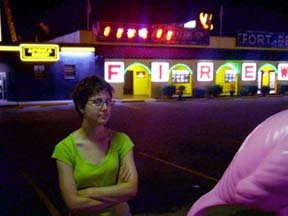

Saturday, May 06, 2006
Laura Kathleen Herrmann
She was dying when I met her. We met through online personal ads, and she wrote me saying that she liked the philosophy I had sprinkled through my post. I don't even recall what it said, really--something about finding humor and hope even in down times, I think. And she told me she'd been through some down times. She'd fought breast cancer, her husband had left her when she was diagnosed with the disease. This might send other people into a spiral of despair and self-pity that they could never pull out of. But, she hadn't surrendered to her worries and woes. She bested them, and went on to live a terrific life. She had gotten a butterfly tattoo--it was her symbol of transformation. The time of her cancer and her divorce were when she had been drawn into her cocoon. But she'd emerged with wings.
At the time I met her, she was cancer free--or, more accurately, her cancer treatment had pushed the disease back to a level below the threshold of detection. She was up front about this--she told me that she was living with the knowledge that her disease might return any day. After I'd been dating her about three months, she put a timeline on it. According to the doctor, she said, all but a handful of people who had been through breast cancer and had it spread to other parts of the body would survive more than five years, even if they were "cured."
We were in the stage of our relationship where we were hungry for each other, very fully in that early, giddy, passionate love that is so intoxicating. And she wanted me to have all the facts. She wanted me to understand, before I fell too much in love, that we would probably never have the kind of relationship where we would grow old and gray together. There wasn't much chance of us sitting on the rocking chair on the porch and watching our grandkids play. Her exact words to me were, "I'm not a very good investment."
I admit, at the time, it staggered me. She said she didn't really know if she would live to see her 40th birthday. It wasn't something I could really wrap my head around. At the time she told me this, she was very healthy--maybe the healthiest person I knew. She ate right, loved being outdoors, and possessed this thirst for life that just made it impossible to think that she might be in any danger from disease. Plus, every day in the papers, there was some new development in the fight against cancer. The genetics were being unraveled. New drugs were better, more targeted. Worrying about death from cancer five years out just wasn't a worry I was prepared to embrace. I really believed at the time that a real cure was only a year or two away. And so I told her I was in this for the long haul. Things would work out.
So, of course, the cancer returned a few months later. Lungs, liver, spine--tiny tumors only millimeters long, but described in the cat scan as "innumerable." The tumors were like shrapnel from the world's slowest hand grenade. Up until that point, we had been able to talk a bit about a future together. But, we hadn't been rushing things. She'd been through a divorce, I'd been through two--we weren't the sort of people who were going to run out and get married in Vegas. We both felt a long, slow courtship was best. If marriage was going to be talked about, it would be talked about after a few years, not a few months. But once the cancer returned, discussions of the future were shut down. We dealt mainly with the day to day, and with the immediately problems caused by her illness and treatment.
Last year, I asked her if she would like to get married. She'd gotten too sick to work full time. It seemed like there was a lot I would be able to help her with as a spouse that I was legally not able to as a boyfriend. She turned me down. She said she didn't want to take me down with her.
Even then, I didn't give up hope. The growth of her disease had been very gradual. The tiny little flea sided tumors would grow to rice sized tumors, then fade a bit, then return as fly sized tumors. A few years ago a few of the tumors in her lung went wild and grew much larger--her lungs began to fill with fluid, and she landed in the hospital with blood oxygen levels at in a range that might have killed another person. That was about 18 months ago--and she beat it back. She had a drain installed in her chest--and every night for weeks we would drain of the fluid. And slowly she got her breath back. She went from near death on New Years Eve to walking over a mile in downtown High Point with me in March as we looked for a Mexican restaurant "just down the street" that turned out to have shut down months before. The chemo she had gotten immediately after her surgury did a good job of holding back the disease. I started to think that anyone who could survive that dark time could beat anything.
She died Saturday morning, May 6, about 3:40. She was 39. I held her hand as she went.
In the days to come, I plan to write a lot about Laura. I didn't write much about her here over the last few years because I worried about her kids reading my blog and discovering my fears and anxieties. For that matter, I didn't want her to read about my fears and anxieties. I had a clearly defined job in Laura's life. She saw a lot of doctors over the years. I was her spin doctor. There was no bit of news she could get that was so bad that I couldn't find some positive or funny way of looking at it. When chemo made her skin peel and crack, I told her to imagine that same reaction going on inside, chewing up tumor. When she was in the hospital week before last with her liver swelling, she was next to a woman who was flat out yellow, like florescent highlighter had been rubbed over every part of her body. That woman was obviously dying, and in a lot of pain. This is a horrible thing to say, but I helped Laura find a grim comfort in it, because, in the presence of someone whose liver had failed, the fact that Laura's liver had swollen didn't seem so bad. Things were going wrong inside her, but obviously her liver was still working, and if she had to spend the rest of her life in maternity pants, well, there are worse fates.
So, for close to four years, I've spent pretty much every day thinking of reasons why Laura was going to beat the cancer, and giving her pep talks. And then I'd come downstairs (I rented her basement apartment) and stand in the shower and groan, on the verge of tears, because I knew, deep down, that I didn't believe it. Little by little, the cancer was winning. Every time a chemo drug exhausted itself, it left her just a little sicker and the tumors just a little tougher and more drug resistant. I knew it was only a matter of time. She knew, too. But the unspoken rule was that we were never going to talk about the possibility of her losing. She wanted to fight until the last possible second, and I had her back.
As she died over the last few days, I've second guessed a lot of my decisions. Because, if someone had given me a calendar, and said, "Yep, May 6. That's the day," then maybe I would have handled things differently. I praised her almost daily about what a fighter she was, and how awed I was of her strength. I told her I admired her courage. But, I wish there was a point where I had also said it's okay to give up. No one was going to judge her or think her weak for letting go. And maybe she could have used the last few days to say good-bye to people. But I don't know. I don't know if she could have made peace with the idea of dying, or if her desire to live was just too strong for her to ever willingly let go, no matter how bad things got. I wasn't there with her when they put her under Thursday morning to hook up the ventilator. I'm told her last words were, "Is there hope?"
The fact that I wasn't there to say yes is going to haunt me for a long time.
I talked to her a lot while she was under the morphine, probably beyond hearing me. I'll never know. A lot of what I said to her is going to remain between me and her. But there was one thing I told her. She was the best investment of time and energy and love I ever made. I don't believe in a soul, or an afterlife, but, I promise you, I believe in memory, and her memory has forever changed me, and changed dozens of others. Everyone who knew her is going to carry part of her for the rest of their lives. She will live on from this day in a slowly expanding wave of kindness and courage and hope that spreads from the people who knew her to the people they know.
She was dying when I met her. She knew it. And it made her truly, deeply aware that she loved her life. She lived with a passion and a grace that I've never before encountered.
Oh, sweet Jesus, I'm going to miss her.
At the time I met her, she was cancer free--or, more accurately, her cancer treatment had pushed the disease back to a level below the threshold of detection. She was up front about this--she told me that she was living with the knowledge that her disease might return any day. After I'd been dating her about three months, she put a timeline on it. According to the doctor, she said, all but a handful of people who had been through breast cancer and had it spread to other parts of the body would survive more than five years, even if they were "cured."
We were in the stage of our relationship where we were hungry for each other, very fully in that early, giddy, passionate love that is so intoxicating. And she wanted me to have all the facts. She wanted me to understand, before I fell too much in love, that we would probably never have the kind of relationship where we would grow old and gray together. There wasn't much chance of us sitting on the rocking chair on the porch and watching our grandkids play. Her exact words to me were, "I'm not a very good investment."
I admit, at the time, it staggered me. She said she didn't really know if she would live to see her 40th birthday. It wasn't something I could really wrap my head around. At the time she told me this, she was very healthy--maybe the healthiest person I knew. She ate right, loved being outdoors, and possessed this thirst for life that just made it impossible to think that she might be in any danger from disease. Plus, every day in the papers, there was some new development in the fight against cancer. The genetics were being unraveled. New drugs were better, more targeted. Worrying about death from cancer five years out just wasn't a worry I was prepared to embrace. I really believed at the time that a real cure was only a year or two away. And so I told her I was in this for the long haul. Things would work out.
So, of course, the cancer returned a few months later. Lungs, liver, spine--tiny tumors only millimeters long, but described in the cat scan as "innumerable." The tumors were like shrapnel from the world's slowest hand grenade. Up until that point, we had been able to talk a bit about a future together. But, we hadn't been rushing things. She'd been through a divorce, I'd been through two--we weren't the sort of people who were going to run out and get married in Vegas. We both felt a long, slow courtship was best. If marriage was going to be talked about, it would be talked about after a few years, not a few months. But once the cancer returned, discussions of the future were shut down. We dealt mainly with the day to day, and with the immediately problems caused by her illness and treatment.
Last year, I asked her if she would like to get married. She'd gotten too sick to work full time. It seemed like there was a lot I would be able to help her with as a spouse that I was legally not able to as a boyfriend. She turned me down. She said she didn't want to take me down with her.
Even then, I didn't give up hope. The growth of her disease had been very gradual. The tiny little flea sided tumors would grow to rice sized tumors, then fade a bit, then return as fly sized tumors. A few years ago a few of the tumors in her lung went wild and grew much larger--her lungs began to fill with fluid, and she landed in the hospital with blood oxygen levels at in a range that might have killed another person. That was about 18 months ago--and she beat it back. She had a drain installed in her chest--and every night for weeks we would drain of the fluid. And slowly she got her breath back. She went from near death on New Years Eve to walking over a mile in downtown High Point with me in March as we looked for a Mexican restaurant "just down the street" that turned out to have shut down months before. The chemo she had gotten immediately after her surgury did a good job of holding back the disease. I started to think that anyone who could survive that dark time could beat anything.
She died Saturday morning, May 6, about 3:40. She was 39. I held her hand as she went.
In the days to come, I plan to write a lot about Laura. I didn't write much about her here over the last few years because I worried about her kids reading my blog and discovering my fears and anxieties. For that matter, I didn't want her to read about my fears and anxieties. I had a clearly defined job in Laura's life. She saw a lot of doctors over the years. I was her spin doctor. There was no bit of news she could get that was so bad that I couldn't find some positive or funny way of looking at it. When chemo made her skin peel and crack, I told her to imagine that same reaction going on inside, chewing up tumor. When she was in the hospital week before last with her liver swelling, she was next to a woman who was flat out yellow, like florescent highlighter had been rubbed over every part of her body. That woman was obviously dying, and in a lot of pain. This is a horrible thing to say, but I helped Laura find a grim comfort in it, because, in the presence of someone whose liver had failed, the fact that Laura's liver had swollen didn't seem so bad. Things were going wrong inside her, but obviously her liver was still working, and if she had to spend the rest of her life in maternity pants, well, there are worse fates.
So, for close to four years, I've spent pretty much every day thinking of reasons why Laura was going to beat the cancer, and giving her pep talks. And then I'd come downstairs (I rented her basement apartment) and stand in the shower and groan, on the verge of tears, because I knew, deep down, that I didn't believe it. Little by little, the cancer was winning. Every time a chemo drug exhausted itself, it left her just a little sicker and the tumors just a little tougher and more drug resistant. I knew it was only a matter of time. She knew, too. But the unspoken rule was that we were never going to talk about the possibility of her losing. She wanted to fight until the last possible second, and I had her back.
As she died over the last few days, I've second guessed a lot of my decisions. Because, if someone had given me a calendar, and said, "Yep, May 6. That's the day," then maybe I would have handled things differently. I praised her almost daily about what a fighter she was, and how awed I was of her strength. I told her I admired her courage. But, I wish there was a point where I had also said it's okay to give up. No one was going to judge her or think her weak for letting go. And maybe she could have used the last few days to say good-bye to people. But I don't know. I don't know if she could have made peace with the idea of dying, or if her desire to live was just too strong for her to ever willingly let go, no matter how bad things got. I wasn't there with her when they put her under Thursday morning to hook up the ventilator. I'm told her last words were, "Is there hope?"
The fact that I wasn't there to say yes is going to haunt me for a long time.
I talked to her a lot while she was under the morphine, probably beyond hearing me. I'll never know. A lot of what I said to her is going to remain between me and her. But there was one thing I told her. She was the best investment of time and energy and love I ever made. I don't believe in a soul, or an afterlife, but, I promise you, I believe in memory, and her memory has forever changed me, and changed dozens of others. Everyone who knew her is going to carry part of her for the rest of their lives. She will live on from this day in a slowly expanding wave of kindness and courage and hope that spreads from the people who knew her to the people they know.
She was dying when I met her. She knew it. And it made her truly, deeply aware that she loved her life. She lived with a passion and a grace that I've never before encountered.
Oh, sweet Jesus, I'm going to miss her.
Subscribe to:
Posts (Atom)


 Posts
Posts


