

The following interview was written for the Writers Group of the Triad Newsletter:
My short story, "Pentacle on His Forehead, Lizard on His Breath" saw print at the end of April in the anthology MODERN MAGIC: TALES OF FANTASY AND HORROR, published by Fantasist Enterprises, edited by W. H. Horner. The anthology is the best I've yet had a story appear in, with twenty-six terrific tales and thirty-five gorgeous illustrations by artist David Seidman. Fantasist Enterprises is a small press that is developing a reputation for high-quality books. One key to their success is their pay-rates, which are competitive with larger presses. But the real key to success lies in the hard work and dedication of publisher W. H. Horner.
I knew something special was going on when, wearing his editor hat, Horner did something very strange: He edited me. I've had stories appear in about a dozen magazine and anthologies, and usually the story has appeared in exactly the format I submitted it, with editorial feedback limited to correcting typos (if that). But Horner made several suggestions to improve the flow of the story. One exchange that impressed me was a series of emails where we discussed the sentence, "Sure, my stuff is illegal," versus, "Sure. My stuff is illegal." (Note: In case your browser is as unreliable as mine, in the first sentence "sure" is italicised, while "my" is italicised in the second.) I wanted the "sure" to be heard as sarcasm, but as I had written the sentence, it could easily have been read as an affirmation of the illegality of the speaker's product. Horner's attention to detail wasn't restricted to correcting grammar. He actively worked to help me sharpen the music of the story. It was a rewarding experience that earned my respect.
To find out more about W. H. Horner, I conducted an e-mail interview where I asked a few questions about Fantasist Enterprises:
JM: What inspired you to start Fantasist Enterprises?
WHH: I have always been in love with story. Especially stories that inspire awe and wonder. I wanted to create books that carry that spark of imagination. During my college years, I also discovered that I have a passion for helping other people say what it is they are truly attempting to say. I love helping my authors make a story the best it can be. FE is truly a labor of love.
JM: Professional short story markets are disappearing, at least in the genres of science fiction and fantasy. Markets like the now defunct Amazing Stories were gateways for new talent. Do you see the small press filling that gateway role?
WHH: I love small presses because they are more likely to take chances and stir things up. I see anthologies and the fiction magazines as excellent opportunities for writers to start up their careers by putting some short story sales under their belts, and to learn a bit about the publishing world. Not that it's a requirement in order to sell a novel to one of the big houses, but having those credits will make you look a bit more professional and dedicated.
Small presses can also give authors a chance to play with new concepts and characters. One established author in MODERN MAGIC was recently requested by her agent to take characters from her story and write a novel centering on them. It's very exciting to be able to say I was there in the beginning of something.
JM: One interesting aspect of the themed anthologies you've brought to press so far (2004's CLOAKED IN SHADOW: DARK TALES OF ELVES and the just released MODERN MAGIC: TALES OF FANTASY AND HORROR) is that they are heavily illustrated by a single artist. Which comes first for you? Does a particular artist's work inspire you to think of a theme, or do you think of the theme and then search out an appropriate artist? Am I correct in assuming that you have the artist signed on before you start signing authors?
WHH: It depends on the book. With CLOAKED, Star Sutezzo sent me a sample of her art, including the piece that eventually became the cover. It inspired me to see what people could do with the theme of evil elves. MODERN MAGIC came about because so many of the submissions to CLOAKED were set in modern times, and I wanted to see what other stories people could tell in our world with fantasy and horror elements. David Seidman had sent me his portfolio months before the idea struck, and I knew he would be perfect with his ability to create very real images of fantasy. It was a similar process with BASH DOWN THE DOOR AND SLICE OPEN THE BADGUY and BLOOD AND DEVOTION, with Chris Chua and Michael Dixon, respectively. So far, I've had an artist signed on before I made a final decision on the lineup of stories. In a way, it helps with the selection process, because as I read, I look for scenes that would make great illustrations in the artist's style.
JM: What inspired you to use interior artwork in the first place? In most books, the artwork is restricted to the cover. Also, you mention BLOOD AND DEVOTION and BASH DOWN THE DOOR AND SLICE OPEN THE BAD GUY. What's your normal time from conceiving an anthology to seeing it come to fruition?
WHH: In the history of books, it's a rather new phenomenon to not have illustrations to go along with the text. In the late 19th century, with the proliferation of books aimed at children, it slowly came to be thought that books with pictures were just for kids, but again, this is not historically accurate.
In the early nineties, I read THE GIANT BOOK OF FANTASY AND THE SUPERNATURAL, edited by Stephen Jones and David Sutton, which contained 39 stories and 24 illustrations. That book affected how I came to envision what I wanted to do with the books I publish. I'm also a fan of the speculative fiction magazines such as REALMS OF FANTASY and WEIRD TALES which combine art with words.
My decision to make art such an important part of FE books goes back to that sense of wonder I mentioned earlier. I want readers to turn the page and see a new illustration and say, "Wow." That will hopefully draw them right into the next story since they can't wait to find out what inspired the artist to create that particular work of art.
As for the time it takes to get an anthology out the door, it has taken much longer than I would like! Both CLOAKED and MODERN MAGIC took probably three years from when I came up with the idea to when it finally hit presses. As we get the infrastructure of the company running a bit more smoothly, I'm hoping to cut that time in half, which I know is asking a lot, but I have high hopes.
JM: You call your anthologies a labor of love. But have you also found a way to make money off these books?
WHH: I certainly have faith that a small, well run press can turn a profit with anthologies. I'm not expecting to get rich off this endeavor by any stretch of the imagination, but I do hope to be able to keep the company off the ground and eventually flying steadily.
JM: What kind of reading load does finding stories for an anthology entail? Are you able to read all the submissions yourself? Do you read each story all the way through, or do you know early on if a story isn't going to make the cut?
WHH: Depending on my work load, I try to personally read every story, though with some books I have brought on trusted friends and associates who I know are competent writers and editors to go through the stacks of manuscripts and pull out the top 75% for me to read. The call for submissions for MODERN MAGIC resulted in about 125 submissions, while the most recent, BLOOD & DEVOTION, resulted in about 150. The selection process for B&D was definitely the hardest I've yet to experience. There were so many good stories that I would love to publish, but there is just not enough room. And there were a number of wonderful stories that did not quite fit the theme tight enough to get in.
As to how many pages it takes to know if a story is "in" . . . well, it depends. I can usually tell in about a page and a half if the story is written well enough to warrant taking a serious look at, but I usually try to stick it out for about seven or eight pages to see if things get better. If a manuscript is written well, I usually hope to see confirmation that it will fit the theme within the first ten pages or so (this, of course, depends on length). With B&D, there were a good dozen stories that I read all the way through, since they were so good, and the theme requirements were almost there, in the hopes that something would happen to make it more of a thematic fit--and ended up being disappointed.
JM: What's the best way to support a small press? Would you prefer people purchase books directly on your website, via Amazon, or go into a bookstore and request a copy if it isn't in stock?
WHH: It's good to have a mix of all three of those options. When someone buys books direct from us, that means we and the authors make more from that sale. But most book purchases are impulse buys in stores . . . and if people don't buy a company or author's books in the stores, then stores will not stock them, obviously. Lastly, a book that does well on Amazon.com or B&N.com always gets more attention in other places as well, besides the promotion that those websites give their better-selling books.
To see illustrations from MODERN MAGIC, read story excerpts, or order your own copy, visit the links on the side of this page!
Thursday, May 18, 2006


Saturday, May 13, 2006
Laura in her own words, followed by a few of mine
I've been going through emails Laura and I exchanged over the years. I found some moments where she spelled out her attitude toward life very directly, and thought I'd pass them on. These are excerpts from six or seven letters--don't try to read them all as one direct narrative.
Laura in her own words:
Some people have bad credit, some people have addiction, I have this health thing. It has been my greatest curse and my greatest blessing all rolled up into one. I got to see who my people are, and are not. Cancer has made me a very positive person.
--
As far as my spiritual beliefs go, I know there is a source whether you want to call it God or something else I believe its all the same thing. I was raised Catholic and understood pretty early on that what I believed didn't seem to fit in that box well. I've considered joining a church for the community aspect, and if I ever really got around to that it would most likely be Unitarian or similar. Above all I believe in ethics. You do the right thing because its the right thing to do, not because God is looking and taking notes. I believe the source is in all living things a part of the network of what is true and right in everything. I've never blamed or pointed fingers for what happened to me. I know that it was some part of me that needed the "pruning" in order to actually live. I had to get back to what was true and right in my life. Cancer forced that into the foreground for me. One never gets a situation that they can't handle in life, and I'm flattered I was handed such a bucket full.
--
The gift that grows out of misfortune is compassion and wisdom.
--
Sometimes I get very excited when I think of what will happen between now and this time next year. Great things can happen. Life is often like the fruit on the branch, it ripens and becomes sweeter.
--
We finally had rain last night. I know what you mean when you say that rain is lovely. It is lovely in every way.
--
Much like the Buddha laughing with tears running down his face, life is beautiful and tragic all at once.
--
As far as what kind of investment I am, we just have a little more information than the average person as to what could claim me in the end. I get what anyone gets, one lifetime. I consider the time I am with you as time well spent. The best medicine for me is to be able to live my life. I want at least 20 years. My 50th birthday will be a triumph, no "over the hill" black balloons for me. I anticipate feeling like a gold medallist on that day. Any other outcome to my life is too sad to contemplate. I suspect in the meantime I could be in need of a hand to hold from time to time, things can get scary and bravery is easier in numbers. If it comes to that I'll let you in on it.
--
James here again: I considered posting only part of that last paragraph. It is sad to contemplate, and sad that she didn't make it to fifty. But when she went, we were holding her hands. We also were holding her feet--there were five of us in the room, we all had a hand on her somewhere, I think. She was right, of course, that the numbers made it easier, at least for us, and, I hope, for her.
But, it was pretty easy to decide to leave it in, given that she especially knew that tragedy and beauty weren't mutually exclusive. They are, in fact, intertwined in ways not immediately obvious to many people.
It's been just over a week since she left us. Tonight is my first night alone in the house. All of her relatives have returned home, Simon and Veronica have gone to live with their emergency backup parents (divorce does have an oddly positive side effect, in this case), and even her cat, Yoshi, is gone away. I'm left with just memories and lots of clutter. Dying flowers from the funeral are all over the house. By all rights, this should be the saddest night of my life.
Instead, I'm trapped in this borderline psychotic mix between regret and excitement. I keep thinking of things I could have done differently with Laura. Should I have asked her to marry me earlier, instead of waiting so long into her illness? Could I have given her better advice on her treatment? There was a time early in her occurance when she ditched a cancer drug due to the side effects, even though the drug was still showing signs of working. I respected her decision--she was the one having to suffer the side-effects--but at the time I wanted to argue her choice, and encourage her to tough it out a few more months. Would she still be around if I'd given her that advice? Or would everything have just been pushed off a few months more? And the Wednesday when I left her in the hospital--if I'd stuck around through the night, could she have found any additional strength in my holding her hand to make it through to morning? And would it have changed anything in the long run?
Mixed in with all the regret and sorrow, though, is the realization that I'm entering a new chapter in life. It's a strangely giddy feeling. I honestly have no idea what can happen to me in the next year. But I face the year a little wiser, and perhaps, yes, a little more compassionate. I've lived for a long time with the dread of what would come next. And, bluntly, the worst that could happen has happened. Things get better from here.
And, even here, in a lonely house, there's all those flowers, still colorful, still fragrant, even as they fade.
Laura in her own words:
Some people have bad credit, some people have addiction, I have this health thing. It has been my greatest curse and my greatest blessing all rolled up into one. I got to see who my people are, and are not. Cancer has made me a very positive person.
--
As far as my spiritual beliefs go, I know there is a source whether you want to call it God or something else I believe its all the same thing. I was raised Catholic and understood pretty early on that what I believed didn't seem to fit in that box well. I've considered joining a church for the community aspect, and if I ever really got around to that it would most likely be Unitarian or similar. Above all I believe in ethics. You do the right thing because its the right thing to do, not because God is looking and taking notes. I believe the source is in all living things a part of the network of what is true and right in everything. I've never blamed or pointed fingers for what happened to me. I know that it was some part of me that needed the "pruning" in order to actually live. I had to get back to what was true and right in my life. Cancer forced that into the foreground for me. One never gets a situation that they can't handle in life, and I'm flattered I was handed such a bucket full.
--
The gift that grows out of misfortune is compassion and wisdom.
--
Sometimes I get very excited when I think of what will happen between now and this time next year. Great things can happen. Life is often like the fruit on the branch, it ripens and becomes sweeter.
--
We finally had rain last night. I know what you mean when you say that rain is lovely. It is lovely in every way.
--
Much like the Buddha laughing with tears running down his face, life is beautiful and tragic all at once.
--
As far as what kind of investment I am, we just have a little more information than the average person as to what could claim me in the end. I get what anyone gets, one lifetime. I consider the time I am with you as time well spent. The best medicine for me is to be able to live my life. I want at least 20 years. My 50th birthday will be a triumph, no "over the hill" black balloons for me. I anticipate feeling like a gold medallist on that day. Any other outcome to my life is too sad to contemplate. I suspect in the meantime I could be in need of a hand to hold from time to time, things can get scary and bravery is easier in numbers. If it comes to that I'll let you in on it.
--
James here again: I considered posting only part of that last paragraph. It is sad to contemplate, and sad that she didn't make it to fifty. But when she went, we were holding her hands. We also were holding her feet--there were five of us in the room, we all had a hand on her somewhere, I think. She was right, of course, that the numbers made it easier, at least for us, and, I hope, for her.
But, it was pretty easy to decide to leave it in, given that she especially knew that tragedy and beauty weren't mutually exclusive. They are, in fact, intertwined in ways not immediately obvious to many people.
It's been just over a week since she left us. Tonight is my first night alone in the house. All of her relatives have returned home, Simon and Veronica have gone to live with their emergency backup parents (divorce does have an oddly positive side effect, in this case), and even her cat, Yoshi, is gone away. I'm left with just memories and lots of clutter. Dying flowers from the funeral are all over the house. By all rights, this should be the saddest night of my life.
Instead, I'm trapped in this borderline psychotic mix between regret and excitement. I keep thinking of things I could have done differently with Laura. Should I have asked her to marry me earlier, instead of waiting so long into her illness? Could I have given her better advice on her treatment? There was a time early in her occurance when she ditched a cancer drug due to the side effects, even though the drug was still showing signs of working. I respected her decision--she was the one having to suffer the side-effects--but at the time I wanted to argue her choice, and encourage her to tough it out a few more months. Would she still be around if I'd given her that advice? Or would everything have just been pushed off a few months more? And the Wednesday when I left her in the hospital--if I'd stuck around through the night, could she have found any additional strength in my holding her hand to make it through to morning? And would it have changed anything in the long run?
Mixed in with all the regret and sorrow, though, is the realization that I'm entering a new chapter in life. It's a strangely giddy feeling. I honestly have no idea what can happen to me in the next year. But I face the year a little wiser, and perhaps, yes, a little more compassionate. I've lived for a long time with the dread of what would come next. And, bluntly, the worst that could happen has happened. Things get better from here.
And, even here, in a lonely house, there's all those flowers, still colorful, still fragrant, even as they fade.
Wednesday, May 10, 2006
Homily
This is the homily I wrote for Laura's funeral service today. It makes reference to Ecclesiastes 11:1 "Cast your bread upon the waters, for you will find it after many days." To me it sounds a little strange and detached, since I'm writing about myself in third person. But I felt it was important to make the homily as broad as possible, and talk about the impact she had had on so many lives. There were well over a hundred people at her funeral today--we had been told the church seated 140, and there were people standing around the back it was so packed. I didn't want to make it seem like I alone was claiming her memory by telling a personal story about her. But, I promise I will post some of those personal stories here in the coming days. For now, this is what people in church heard from Reverend Tammy Lee:
---
Whenever Laura went out in public, she always met someone that she knew. It didn't matter if she was at a restaurant, a park, a theater, or just walking through a grocery store--she would bump into people who wanted to stand and talk with her for ten minutes. And she would always give people those ten minutes, or more. It sometimes seemed like Laura knew details of everyone's life. When she'd see people, she'd remember the names and ages of their kids. She could talk about where they'd just gone on vacation, or how their parents were doing, or what their favorite flowers were. It was as if she knew every single person in the town of Chapel Hill, and they all knew her.
Laura had plenty of excuses not to spend time standing in a grocery store chatting. She was a busy single mom who over the years dealt with health problems that sometimes made even a small excursion exhausting. But she cast her bread upon the waters by giving everyone she met her time and her kindness. She was willing to offer her friends help in anyway--giving people rides when they needed them, offering what little financial support she could cobble together to people in tougher situations than her own, and, most importantly, in always being willing to listen to people no matter what their problems. Her sage advice and terrific sense of irony carried her friends through many a tough time. In later years, she saw the bread she had cast upon the water returned to her. Her kindness and charity were given back ten fold by her vast network of friends and loved ones.
Laura lived life with a sense of adventure and passion. Laura once wrote in a letter to James, her companion, "Sometimes I get very excited when I think of what will happen between now and this time next year. Great things can happen. Life is often like the fruit on the branch, it ripens and becomes sweeter." Her optimism inspired the people around her. Yet there was nothing unrealistic in her acceptance of her circumstances in life. Laura lived knowing that she might not live as long as the average person. She never allowed that to make her bitter. She accepted her problems as part of her life, and learned to draw wisdom from them. She believed that the battles she fought in life, even the losing ones, made her stronger. She said, "I get what anyone gets, one lifetime." She made the most of that life. Laura remained focused on what she could do, not on what she had lost or might lose. She found something beautiful in almost every day.
Laura loved her children. She was proud of Bevin's maturity and independence. She adored Simon's humor and insight. She cherished Veronica's creativity and energy. She loved her family, her parents: Bob and Anne, her brothers Mike and Matt and Andy, her sisters Sara and Alicia. She welcomed any and all additions to her already large family, forming a special bond with her sister in law Jessica and her sister in law in waiting Naoko. Her joys in life were many and simple--she possessed an almost inexhaustible knowledge of flowers. She loved Mediterranean food and wasabi and pickles. She wore out many a pencil filling in su-do-ku and crossword puzzles. There was almost no occasion in life where she couldn't find an appropriate quote from the Simpsons. She could find something to laugh about in even the darkest moments.
We all lose something in her passing. But we've all gained something from her life. We can take the seeds of her kindness and love and wisdom and carry them out in to the world and plant them in our own lives and the lives of others. The good she did in this world doesn't end simply because her life has ended. As long as we carry her in our memories, Laura will be with us.
---
Whenever Laura went out in public, she always met someone that she knew. It didn't matter if she was at a restaurant, a park, a theater, or just walking through a grocery store--she would bump into people who wanted to stand and talk with her for ten minutes. And she would always give people those ten minutes, or more. It sometimes seemed like Laura knew details of everyone's life. When she'd see people, she'd remember the names and ages of their kids. She could talk about where they'd just gone on vacation, or how their parents were doing, or what their favorite flowers were. It was as if she knew every single person in the town of Chapel Hill, and they all knew her.
Laura had plenty of excuses not to spend time standing in a grocery store chatting. She was a busy single mom who over the years dealt with health problems that sometimes made even a small excursion exhausting. But she cast her bread upon the waters by giving everyone she met her time and her kindness. She was willing to offer her friends help in anyway--giving people rides when they needed them, offering what little financial support she could cobble together to people in tougher situations than her own, and, most importantly, in always being willing to listen to people no matter what their problems. Her sage advice and terrific sense of irony carried her friends through many a tough time. In later years, she saw the bread she had cast upon the water returned to her. Her kindness and charity were given back ten fold by her vast network of friends and loved ones.
Laura lived life with a sense of adventure and passion. Laura once wrote in a letter to James, her companion, "Sometimes I get very excited when I think of what will happen between now and this time next year. Great things can happen. Life is often like the fruit on the branch, it ripens and becomes sweeter." Her optimism inspired the people around her. Yet there was nothing unrealistic in her acceptance of her circumstances in life. Laura lived knowing that she might not live as long as the average person. She never allowed that to make her bitter. She accepted her problems as part of her life, and learned to draw wisdom from them. She believed that the battles she fought in life, even the losing ones, made her stronger. She said, "I get what anyone gets, one lifetime." She made the most of that life. Laura remained focused on what she could do, not on what she had lost or might lose. She found something beautiful in almost every day.
Laura loved her children. She was proud of Bevin's maturity and independence. She adored Simon's humor and insight. She cherished Veronica's creativity and energy. She loved her family, her parents: Bob and Anne, her brothers Mike and Matt and Andy, her sisters Sara and Alicia. She welcomed any and all additions to her already large family, forming a special bond with her sister in law Jessica and her sister in law in waiting Naoko. Her joys in life were many and simple--she possessed an almost inexhaustible knowledge of flowers. She loved Mediterranean food and wasabi and pickles. She wore out many a pencil filling in su-do-ku and crossword puzzles. There was almost no occasion in life where she couldn't find an appropriate quote from the Simpsons. She could find something to laugh about in even the darkest moments.
We all lose something in her passing. But we've all gained something from her life. We can take the seeds of her kindness and love and wisdom and carry them out in to the world and plant them in our own lives and the lives of others. The good she did in this world doesn't end simply because her life has ended. As long as we carry her in our memories, Laura will be with us.
Tuesday, May 09, 2006

Saturday, May 06, 2006
Laura Kathleen Herrmann
She was dying when I met her. We met through online personal ads, and she wrote me saying that she liked the philosophy I had sprinkled through my post. I don't even recall what it said, really--something about finding humor and hope even in down times, I think. And she told me she'd been through some down times. She'd fought breast cancer, her husband had left her when she was diagnosed with the disease. This might send other people into a spiral of despair and self-pity that they could never pull out of. But, she hadn't surrendered to her worries and woes. She bested them, and went on to live a terrific life. She had gotten a butterfly tattoo--it was her symbol of transformation. The time of her cancer and her divorce were when she had been drawn into her cocoon. But she'd emerged with wings.
At the time I met her, she was cancer free--or, more accurately, her cancer treatment had pushed the disease back to a level below the threshold of detection. She was up front about this--she told me that she was living with the knowledge that her disease might return any day. After I'd been dating her about three months, she put a timeline on it. According to the doctor, she said, all but a handful of people who had been through breast cancer and had it spread to other parts of the body would survive more than five years, even if they were "cured."
We were in the stage of our relationship where we were hungry for each other, very fully in that early, giddy, passionate love that is so intoxicating. And she wanted me to have all the facts. She wanted me to understand, before I fell too much in love, that we would probably never have the kind of relationship where we would grow old and gray together. There wasn't much chance of us sitting on the rocking chair on the porch and watching our grandkids play. Her exact words to me were, "I'm not a very good investment."
I admit, at the time, it staggered me. She said she didn't really know if she would live to see her 40th birthday. It wasn't something I could really wrap my head around. At the time she told me this, she was very healthy--maybe the healthiest person I knew. She ate right, loved being outdoors, and possessed this thirst for life that just made it impossible to think that she might be in any danger from disease. Plus, every day in the papers, there was some new development in the fight against cancer. The genetics were being unraveled. New drugs were better, more targeted. Worrying about death from cancer five years out just wasn't a worry I was prepared to embrace. I really believed at the time that a real cure was only a year or two away. And so I told her I was in this for the long haul. Things would work out.
So, of course, the cancer returned a few months later. Lungs, liver, spine--tiny tumors only millimeters long, but described in the cat scan as "innumerable." The tumors were like shrapnel from the world's slowest hand grenade. Up until that point, we had been able to talk a bit about a future together. But, we hadn't been rushing things. She'd been through a divorce, I'd been through two--we weren't the sort of people who were going to run out and get married in Vegas. We both felt a long, slow courtship was best. If marriage was going to be talked about, it would be talked about after a few years, not a few months. But once the cancer returned, discussions of the future were shut down. We dealt mainly with the day to day, and with the immediately problems caused by her illness and treatment.
Last year, I asked her if she would like to get married. She'd gotten too sick to work full time. It seemed like there was a lot I would be able to help her with as a spouse that I was legally not able to as a boyfriend. She turned me down. She said she didn't want to take me down with her.
Even then, I didn't give up hope. The growth of her disease had been very gradual. The tiny little flea sided tumors would grow to rice sized tumors, then fade a bit, then return as fly sized tumors. A few years ago a few of the tumors in her lung went wild and grew much larger--her lungs began to fill with fluid, and she landed in the hospital with blood oxygen levels at in a range that might have killed another person. That was about 18 months ago--and she beat it back. She had a drain installed in her chest--and every night for weeks we would drain of the fluid. And slowly she got her breath back. She went from near death on New Years Eve to walking over a mile in downtown High Point with me in March as we looked for a Mexican restaurant "just down the street" that turned out to have shut down months before. The chemo she had gotten immediately after her surgury did a good job of holding back the disease. I started to think that anyone who could survive that dark time could beat anything.
She died Saturday morning, May 6, about 3:40. She was 39. I held her hand as she went.
In the days to come, I plan to write a lot about Laura. I didn't write much about her here over the last few years because I worried about her kids reading my blog and discovering my fears and anxieties. For that matter, I didn't want her to read about my fears and anxieties. I had a clearly defined job in Laura's life. She saw a lot of doctors over the years. I was her spin doctor. There was no bit of news she could get that was so bad that I couldn't find some positive or funny way of looking at it. When chemo made her skin peel and crack, I told her to imagine that same reaction going on inside, chewing up tumor. When she was in the hospital week before last with her liver swelling, she was next to a woman who was flat out yellow, like florescent highlighter had been rubbed over every part of her body. That woman was obviously dying, and in a lot of pain. This is a horrible thing to say, but I helped Laura find a grim comfort in it, because, in the presence of someone whose liver had failed, the fact that Laura's liver had swollen didn't seem so bad. Things were going wrong inside her, but obviously her liver was still working, and if she had to spend the rest of her life in maternity pants, well, there are worse fates.
So, for close to four years, I've spent pretty much every day thinking of reasons why Laura was going to beat the cancer, and giving her pep talks. And then I'd come downstairs (I rented her basement apartment) and stand in the shower and groan, on the verge of tears, because I knew, deep down, that I didn't believe it. Little by little, the cancer was winning. Every time a chemo drug exhausted itself, it left her just a little sicker and the tumors just a little tougher and more drug resistant. I knew it was only a matter of time. She knew, too. But the unspoken rule was that we were never going to talk about the possibility of her losing. She wanted to fight until the last possible second, and I had her back.
As she died over the last few days, I've second guessed a lot of my decisions. Because, if someone had given me a calendar, and said, "Yep, May 6. That's the day," then maybe I would have handled things differently. I praised her almost daily about what a fighter she was, and how awed I was of her strength. I told her I admired her courage. But, I wish there was a point where I had also said it's okay to give up. No one was going to judge her or think her weak for letting go. And maybe she could have used the last few days to say good-bye to people. But I don't know. I don't know if she could have made peace with the idea of dying, or if her desire to live was just too strong for her to ever willingly let go, no matter how bad things got. I wasn't there with her when they put her under Thursday morning to hook up the ventilator. I'm told her last words were, "Is there hope?"
The fact that I wasn't there to say yes is going to haunt me for a long time.
I talked to her a lot while she was under the morphine, probably beyond hearing me. I'll never know. A lot of what I said to her is going to remain between me and her. But there was one thing I told her. She was the best investment of time and energy and love I ever made. I don't believe in a soul, or an afterlife, but, I promise you, I believe in memory, and her memory has forever changed me, and changed dozens of others. Everyone who knew her is going to carry part of her for the rest of their lives. She will live on from this day in a slowly expanding wave of kindness and courage and hope that spreads from the people who knew her to the people they know.
She was dying when I met her. She knew it. And it made her truly, deeply aware that she loved her life. She lived with a passion and a grace that I've never before encountered.
Oh, sweet Jesus, I'm going to miss her.
At the time I met her, she was cancer free--or, more accurately, her cancer treatment had pushed the disease back to a level below the threshold of detection. She was up front about this--she told me that she was living with the knowledge that her disease might return any day. After I'd been dating her about three months, she put a timeline on it. According to the doctor, she said, all but a handful of people who had been through breast cancer and had it spread to other parts of the body would survive more than five years, even if they were "cured."
We were in the stage of our relationship where we were hungry for each other, very fully in that early, giddy, passionate love that is so intoxicating. And she wanted me to have all the facts. She wanted me to understand, before I fell too much in love, that we would probably never have the kind of relationship where we would grow old and gray together. There wasn't much chance of us sitting on the rocking chair on the porch and watching our grandkids play. Her exact words to me were, "I'm not a very good investment."
I admit, at the time, it staggered me. She said she didn't really know if she would live to see her 40th birthday. It wasn't something I could really wrap my head around. At the time she told me this, she was very healthy--maybe the healthiest person I knew. She ate right, loved being outdoors, and possessed this thirst for life that just made it impossible to think that she might be in any danger from disease. Plus, every day in the papers, there was some new development in the fight against cancer. The genetics were being unraveled. New drugs were better, more targeted. Worrying about death from cancer five years out just wasn't a worry I was prepared to embrace. I really believed at the time that a real cure was only a year or two away. And so I told her I was in this for the long haul. Things would work out.
So, of course, the cancer returned a few months later. Lungs, liver, spine--tiny tumors only millimeters long, but described in the cat scan as "innumerable." The tumors were like shrapnel from the world's slowest hand grenade. Up until that point, we had been able to talk a bit about a future together. But, we hadn't been rushing things. She'd been through a divorce, I'd been through two--we weren't the sort of people who were going to run out and get married in Vegas. We both felt a long, slow courtship was best. If marriage was going to be talked about, it would be talked about after a few years, not a few months. But once the cancer returned, discussions of the future were shut down. We dealt mainly with the day to day, and with the immediately problems caused by her illness and treatment.
Last year, I asked her if she would like to get married. She'd gotten too sick to work full time. It seemed like there was a lot I would be able to help her with as a spouse that I was legally not able to as a boyfriend. She turned me down. She said she didn't want to take me down with her.
Even then, I didn't give up hope. The growth of her disease had been very gradual. The tiny little flea sided tumors would grow to rice sized tumors, then fade a bit, then return as fly sized tumors. A few years ago a few of the tumors in her lung went wild and grew much larger--her lungs began to fill with fluid, and she landed in the hospital with blood oxygen levels at in a range that might have killed another person. That was about 18 months ago--and she beat it back. She had a drain installed in her chest--and every night for weeks we would drain of the fluid. And slowly she got her breath back. She went from near death on New Years Eve to walking over a mile in downtown High Point with me in March as we looked for a Mexican restaurant "just down the street" that turned out to have shut down months before. The chemo she had gotten immediately after her surgury did a good job of holding back the disease. I started to think that anyone who could survive that dark time could beat anything.
She died Saturday morning, May 6, about 3:40. She was 39. I held her hand as she went.
In the days to come, I plan to write a lot about Laura. I didn't write much about her here over the last few years because I worried about her kids reading my blog and discovering my fears and anxieties. For that matter, I didn't want her to read about my fears and anxieties. I had a clearly defined job in Laura's life. She saw a lot of doctors over the years. I was her spin doctor. There was no bit of news she could get that was so bad that I couldn't find some positive or funny way of looking at it. When chemo made her skin peel and crack, I told her to imagine that same reaction going on inside, chewing up tumor. When she was in the hospital week before last with her liver swelling, she was next to a woman who was flat out yellow, like florescent highlighter had been rubbed over every part of her body. That woman was obviously dying, and in a lot of pain. This is a horrible thing to say, but I helped Laura find a grim comfort in it, because, in the presence of someone whose liver had failed, the fact that Laura's liver had swollen didn't seem so bad. Things were going wrong inside her, but obviously her liver was still working, and if she had to spend the rest of her life in maternity pants, well, there are worse fates.
So, for close to four years, I've spent pretty much every day thinking of reasons why Laura was going to beat the cancer, and giving her pep talks. And then I'd come downstairs (I rented her basement apartment) and stand in the shower and groan, on the verge of tears, because I knew, deep down, that I didn't believe it. Little by little, the cancer was winning. Every time a chemo drug exhausted itself, it left her just a little sicker and the tumors just a little tougher and more drug resistant. I knew it was only a matter of time. She knew, too. But the unspoken rule was that we were never going to talk about the possibility of her losing. She wanted to fight until the last possible second, and I had her back.
As she died over the last few days, I've second guessed a lot of my decisions. Because, if someone had given me a calendar, and said, "Yep, May 6. That's the day," then maybe I would have handled things differently. I praised her almost daily about what a fighter she was, and how awed I was of her strength. I told her I admired her courage. But, I wish there was a point where I had also said it's okay to give up. No one was going to judge her or think her weak for letting go. And maybe she could have used the last few days to say good-bye to people. But I don't know. I don't know if she could have made peace with the idea of dying, or if her desire to live was just too strong for her to ever willingly let go, no matter how bad things got. I wasn't there with her when they put her under Thursday morning to hook up the ventilator. I'm told her last words were, "Is there hope?"
The fact that I wasn't there to say yes is going to haunt me for a long time.
I talked to her a lot while she was under the morphine, probably beyond hearing me. I'll never know. A lot of what I said to her is going to remain between me and her. But there was one thing I told her. She was the best investment of time and energy and love I ever made. I don't believe in a soul, or an afterlife, but, I promise you, I believe in memory, and her memory has forever changed me, and changed dozens of others. Everyone who knew her is going to carry part of her for the rest of their lives. She will live on from this day in a slowly expanding wave of kindness and courage and hope that spreads from the people who knew her to the people they know.
She was dying when I met her. She knew it. And it made her truly, deeply aware that she loved her life. She lived with a passion and a grace that I've never before encountered.
Oh, sweet Jesus, I'm going to miss her.
Monday, April 24, 2006
Modern Magic Artwork
Today I learned about David Seidman's website. He's the insanely talented illustrator of the modern magic anthology. If the stories in this book are 1/10th as good as the illustrations, it's going to be one heck of a collection. Take a look here to see some good stuff.
Friday, April 14, 2006
Funk
So, tonight I'm in a funk. One of those moods where I'm trying to make a list of things I like about the world and I'm coming up with, oh, my girlfriend, her kids, and kalamata olives. And in the list of stuff I hate I have pretty much everyone else in the world, and everything animal, mineral, vegetable, and political.
The odd thing is, this been a great week for me. I accepted the book deal on Bitterwood. It's not as good as my wildest fantasies would have liked it to have been, but it ain't bad, either. Much better than my deal with Phobos for Nobody Gets the Girl, at least. It's with a company that I have good vibes about, Solaris, a new fiction line from BL publishing. They are located in the UK, so my book will get a truly international release, which is damn cool. So, I'll move Solaris out of my hate column, and, what the hey, the rest of the Brits. Good people.
No, I think I can narrow down my hatred tonight to Americans. You hear conservative talk shows going on about how liberals hate America--well, why not? I'm not even a little bit liberal, and I'm fed up with it. The way we spend money at such a crazy pace--both on a national level and at a personal level. Are we insane? We are a nation living on its credit cards, and I see not one politician of any stripe who has the faintest plan of what to do with it. Tax and spend was awful, but borrow and spend is worse. And it's the same old endless cycle of it all that gets to me--the problem's facing the world today seem to be variants of the same problems we faced twenty years ago when I was in college. Social security in crisis, conflict in the middle east, political corruption... it just gets wearisome. I tune out. Then I hate myself for tuning out, because I believe that we've wound up in the mess precisely because people tune out.
I'm not sure what brought me to the snapping point. But it's been a week where every news story just drove home to me that I live in a world full of scummy, awful people. For instance, there's a guy here in North Carolina who was recently let off death row because it was learned that the prosecutors in his case had surpressed clear evidence of his innocence--namely, at the time of the murder, the convicted man was securely locked up in jail for entirely different charges. His name is Alan Gell--you can google him if you want to learn more details about his case. In a way, it's a happy, feel good story if you're an optimist--the system worked, the innocent man was spared, after nine years, from death row. But, if you are in a mood where you hate everyone, you have to wonder why the prosecutor was allowed to almost get away with murder and faces no real consequences for sending an innocent man to jail. Then, to make sure there's absolutely nothing good that came out of this case, this week Gell was again hauled before the court, this time to face charges of cocaine possession and having sex with a 15 year old girl. Were his nine years in prison such a holiday that he wanted to get back in? Here's a man who was literally given a second chance at life--and he seems to have made a choice to live that life in prison after all.
Then, tonight, driving home I was listening to the radio and they had two stories in a row about finding the bodies of missing children. I know no further details. But hearing the news just left me despairing. How do you fix a world where people murder kids? Religion sure as hell hasn't worked. Politics seems to be making a mess of it. Prisons apparently aren't answer. I ask myself, what can I do about this? About anything? Nothing.
So, yeah, I'm in a pretty bad funk tonight. And I'm trying to hold onto it just a little longer. Because, I know, I'm going to get some sleep, then tomorrow I'll be busy mowing the yard, catching up on email, maybe going to a movie--and I'll forget about it. The evil in the world will be a distant and forgotten thing if I stay away from the newspaper and the radio. It will become someone else's problem again, nothing I need to worry about as long as the people I love are safe.
So why would I want to hold onto such bad feelings? Because, often, the further down I go into a dark mood, the more likely I am to surface from it with a story. There's a lot of story potential in the question, "How can the world be made a better place?" In many of my stories, I struggle to answer this question. Which might surprise some of my readers--I'm often told that the worlds I show in my stories are rather dark ones, and I'll plead guilty to that charge. But I think, on the whole, my stories usually move in the direction that allows the lead characters to find happiness or at least peace in the middle of their broken, fucked-up landscapes. Devie in "Perhaps the Snail" finds bliss after having her entire life exposed as hollow and meaningless. Rob in "Little Guilt Thing Goin' On" learns to allow himself to love who he loves rather than who he thinks he should love. Tony in "To the East, a Bright Star" faces the ultimate apocolyptic conclusion, at ground zero of a comet strike, and, with inescapable death seconds away, to live a good, full, final fifteen minutes.
Not all of my stories fit this model, of course. But, a few years ago, in a critique group, a woman named Mary (and, alas, I'm drawing a blank on her last name at the moment), gave me a bit of advice that was probably the best thing I've ever learned about writing. She told me to show my character's beautiful world. She used the example of the movie Trainspotters. The characters are heroin addicts, living lives that by any objective standards are pretty rough, yet the movie still manages to show why they live this way--it finds the beauty that the characters see, the reason they stick with lives others would find unacceptable. I'll take her word on this specific case, since I've never seen the movie. But, it made sense when she said it. Since then, I've written some pretty bleak, dystopian futures (and presents for that matter), but I've always been aware that there are things that my characters do in pursuit of happiness.
I'm rambling, aren't I? I started off talking about hating everything in the world and worked around to beauty and happiness. Dammit, I knew I couldn't hold onto my funk if I started writing about it. Writing is my pursuit of happiness. Ultimately, it's my own answer to what I can do to fix things. Maybe one of two people will see the world in a different light when they are done with one of my stories, and see a path to happiness in a world that seems in active opposition to their joy. I'm writing to save the world!
Now if only I can work up the same enthusiasm for mowing the yard tomorrow....
The odd thing is, this been a great week for me. I accepted the book deal on Bitterwood. It's not as good as my wildest fantasies would have liked it to have been, but it ain't bad, either. Much better than my deal with Phobos for Nobody Gets the Girl, at least. It's with a company that I have good vibes about, Solaris, a new fiction line from BL publishing. They are located in the UK, so my book will get a truly international release, which is damn cool. So, I'll move Solaris out of my hate column, and, what the hey, the rest of the Brits. Good people.
No, I think I can narrow down my hatred tonight to Americans. You hear conservative talk shows going on about how liberals hate America--well, why not? I'm not even a little bit liberal, and I'm fed up with it. The way we spend money at such a crazy pace--both on a national level and at a personal level. Are we insane? We are a nation living on its credit cards, and I see not one politician of any stripe who has the faintest plan of what to do with it. Tax and spend was awful, but borrow and spend is worse. And it's the same old endless cycle of it all that gets to me--the problem's facing the world today seem to be variants of the same problems we faced twenty years ago when I was in college. Social security in crisis, conflict in the middle east, political corruption... it just gets wearisome. I tune out. Then I hate myself for tuning out, because I believe that we've wound up in the mess precisely because people tune out.
I'm not sure what brought me to the snapping point. But it's been a week where every news story just drove home to me that I live in a world full of scummy, awful people. For instance, there's a guy here in North Carolina who was recently let off death row because it was learned that the prosecutors in his case had surpressed clear evidence of his innocence--namely, at the time of the murder, the convicted man was securely locked up in jail for entirely different charges. His name is Alan Gell--you can google him if you want to learn more details about his case. In a way, it's a happy, feel good story if you're an optimist--the system worked, the innocent man was spared, after nine years, from death row. But, if you are in a mood where you hate everyone, you have to wonder why the prosecutor was allowed to almost get away with murder and faces no real consequences for sending an innocent man to jail. Then, to make sure there's absolutely nothing good that came out of this case, this week Gell was again hauled before the court, this time to face charges of cocaine possession and having sex with a 15 year old girl. Were his nine years in prison such a holiday that he wanted to get back in? Here's a man who was literally given a second chance at life--and he seems to have made a choice to live that life in prison after all.
Then, tonight, driving home I was listening to the radio and they had two stories in a row about finding the bodies of missing children. I know no further details. But hearing the news just left me despairing. How do you fix a world where people murder kids? Religion sure as hell hasn't worked. Politics seems to be making a mess of it. Prisons apparently aren't answer. I ask myself, what can I do about this? About anything? Nothing.
So, yeah, I'm in a pretty bad funk tonight. And I'm trying to hold onto it just a little longer. Because, I know, I'm going to get some sleep, then tomorrow I'll be busy mowing the yard, catching up on email, maybe going to a movie--and I'll forget about it. The evil in the world will be a distant and forgotten thing if I stay away from the newspaper and the radio. It will become someone else's problem again, nothing I need to worry about as long as the people I love are safe.
So why would I want to hold onto such bad feelings? Because, often, the further down I go into a dark mood, the more likely I am to surface from it with a story. There's a lot of story potential in the question, "How can the world be made a better place?" In many of my stories, I struggle to answer this question. Which might surprise some of my readers--I'm often told that the worlds I show in my stories are rather dark ones, and I'll plead guilty to that charge. But I think, on the whole, my stories usually move in the direction that allows the lead characters to find happiness or at least peace in the middle of their broken, fucked-up landscapes. Devie in "Perhaps the Snail" finds bliss after having her entire life exposed as hollow and meaningless. Rob in "Little Guilt Thing Goin' On" learns to allow himself to love who he loves rather than who he thinks he should love. Tony in "To the East, a Bright Star" faces the ultimate apocolyptic conclusion, at ground zero of a comet strike, and, with inescapable death seconds away, to live a good, full, final fifteen minutes.
Not all of my stories fit this model, of course. But, a few years ago, in a critique group, a woman named Mary (and, alas, I'm drawing a blank on her last name at the moment), gave me a bit of advice that was probably the best thing I've ever learned about writing. She told me to show my character's beautiful world. She used the example of the movie Trainspotters. The characters are heroin addicts, living lives that by any objective standards are pretty rough, yet the movie still manages to show why they live this way--it finds the beauty that the characters see, the reason they stick with lives others would find unacceptable. I'll take her word on this specific case, since I've never seen the movie. But, it made sense when she said it. Since then, I've written some pretty bleak, dystopian futures (and presents for that matter), but I've always been aware that there are things that my characters do in pursuit of happiness.
I'm rambling, aren't I? I started off talking about hating everything in the world and worked around to beauty and happiness. Dammit, I knew I couldn't hold onto my funk if I started writing about it. Writing is my pursuit of happiness. Ultimately, it's my own answer to what I can do to fix things. Maybe one of two people will see the world in a different light when they are done with one of my stories, and see a path to happiness in a world that seems in active opposition to their joy. I'm writing to save the world!
Now if only I can work up the same enthusiasm for mowing the yard tomorrow....
Thursday, April 06, 2006
The Ugly Clock
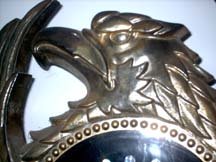
So, I own this ugly clock. I first encountered the clock in an antique store, and from a distance, I thought it was a fairly unattractive work of timekeeping, and assumed it was fairly old. But when I got closer to it, I realized it was of more recent vintage--for one thing, it was all plastic. Also, the clock had fiberoptic flowers in its guts. But the thing that truly pushed it over the top for me, and changed it from an ugly clock I noticed in a store to an ugly clock I was willing to shell out ten dollars for, was the crude cloth butterfly glued to the second hand. The notion of the butterfly racing around above the glowing fiber optic flowers, all set within the belly of a gothic, stern-faced eagle somehow touched me. Because someone, somewhere, some dreamy young clock designer thought this combination of elements, of mean-eyed eagle, meth-amped butterfly, and radioactive flowers was beautiful.
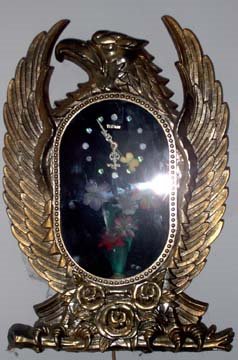 That dreamer was wrong, of course. In my darker moments, the clock looks like the sort of timepieces that would be on walls everywhere if the Nazi's had won the war. There's something vaguely sinister about it - as if the cruel eagle of the superman has devoured the flowers and butterflies of the world, and their eventual digestion is only a matter of time.
But, perhaps I'm reading too much into this. The clock is from Taiwan. Probably, its true origins are in a tiny factory where some entrepeneur got a good deal on hollow gold eagles, fiber-optic flowers, cloth butterflies, and battery operated clockworks. Then, knowing about America only from pop culture, he figured, well, American's like eagles, right? And women everywhere love flowers and sparkly things. And who doesn't need to know the time? Thus, from the bowels of a third world warehouse, the ultimate American clock was born.
Sadly, time has not been kind to the ugly clock. The clockworks have failed. Apparently glueing a large butterfly onto the second hand wears out the works. Worse, the fiber optics don't work any more. I had to unplug it months ago due to a faint burning smell. I banished the clock to a back closet, and dragged it out today thinking I might sell it in a yard sale this weekend. When I plugged it in, the flowers didn't light up. Time has vanquished the flowers and the butterflies, now faded and dusty, as the eagle looks stoicly onward. I take some small comfort in thinking he will look stoicly onward through nuclear wars, global warming, bird flu, and economic collapse.
Speaking of economic collapse, I'm thinking of asking $5 for him. True, he doesn't work anymore. But, you know, Americans will buy almost anything, as my ownership of this clock proves.
Secretly, I hope he doesn't sell.
Tuesday, April 04, 2006
Modern Magic release imminent....
So, I've been told that the Modern Magic anthology is going to be going to press this week. There's a link along the side of this page if you want to check it out. If you like my writing, I highly recommend my story in this antho, "Pentacle on His Forehead, Lizard on His Breath." If I become a famous enough author one day to wind up in a trivia game, a good trivia question would be "What was the longest title of any published James Maxey story?" This story would be the answer. No, wait, now that I think about it, it ties with "Earl Billings and the Angels of the Lord."
But I digress. What I intended to say before getting sidetracked by self-admitted trivia is that "POHFLOHB" is actually one of the stories I'm most proud of. It's funny, scarey, weird, and a little heartbreaking. It's got tea made from lizard parts and a pentacle made out of duct tape. Also, a mayonnaise painting. And, sure, some monkeys. Invisible monkeys.
On another publishing matter, some of you may have heard rumors about my novel "Bitterwood" finding a publisher. Currently, I do have an offer, but I feel like a shouldn't talk about the book until all the details are hammered out. So, all I will say for now is, watch this space.
But I digress. What I intended to say before getting sidetracked by self-admitted trivia is that "POHFLOHB" is actually one of the stories I'm most proud of. It's funny, scarey, weird, and a little heartbreaking. It's got tea made from lizard parts and a pentacle made out of duct tape. Also, a mayonnaise painting. And, sure, some monkeys. Invisible monkeys.
On another publishing matter, some of you may have heard rumors about my novel "Bitterwood" finding a publisher. Currently, I do have an offer, but I feel like a shouldn't talk about the book until all the details are hammered out. So, all I will say for now is, watch this space.
Sunday, March 26, 2006
Has this ever happened?
So, I was reading an old Fortean Times when I stumbled across a reference to women and children who, in times of panic, gained superhuman strength and lifted cars or other heavy objects. This certainly isn't the first time I'd heard of this--I suspect most people believe that bursts of superhuman stregth occur under the right circumstances. But has there ever been a real, documented case of this happening on film? It seems like if people really go gain superhuman strength in panic situations, we would see that caught on police chase film or something. There are thousands of rescue situations caught on film each year. Can someone point me to proof that panic strength is real? Or is the last second surge of superhuman strength just a myth we embrace to comfort us?
Monday, March 13, 2006
Final Flight of the Blue Bee
So, I've been telling people for months now to look for the "Final Flight of the Blue Bee" in Asimov's in April. My timing was a bit off--it's on the newstands right now. If you like your superhero fantasies straight, this might not be the story for you. On the other hand, it does have a damsel in distress atop the Empire State Building. How wrong can you go with that?
Tuesday, March 07, 2006
More Harlan Ellison Stuff
Recently over at Codexwriters, a conversation got started about Harlan Ellison's teaching style. Apparently, he has a reputation as a bully. I have some insight as to why. But, the bigger question was: Are his methods effective?
I'm not here to defend Harlan Ellison or condemn him. I can say that my writing changed after a week with him, and can never know if I turned back the clock what my writing would have evolved to without the Ellison encounter. It's possible I would have gone on to write exactly as I write today--or possibly better, or possibly worse.
But I took two things away from that week that forever changed my attitude toward my own writing. To boil those two things down:
1: Only show people your best work. Before Harlan, I used to workshop every thing I wrote. There was no trivial bit of unfinished crap that I didn't consider worthy of other people's eyes. I had a workshop mentality--I would show people my unpolished, unfinished work, get their reactions, then tweak it. I didn't pay much attention to detail on my early drafts, and was lazy about spelling, grammar, etc., because, hey, this was only a dress rehearsal, not the real show. I wasn't giving stories to people so they could read and enjoy them, I was giving them to people so they could tell me what was wrong with them. I was letting other people do part of my creative thinking for me. This works fine in workshop world, where everybody turns in poor work. But in Harlan world, it was asking for grief. I made the mistake of writing a story and turning it in without reading it, due to the time constraints of the workshop. Whether the story was any good or not is irrelevant. Harlan started tearing the story apart in the first sentence, because there was an obvious, easily fixed spelling error. When I defended it as a workshop piece, not something I would send to an editor, he tore into me, and said that if I didn't care enough to make sure that my first sentence was free of mistakes, I didn't care about my readers, period. In retrospect, he was right. I didn't care enough about making my writing look professional, even under a terrible time crunch, even for a workshop story. I told him it wasn't the best I could do, but I'd be glad to mail him a copy of the best story I'd ever written. He wasn't interested. It was too late. I didn't get a chance for Harlan to read another James Maxey story until I published work in a market he read.
I'm not making any kind of claim that I write error free work today, or that everything I write is golden on the first draft. I actually write horrible first drafts. But I no longer workshop a piece until I'm sure that it's something I'm happy with. I view every story that I give to someone to read--even my peers on critique groups--as a chance to gain another loyal James Maxey fan. If I write a story that isn't up to that standard, I spike the story without showing to to people.
2: Every word is important. Without revealing any names, there was a writer at that Odyssey that turned in a story that had a pretty good story idea but was written in a fairly plodding, workmanlike voice that buried the clever premise under banality. In his critique of the story, Harlan broke a cardinal rule of workshopping: He said, "Here's how I would write this story." Then he proceeded to give us five hundred or so words of a new opening. The very same story, the very same premise, even if memory serves, the same opening scene, but this time written in a style where every word popped. I wasn't just drawn in by the premise, I was drawn in by the voice and the energy of the prose. And the style wasn't anything particularly fancy. Harlan made it clear that the keys to his written style was that he wrote with his mouth--one breath, one idea. Every sentence made you want to hear the following sentence. Of course, this is unfair on many, many levels. Harlan is a master of style, so of course he was going to do better than some unpublished writer in a workshop. And, he was reading out loud, and it's hard to know if what was on the page would have translated in my head into that dynamic, enthralling Harlan voice. Still, it was an eye-opening experience, hearing the dull story transformed into a brilliant story just by changing the style in which it was told. Since then, I've always strived to make sure my stories sound good when read out loud.
To put it more succinctly, pre-Harlan, I thought the key to good writing was to tell a good story. Post-Harlan, I realized that a good story isn't going to get a chance at being read unless it's matched with great writing.
I saw people humiliated in the course of Harlan teaching these things. I, personally, reached one of the lowest emotional points of my life due to that week. But, six years on, I'm glad I had the experience. Orson Scott Card asks wanna-be fantasy authors, "What is the price of magic?" In my case, I feel like I sometimes, every now and then, write magic. And the price I paid was that one stressful week. I think it was worth it.
I'm not here to defend Harlan Ellison or condemn him. I can say that my writing changed after a week with him, and can never know if I turned back the clock what my writing would have evolved to without the Ellison encounter. It's possible I would have gone on to write exactly as I write today--or possibly better, or possibly worse.
But I took two things away from that week that forever changed my attitude toward my own writing. To boil those two things down:
1: Only show people your best work. Before Harlan, I used to workshop every thing I wrote. There was no trivial bit of unfinished crap that I didn't consider worthy of other people's eyes. I had a workshop mentality--I would show people my unpolished, unfinished work, get their reactions, then tweak it. I didn't pay much attention to detail on my early drafts, and was lazy about spelling, grammar, etc., because, hey, this was only a dress rehearsal, not the real show. I wasn't giving stories to people so they could read and enjoy them, I was giving them to people so they could tell me what was wrong with them. I was letting other people do part of my creative thinking for me. This works fine in workshop world, where everybody turns in poor work. But in Harlan world, it was asking for grief. I made the mistake of writing a story and turning it in without reading it, due to the time constraints of the workshop. Whether the story was any good or not is irrelevant. Harlan started tearing the story apart in the first sentence, because there was an obvious, easily fixed spelling error. When I defended it as a workshop piece, not something I would send to an editor, he tore into me, and said that if I didn't care enough to make sure that my first sentence was free of mistakes, I didn't care about my readers, period. In retrospect, he was right. I didn't care enough about making my writing look professional, even under a terrible time crunch, even for a workshop story. I told him it wasn't the best I could do, but I'd be glad to mail him a copy of the best story I'd ever written. He wasn't interested. It was too late. I didn't get a chance for Harlan to read another James Maxey story until I published work in a market he read.
I'm not making any kind of claim that I write error free work today, or that everything I write is golden on the first draft. I actually write horrible first drafts. But I no longer workshop a piece until I'm sure that it's something I'm happy with. I view every story that I give to someone to read--even my peers on critique groups--as a chance to gain another loyal James Maxey fan. If I write a story that isn't up to that standard, I spike the story without showing to to people.
2: Every word is important. Without revealing any names, there was a writer at that Odyssey that turned in a story that had a pretty good story idea but was written in a fairly plodding, workmanlike voice that buried the clever premise under banality. In his critique of the story, Harlan broke a cardinal rule of workshopping: He said, "Here's how I would write this story." Then he proceeded to give us five hundred or so words of a new opening. The very same story, the very same premise, even if memory serves, the same opening scene, but this time written in a style where every word popped. I wasn't just drawn in by the premise, I was drawn in by the voice and the energy of the prose. And the style wasn't anything particularly fancy. Harlan made it clear that the keys to his written style was that he wrote with his mouth--one breath, one idea. Every sentence made you want to hear the following sentence. Of course, this is unfair on many, many levels. Harlan is a master of style, so of course he was going to do better than some unpublished writer in a workshop. And, he was reading out loud, and it's hard to know if what was on the page would have translated in my head into that dynamic, enthralling Harlan voice. Still, it was an eye-opening experience, hearing the dull story transformed into a brilliant story just by changing the style in which it was told. Since then, I've always strived to make sure my stories sound good when read out loud.
To put it more succinctly, pre-Harlan, I thought the key to good writing was to tell a good story. Post-Harlan, I realized that a good story isn't going to get a chance at being read unless it's matched with great writing.
I saw people humiliated in the course of Harlan teaching these things. I, personally, reached one of the lowest emotional points of my life due to that week. But, six years on, I'm glad I had the experience. Orson Scott Card asks wanna-be fantasy authors, "What is the price of magic?" In my case, I feel like I sometimes, every now and then, write magic. And the price I paid was that one stressful week. I think it was worth it.
Sunday, February 26, 2006
Duds
I recently wrote a big list on the wall next to me of all the stories I've written to date. And, looking over it, I think I've written more duds than gems. The majority of my duds happened early in my writing experience of course, when I was ignorant of many of the best practices of story telling. That's to be expected. I just chalk these up to the growing pains any writer experiences as he learns a difficult craft.
But my later duds are harder to explain. I've been writing fiction for 15 years at this point. Either I should have learned how to tell a story by now, or I should give up. Yet, again and again, I dud out, and put stories on the page that I'm not only not proud of, I'm actually a little ashamed of.
Why? My flops fall into three categories.
1: I try something new. It gets boring telling stories in the same linear sequence, beginning at the beginning, ending at the end, telling the story with a reliable single POV character. So I occasionally get these brilliant ideas to tell the story backwards, or to make the narrator insane, or to attempt some new voice that I've never tackled before (I have a story called "40 Pound Hammer" that I tried to write in the voice of an illiterate 10 year old child that is just cringe-provoking when I read it). In retrospect, I'm usually tempted to try new techniques and approaches when I'm worried the story needs spicing up to make it interesting. So, most of these failed stories come not only from bad writing, but also have, at their centers, ideas I didn't fully believe in.
2: I try something old. Many of my duds result from my trying to mimic my own successes. My first real breakthrough story was "Empire of Dreams and Miracles." This was a story that initially met with nothing but rejections. Critique groups always split down the middle, with people telling me not to change a word and other dismissing it as rambling and wordy. I believed in the story, and still rank it as among my finest work. But, I have two other stories set in the same setting, based on characters introduced in "Empire." I have a story from the POV of the death-poet Makan called "One Plus One Equals One" and a story from the POV of Alandra, the Empire-protagonists ex-lover called "Tuesday Morning By the Sea When We Were Gods." Both are written in the same sensual, poetic voice I used in "Empire." Both are built around characters I found interesting and worth a second look. Both explore interesting aspects of the world of "Empire." And I gave up on both of them long ago. They just didn't pop for me. They are stories I wrote not because I had an idea that I got excited about and had to write, but because I had some success with a story and then went back to it looking for more ideas I could milk out of it.
3: Sow's ears. You really can't make silk purses out of them. Occasionally, the central idea I have for a story just sucks. I'm excited about them when I sit down to write, but in retrospect I shouldn't have been. These are often stories where I use heavily explored premises. I do this because I've sold heavily explored premises many times. Maybe the world didn't need yet another story about a comet that's going to hit the Earth, but, what the hell, I wrote one anyway, and liked it, and sold it to Asimov's. On the other hand, I wrote a time travel story about a guy who goes back into the past to warn his younger self about a mistake to avoid called "The Machine in His Mind." This was a pretty threadbare premise, but I thought I could make it my own with good writing and a character I loved. Today I still like the character, and I think my writing in that story is some of my best--it's tight and focused, funny when it should be funny, moving when it should be moving. But, I look at the story now as a flop and rarely try to market it. It flops because good writing and likable characters still aren't enough to make readers shake off the "been there, done that" feeling they get when they read the story. No amount of further line editing or tweaking is ever going to overcome the hurdle that the idea the story is based on is well past its shelf date. If I'd written the story in 1890, man, I'd have a hit on my hands. But ten-thousand time travel stories later, there just isn't enough new there to justify the stories existance.
The extra special bonus reason #4 why I often write duds: If you want to be a writer, you gotta write. And my best writing, the stuff I'm in love with, usually comes to me from some moment of clarity and inspiration where I realize I have something big to say and have stumbled upon the proper vehicle to say it. But, if I only waited for these moments of clarity and inspiration, I might be lucky to write a story every other year. If you want to make it as a writer, you have to have the discipline to make yourself sit down and write a story even when you don't have clarity and inspiration, even when you haven't got a damn thing to say, even when you hate your characters and you hate the voice of the story and you hate the stupid premise that you've pulled out of your mental hat. You gotta punch those keys and hope that magic happens. Sometimes, it does. You get 1000 words into the worst story you've ever tried to tell and BOOM, the lightning strikes, and suddenly all is right with the universe. But, if the lightning doesn't strike, you haven't wasted your time. The hours you spend slogging through the swamps of your duds help you build up strength and endurance for when the you finally do have the golden idea handed to you.
To change analogies in midstream, if you're not striking out from time to time, you're not swinging for the fences.
But my later duds are harder to explain. I've been writing fiction for 15 years at this point. Either I should have learned how to tell a story by now, or I should give up. Yet, again and again, I dud out, and put stories on the page that I'm not only not proud of, I'm actually a little ashamed of.
Why? My flops fall into three categories.
1: I try something new. It gets boring telling stories in the same linear sequence, beginning at the beginning, ending at the end, telling the story with a reliable single POV character. So I occasionally get these brilliant ideas to tell the story backwards, or to make the narrator insane, or to attempt some new voice that I've never tackled before (I have a story called "40 Pound Hammer" that I tried to write in the voice of an illiterate 10 year old child that is just cringe-provoking when I read it). In retrospect, I'm usually tempted to try new techniques and approaches when I'm worried the story needs spicing up to make it interesting. So, most of these failed stories come not only from bad writing, but also have, at their centers, ideas I didn't fully believe in.
2: I try something old. Many of my duds result from my trying to mimic my own successes. My first real breakthrough story was "Empire of Dreams and Miracles." This was a story that initially met with nothing but rejections. Critique groups always split down the middle, with people telling me not to change a word and other dismissing it as rambling and wordy. I believed in the story, and still rank it as among my finest work. But, I have two other stories set in the same setting, based on characters introduced in "Empire." I have a story from the POV of the death-poet Makan called "One Plus One Equals One" and a story from the POV of Alandra, the Empire-protagonists ex-lover called "Tuesday Morning By the Sea When We Were Gods." Both are written in the same sensual, poetic voice I used in "Empire." Both are built around characters I found interesting and worth a second look. Both explore interesting aspects of the world of "Empire." And I gave up on both of them long ago. They just didn't pop for me. They are stories I wrote not because I had an idea that I got excited about and had to write, but because I had some success with a story and then went back to it looking for more ideas I could milk out of it.
3: Sow's ears. You really can't make silk purses out of them. Occasionally, the central idea I have for a story just sucks. I'm excited about them when I sit down to write, but in retrospect I shouldn't have been. These are often stories where I use heavily explored premises. I do this because I've sold heavily explored premises many times. Maybe the world didn't need yet another story about a comet that's going to hit the Earth, but, what the hell, I wrote one anyway, and liked it, and sold it to Asimov's. On the other hand, I wrote a time travel story about a guy who goes back into the past to warn his younger self about a mistake to avoid called "The Machine in His Mind." This was a pretty threadbare premise, but I thought I could make it my own with good writing and a character I loved. Today I still like the character, and I think my writing in that story is some of my best--it's tight and focused, funny when it should be funny, moving when it should be moving. But, I look at the story now as a flop and rarely try to market it. It flops because good writing and likable characters still aren't enough to make readers shake off the "been there, done that" feeling they get when they read the story. No amount of further line editing or tweaking is ever going to overcome the hurdle that the idea the story is based on is well past its shelf date. If I'd written the story in 1890, man, I'd have a hit on my hands. But ten-thousand time travel stories later, there just isn't enough new there to justify the stories existance.
The extra special bonus reason #4 why I often write duds: If you want to be a writer, you gotta write. And my best writing, the stuff I'm in love with, usually comes to me from some moment of clarity and inspiration where I realize I have something big to say and have stumbled upon the proper vehicle to say it. But, if I only waited for these moments of clarity and inspiration, I might be lucky to write a story every other year. If you want to make it as a writer, you have to have the discipline to make yourself sit down and write a story even when you don't have clarity and inspiration, even when you haven't got a damn thing to say, even when you hate your characters and you hate the voice of the story and you hate the stupid premise that you've pulled out of your mental hat. You gotta punch those keys and hope that magic happens. Sometimes, it does. You get 1000 words into the worst story you've ever tried to tell and BOOM, the lightning strikes, and suddenly all is right with the universe. But, if the lightning doesn't strike, you haven't wasted your time. The hours you spend slogging through the swamps of your duds help you build up strength and endurance for when the you finally do have the golden idea handed to you.
To change analogies in midstream, if you're not striking out from time to time, you're not swinging for the fences.
Sunday, February 12, 2006
Well, Cheney just shot a man . . .
http://www.breitbart.com/news/2006/02/12/D8FNQDG80.html
Not only did Cheney shoot an innocent man, that man is 78 years old. They say it was an accident. Sure.
Personally, I can't help but think this will really boost Cheney's poll numbers. It's really kind of bad-ass when you think about it.
Not only did Cheney shoot an innocent man, that man is 78 years old. They say it was an accident. Sure.
Personally, I can't help but think this will really boost Cheney's poll numbers. It's really kind of bad-ass when you think about it.
Sunday, January 15, 2006
Ghost lyrics
So this morning, I wake up with a song in my head. In my mind's ear, it sounds a bit like Bob Dylan singing. They lyrics I can't recall are:
The things that you want back
are the things you can't get back
And when you get them back
You'll really want to know
But the things you want to know
You know you already know
So, probably, these aren't Bob Dylan lyrics, because, well, they aren't all that good, and he's a genius. Then again, genius or not, when you have a catalogue of a couple of thousand songs, some are going to be clunkers.
Still, I've googled bits and peices of the lyrics this morning, trying to figure out what song I'm hearing, and I can't find any songs that match. The tune, for what it's worth, kind of matches the opening of "Hurricane," and plainly these aren't lyrics from that song.
It's not at all uncommon for me to get a song stuck in my head, so stuck it dislodges all other attempts at thought until I dig out the album and listen to it. But how the hell am I supposed to do that with a song that, apparently, my mind has just made up?
The things that you want back
are the things you can't get back
And when you get them back
You'll really want to know
But the things you want to know
You know you already know
So, probably, these aren't Bob Dylan lyrics, because, well, they aren't all that good, and he's a genius. Then again, genius or not, when you have a catalogue of a couple of thousand songs, some are going to be clunkers.
Still, I've googled bits and peices of the lyrics this morning, trying to figure out what song I'm hearing, and I can't find any songs that match. The tune, for what it's worth, kind of matches the opening of "Hurricane," and plainly these aren't lyrics from that song.
It's not at all uncommon for me to get a song stuck in my head, so stuck it dislodges all other attempts at thought until I dig out the album and listen to it. But how the hell am I supposed to do that with a song that, apparently, my mind has just made up?
Saturday, December 17, 2005
Nothing profound
So, yesterday was a slow day at work... the first truly slow day I've had at work since moving to this location. I spent the morning searching the web for free Mountain Goats MP3s and found over 30 of them. Most of these are live recordings from various concert venues, plus a few demos and outtakes from earlier albums. About half of the material I found was of songs I'd never heard before, the other half was familiar material with a new twist. "Delaudid" performed solo with guitar instead of the orchestrated cellos of the album version was raw and gripping, but the original version of "Coroner's Gambit" was awful--the lyrics are the same, but the music is too driving and uptempo for a song about death. It's interesting to see where the creative process led both these songs from thier original forms.
But the song that stuck with me is one called "Elijah." This is also from the Coroner's Gambit album, and when I've listened to it in the past I've been intriqued by what the lyrics possibly meant. I assumed it was a song about reincarnation, because I've been listening to it without noticing the title. As an MP3, the title is showing now as I'm driving around in the Scion and, duh, the song isn't about reincarnation, it's about Elijah. He was a Biblical prophet taken up into Heaven who supposedly will return to announce the arrival of the messiah. The song refers to setting out an extra plate--I think this is an actual Jewish tradition, to leave a plate out for Elijah during the celebration of one of their holidays. (I don't know which one, alas... all I know about the tradition I learned from the Saturday Night Live where Jerry Seinfield plays Elijah showing up for dinner. He asks the teenage daughter of the family to answer three questions: "First, are you a virgin?" She "Yes." "Then forget my other two questions.") In any case, this got me thinking that people probably do carry on this tradition, after almost 3000 years of Elijah failing to show up, just as Christians still fervently believe Jesus might show up any minute despite his 2000 year delay. And, rather than striking me as silly or absurd, it strikes me as beautiful, this human ability to believe fervently in the impossible (or highly unlikely).
The ability, even the need, to believe in impossible things is, after all, the very thing that makes all fiction possible. I couldn't make up stories, write them, and have people read them and like them without that important bit of wiring in the human brain that allows us to regard the imaginary as being as real as the real. I'm currently reading "Snow Crash" by Neil Stephenson. It's the sort of book that, while I'm reading it, I'm actually drawn into a second reality where the characters seem like living beings and the imagined settings seem quite solid and real to me. When I put the book down, the illusion vanishes, of course, but it's still a pleasurable experience.
So, perhaps religion can be viewed as fiction that people can't put down. Or, perhaps good fiction is a little, temporary religion that makes you believe in a new creation if only for a few hours.
But the song that stuck with me is one called "Elijah." This is also from the Coroner's Gambit album, and when I've listened to it in the past I've been intriqued by what the lyrics possibly meant. I assumed it was a song about reincarnation, because I've been listening to it without noticing the title. As an MP3, the title is showing now as I'm driving around in the Scion and, duh, the song isn't about reincarnation, it's about Elijah. He was a Biblical prophet taken up into Heaven who supposedly will return to announce the arrival of the messiah. The song refers to setting out an extra plate--I think this is an actual Jewish tradition, to leave a plate out for Elijah during the celebration of one of their holidays. (I don't know which one, alas... all I know about the tradition I learned from the Saturday Night Live where Jerry Seinfield plays Elijah showing up for dinner. He asks the teenage daughter of the family to answer three questions: "First, are you a virgin?" She "Yes." "Then forget my other two questions.") In any case, this got me thinking that people probably do carry on this tradition, after almost 3000 years of Elijah failing to show up, just as Christians still fervently believe Jesus might show up any minute despite his 2000 year delay. And, rather than striking me as silly or absurd, it strikes me as beautiful, this human ability to believe fervently in the impossible (or highly unlikely).
The ability, even the need, to believe in impossible things is, after all, the very thing that makes all fiction possible. I couldn't make up stories, write them, and have people read them and like them without that important bit of wiring in the human brain that allows us to regard the imaginary as being as real as the real. I'm currently reading "Snow Crash" by Neil Stephenson. It's the sort of book that, while I'm reading it, I'm actually drawn into a second reality where the characters seem like living beings and the imagined settings seem quite solid and real to me. When I put the book down, the illusion vanishes, of course, but it's still a pleasurable experience.
So, perhaps religion can be viewed as fiction that people can't put down. Or, perhaps good fiction is a little, temporary religion that makes you believe in a new creation if only for a few hours.
Tuesday, October 18, 2005
In Search of Ancient Idiots
So, every now and then I like to read the sort of trashy 70's paperbacks I was addicted to when I was a teenager. There were dozens of books out about the Bermuda Triangle, ancient astronauts, UFO's, and Bigfoot, and I eagerly devoured them all. I was addicted the implication that there might be some huge secret just waiting to be revealed, some final proof of alien life visiting Earth, or of a second, primitive race of man still hiding in the forests.
I recently found a copy of "In Search of Ancient Mysteries" in a Goodwill Store for a nickel. Who can argue with that price? I read it, wondering if I could still work up that sense of wonder and mystery I'd loved so much as a teen. Alas, no. I'm really left more with the impression that my teen self was a moron. The authors main premise is so self-evidently awful that I can't believe there were enough readers for this book to justify a dozen printings, as the cover boasts. The premise is a familiar one: All the great stone monuments built in ancient times could not have been built by ancient man alone. The blocks must have been carved and moved great distances with the help of advanced alien civilizations. As added proof, any rock carving of a man wearing a funny hat is held up as portraying an astronaut in a space helmet. Any triangular rock is pointed to as a delta winged aircraft, any circle is called a flying saucer.
Many critiques have pointed out that this genre of book is insulting to ancient humans, who were quite capable of these wonderful feats of stone engineering. But, I can't help but think they are also insulting to the ancient alien civilizations as well. They came there across vast reaches of interstellar space and built homes for themselves, and the best material they knew how to use was rock? They built all these giant stone buildings with no running water, no electrical outlets, etc., and they are supposed to be more advanced than we are? Show me a Mayan temple built out of 2000 year old plastic and I might be a little more convinced.
I recently found a copy of "In Search of Ancient Mysteries" in a Goodwill Store for a nickel. Who can argue with that price? I read it, wondering if I could still work up that sense of wonder and mystery I'd loved so much as a teen. Alas, no. I'm really left more with the impression that my teen self was a moron. The authors main premise is so self-evidently awful that I can't believe there were enough readers for this book to justify a dozen printings, as the cover boasts. The premise is a familiar one: All the great stone monuments built in ancient times could not have been built by ancient man alone. The blocks must have been carved and moved great distances with the help of advanced alien civilizations. As added proof, any rock carving of a man wearing a funny hat is held up as portraying an astronaut in a space helmet. Any triangular rock is pointed to as a delta winged aircraft, any circle is called a flying saucer.
Many critiques have pointed out that this genre of book is insulting to ancient humans, who were quite capable of these wonderful feats of stone engineering. But, I can't help but think they are also insulting to the ancient alien civilizations as well. They came there across vast reaches of interstellar space and built homes for themselves, and the best material they knew how to use was rock? They built all these giant stone buildings with no running water, no electrical outlets, etc., and they are supposed to be more advanced than we are? Show me a Mayan temple built out of 2000 year old plastic and I might be a little more convinced.
Sunday, October 09, 2005
Going Too Far
Yesterday, I found the December Asimov's in a local Borders and peeked inside to confirm that I wasn't dreaming, that this issue did indeed contain my story "To the East, a Bright Star." I also noticed something standing in the bookstore that I was blind to in my subscription copy. There's a warning label on my story! "A word of warning: there are brief scenes in this story that may be disturbing to some readers." I don't recall ever seeing that label in another issue of Asimov's before. (Although I've since been informed they've done it for a few years now.)
I'm slightly more flattered than offended by the label. Part of me does wonder what, precisely, earned the warning. I suppose it was explicit drug use. Worse, it's explicit drug use that doesn't ruin the character's lives.
Yet another part of me views the label as completely extraneous. My story might disturb people. Why did they need the word "might" in there? Has fiction become so bland and timid that writers no longer produce disturbing stories? In the stories I'm most proud of, I almost always come to a moment where I'm disturbed by what I'm writing. There's a moment where I think, "I can't write this--I'm going too far." In Nobody Gets the Girl, I felt this way when Rail Blade has her temper tantrum in Jerusalem. Then, I topped my discomfort a chapter later when Rail Blade's father sticks the needle in her veins and delivers the lethal dose of poison. In "Empire of Dreams and Miracles," I felt this way when the Dobay the Gold admits his lust for his transgendered father, and later when he gets his eye gouged out by a clawhammer. In "Perhaps the Snail," I write about masturbation in the back seat of a cab, and took comfort in the fact that the story was so offensive it would never be published and I would be spared the embarassment of having people read it. (I was wrong on the never being published part.)
Perhaps there are some writers who get a thrill out of shocking their readers, and purposefully set out to be sexually explicit or ultra violent. I am not one of those writers. Each time I get to one of these scenes, it's a struggle. I worry about losing readers. Worse, I worry that one day, against all odds, my parents might pick up a science fiction anthology and find out what kind of sicko crap I'm churning out. Yet when I come to these scenes, I never have the option of simply not writing them. My stories often climax with a single, transformative moment in a character's life, and these moments are often disturbing and uncomfortable for the protagonist. If, in "Perhaps the Snail," Devie had decided to go get some ice cream instead of agreeing to be a nude piece of living furniture for her rock star idol, I might have had produced a story that didn't offend anyone. Instead I decided to tell the story of the worst moment of her life--and show how humans are capable of taking these worst moments and flipping them around until they become the moments of thier greatest strength. I write about trauma so that I can write about transformation.
If you aren't convinced the human mind is programmed to make these flips, I have more evidence. I write stuff that I'm embarrassed to write--and later feel proud of it.
So, yeah, some scenes may be disturbing to some readers. If they aren't, then I'm just wasting my time.
I'm slightly more flattered than offended by the label. Part of me does wonder what, precisely, earned the warning. I suppose it was explicit drug use. Worse, it's explicit drug use that doesn't ruin the character's lives.
Yet another part of me views the label as completely extraneous. My story might disturb people. Why did they need the word "might" in there? Has fiction become so bland and timid that writers no longer produce disturbing stories? In the stories I'm most proud of, I almost always come to a moment where I'm disturbed by what I'm writing. There's a moment where I think, "I can't write this--I'm going too far." In Nobody Gets the Girl, I felt this way when Rail Blade has her temper tantrum in Jerusalem. Then, I topped my discomfort a chapter later when Rail Blade's father sticks the needle in her veins and delivers the lethal dose of poison. In "Empire of Dreams and Miracles," I felt this way when the Dobay the Gold admits his lust for his transgendered father, and later when he gets his eye gouged out by a clawhammer. In "Perhaps the Snail," I write about masturbation in the back seat of a cab, and took comfort in the fact that the story was so offensive it would never be published and I would be spared the embarassment of having people read it. (I was wrong on the never being published part.)
Perhaps there are some writers who get a thrill out of shocking their readers, and purposefully set out to be sexually explicit or ultra violent. I am not one of those writers. Each time I get to one of these scenes, it's a struggle. I worry about losing readers. Worse, I worry that one day, against all odds, my parents might pick up a science fiction anthology and find out what kind of sicko crap I'm churning out. Yet when I come to these scenes, I never have the option of simply not writing them. My stories often climax with a single, transformative moment in a character's life, and these moments are often disturbing and uncomfortable for the protagonist. If, in "Perhaps the Snail," Devie had decided to go get some ice cream instead of agreeing to be a nude piece of living furniture for her rock star idol, I might have had produced a story that didn't offend anyone. Instead I decided to tell the story of the worst moment of her life--and show how humans are capable of taking these worst moments and flipping them around until they become the moments of thier greatest strength. I write about trauma so that I can write about transformation.
If you aren't convinced the human mind is programmed to make these flips, I have more evidence. I write stuff that I'm embarrassed to write--and later feel proud of it.
So, yeah, some scenes may be disturbing to some readers. If they aren't, then I'm just wasting my time.
Monday, October 03, 2005
Harlan Ellison
So, just now my phone rings and it turns out to be Harlan Ellison. He read to "To the East, a Bright Star," in Asimov's and wanted to welcome me to the community of professional writers. He also told me that I should have used "as" instead of "like" in the sentence, "It worked quickly, like he remebered."
Harlan Ellison changed my life, a couple of times. First, when I was a teenager, leaving behind a very theistic view of the world and making my first intellectual forays into a science-based world, I read every bit of SF I could lay my hands on. Harlan Ellison's work stood out. I loved everything he wrote. I loved all the long essays and introductions in his anthologies, I loved his world view. I wanted to be a writer, and, not so secretly, I wanted to be Harlan Ellison. He was the ultimate in cool to me when I was 17. I really knew nothing about him but the word he had put on paper, but his words charged me up like lightning.
The second time Harlan changed my life, he was writer in residence the year I went to Odyssey. This made my trip to Odyssey something of a religious experience. The way some pilgrims might journey to Italy to see the Pope, I journeyed a thousand miles to spend a week in his presense. At the workshop, Harlan tore me apart. He ripped to shreds every story I submitted at the workshop. He did have a few nice things to say, but I still have the paper where he circled a misspelling in the first line of my story and wrote "You're writing like a goddamn illiterate redneck." He capped it all of my not even reading my final story and dismissing me as too arrogant for him to waste his time on. The final night of Harlan's stay, I cried like I had never cried in my life. I felt like he had completely crushed my dreams of being a writer. He had taken everything I had written and dismissed it as crap. He had made me look incompetent and ignorant.
It was a huge favor, one which I finally got the chance to thank him for. Because in crushing my dream of being Harlan Ellison, he helped me form a new dream of being James Maxey. By tossing in the wastebin ten years of writing, he gave me the freedom to write in a new and better style, and write stories that were less imitatative of what I had read before.
So, having him call me was a shock. Having him call me a colleague is an honor. And having him correct my story after it's published is a thrill. Yowza.
Harlan Ellison changed my life, a couple of times. First, when I was a teenager, leaving behind a very theistic view of the world and making my first intellectual forays into a science-based world, I read every bit of SF I could lay my hands on. Harlan Ellison's work stood out. I loved everything he wrote. I loved all the long essays and introductions in his anthologies, I loved his world view. I wanted to be a writer, and, not so secretly, I wanted to be Harlan Ellison. He was the ultimate in cool to me when I was 17. I really knew nothing about him but the word he had put on paper, but his words charged me up like lightning.
The second time Harlan changed my life, he was writer in residence the year I went to Odyssey. This made my trip to Odyssey something of a religious experience. The way some pilgrims might journey to Italy to see the Pope, I journeyed a thousand miles to spend a week in his presense. At the workshop, Harlan tore me apart. He ripped to shreds every story I submitted at the workshop. He did have a few nice things to say, but I still have the paper where he circled a misspelling in the first line of my story and wrote "You're writing like a goddamn illiterate redneck." He capped it all of my not even reading my final story and dismissing me as too arrogant for him to waste his time on. The final night of Harlan's stay, I cried like I had never cried in my life. I felt like he had completely crushed my dreams of being a writer. He had taken everything I had written and dismissed it as crap. He had made me look incompetent and ignorant.
It was a huge favor, one which I finally got the chance to thank him for. Because in crushing my dream of being Harlan Ellison, he helped me form a new dream of being James Maxey. By tossing in the wastebin ten years of writing, he gave me the freedom to write in a new and better style, and write stories that were less imitatative of what I had read before.
So, having him call me was a shock. Having him call me a colleague is an honor. And having him correct my story after it's published is a thrill. Yowza.
Saturday, October 01, 2005
Bill Bennett=Racist
So, in my last post I mentioned my recent insomnia. I was so tired I felt drunk. Here it is five hours later, and I'm wide away. Well, "wide" may be the wrong adjective there. I'm narrowly awake, awake by a bare sliver, yet it's a vital sliver. A voice in my head just won't shut up. What kills me is that other people probably get voices in thier heads that worry about important stuff. I'm kept awake by the worst kinds of trivia. I don't know if you've ever seen the comic strip "Syvia." Nicolle Hollander has a running gag about "The Woman Who Worries About Everything." In these strips, the woman is awake in bed thinking about some new political development--Friday, the woman wakes up her husband by worrying out loud about pharmacists refusing to fill prescription drugs, for instance. I identify with this on so many levels. "Sylvia" is one of my all time favorite strips with a political bent. I like Doonesbury and the Boondocks, but seldom do I find myself laughing out loud over their particular brand of humor. They usually devote thier energies to making fun of right wing politics, which is fine by me, but "Sylvia" usually has a more absurdist spin on things. She's making fun of right-wingers, often savagely, but there is also a subtle recognition in her political commentary that recognizes that outrage and fear over a lot of political issues is funny in it's own right. I think she's aware that waking up in the middle of the night to worry about the FDA or Tom Delay or Halliburton is a fairly absurd reaction to most politics. She's making fun of politics, but also making fun of people who take politics seriously.
Which brings me back to my insomnia, and the stupid stuff I worry about. Tonight it's Bill Bennett. By now, most people have probably heard about his suggestion that we abort all black babies to reduce crime. I read about it on Buzzflash, on Democratic Underground, and on Media Matters. Deomocratic Underground has a thread calling for this racist cracker's head on a platter--or, short of that, demanding that he be taken off the air. There's a petition going around, yadda yadda. I heard the clip played on the Alan Colmes show, and thought it was pretty amazing that Bill Bennett had said such a thing. It was also puzzling, because I thought he was opposed to abortion. Sure, maybe he hated black people, but didn't he also hate abortions?
So, driving home yesterday, I heard a longer version of the quote, and more about the context of the quote. Turns out, he doesn't support aborting all black babies. Nor was it even his argument--he plainly states that it's an argument he read in a book called "Freakanomics." And then, in the sentence immediately following his presentation of that arguement, he goes on to call the argument rediculous and morally reprehensible. It's a common defense of politicians to claim that they've been taken out of context--but all the outrage over these remarks plainly requires that his comments be taken way, way out of context. To spin this like this is Bennett's belief requires a level of intellectual dishonesty that makes me ashamed of my fellow human beings.
This isn't just something the left does to demonize the right. The right did it as well with their spin that Gore claimed to have invented the internet. It's a claim he never made, based on spinning a factual and much more modest claim that Gore had been supportive of legislation that funded development of networks while he had been in congress. This is an easily verified, totally non-controversial statement for Gore to make. So, of course, the right wing spin machine yanked his comments out of context and eventually rewrote them to turn Gore into a liar, based on a lie that he never told.
What kills me is how well this works. I don't have any hard polling data, but I would guess that the number of people who believe Gore claims to have invented the internet is up around 70 or 80 percent. The number of people who believe that Dan Quayle went to Latin America and lamented that he didn't speak Latin is probably higher than that--once again based on something that he never said. And now this Bill Bennett thing--a year from now, all people will know about him is that he's the guy who wants to kill black babies.
So, tonight I'm blaming my insomnia on my concerns about the collective ignorance of Americans. Now that that's out of my system, I'm going back to bed.
Which brings me back to my insomnia, and the stupid stuff I worry about. Tonight it's Bill Bennett. By now, most people have probably heard about his suggestion that we abort all black babies to reduce crime. I read about it on Buzzflash, on Democratic Underground, and on Media Matters. Deomocratic Underground has a thread calling for this racist cracker's head on a platter--or, short of that, demanding that he be taken off the air. There's a petition going around, yadda yadda. I heard the clip played on the Alan Colmes show, and thought it was pretty amazing that Bill Bennett had said such a thing. It was also puzzling, because I thought he was opposed to abortion. Sure, maybe he hated black people, but didn't he also hate abortions?
So, driving home yesterday, I heard a longer version of the quote, and more about the context of the quote. Turns out, he doesn't support aborting all black babies. Nor was it even his argument--he plainly states that it's an argument he read in a book called "Freakanomics." And then, in the sentence immediately following his presentation of that arguement, he goes on to call the argument rediculous and morally reprehensible. It's a common defense of politicians to claim that they've been taken out of context--but all the outrage over these remarks plainly requires that his comments be taken way, way out of context. To spin this like this is Bennett's belief requires a level of intellectual dishonesty that makes me ashamed of my fellow human beings.
This isn't just something the left does to demonize the right. The right did it as well with their spin that Gore claimed to have invented the internet. It's a claim he never made, based on spinning a factual and much more modest claim that Gore had been supportive of legislation that funded development of networks while he had been in congress. This is an easily verified, totally non-controversial statement for Gore to make. So, of course, the right wing spin machine yanked his comments out of context and eventually rewrote them to turn Gore into a liar, based on a lie that he never told.
What kills me is how well this works. I don't have any hard polling data, but I would guess that the number of people who believe Gore claims to have invented the internet is up around 70 or 80 percent. The number of people who believe that Dan Quayle went to Latin America and lamented that he didn't speak Latin is probably higher than that--once again based on something that he never said. And now this Bill Bennett thing--a year from now, all people will know about him is that he's the guy who wants to kill black babies.
So, tonight I'm blaming my insomnia on my concerns about the collective ignorance of Americans. Now that that's out of my system, I'm going back to bed.
Subscribe to:
Posts (Atom)


 Posts
Posts


