

One of the bigger political stories of the week was the visit to the US by Iranian prez Ahmadinijad. The university that invited him to speak denounced him as a petty and cruel dictator. And, there is a long list of evidence that Iran is run by cruel dictators--but no evidence it's run by Ahmadinijad. A dictator has the power to issue dictates. In Iran that power rests in religious leaders who decide that teenage girls will be stoned to death for getting knocked up, or who make it possible for Ahmadinijad to assert there are no gays in Iran--since if anyone is caught with homosexual tendencies there, they are put to death. Ahmadinijad is just a puppet. The only power he really wields is the power to give speaches and the power to decide whether or not to wear a tie. If the plane he flew over on had fallen from they sky, it wouldn't have altered the governance of Iran in the least.
The most thought provoking thing about his visit for me, however, was the counter-question: can anyone imagine George Bush going to Iran to speak to a college class where he'd face hostile questioning and an audience that would openly laugh at him? Which then led me to this question: Can anyone imagine George Bush going to an American university to speak to an audience that could ask him questions that weren't approved in advance?
Sunday, September 30, 2007


Sunday, September 23, 2007
Noah's Ark
Among the news sites I like to visit, the most conservative site hands down is World Net Daily. They make the Drudgereport look positively left wing in most of their editorial positions. Most WND stories are written from a decidely fundamentalist Christian viewpoint. Peel away the veneer of most liberal causes, they believe, and you will find Satan's fingerprints. This is especially true of science that runs contrary to the Bible. It's a rare week that WND doesn't run some headline trumpeting the overthrow of Darwinism due to new incontrovertible evidence that God alone is responsible for creating all species, and that the earth is only a few thousand years old.
I actually enjoy reading the occassional stabs at overthrowing Darwin and/or all modern astronomy, geology, and physics. I find it makes for a nice thought experiment to involve in the sort of magical thinking that fundamentalists engage in. It's useful for a science fiction and fantasy writer to occassionally stop and ask: What if everything we know is wrong? What if the moon really is made of cheese and we don't know it because the moon landing was faked? In fact, all stories about space travel is faked because the rockets always crash into the crystal sphere that the stars are painted on? We don't need satellites to bounce the TV signals around the world--we just bounce the signals off the sphere? And why haven't the scientists told us this? Why the charade? Because the devil has gotten his fingers into all our politicians, scientists, and teachers and encourages them to twist the truth so as to spread doubt among the ever dwindling pool of the faithful.
Of course, most fundamentalists don't believe in crystal spheres. However, one thing that fundamentalists do believe in passionately is Noah's Ark. They believe the world was completely submerged by flood waters approximately 4000 years ago because God was angry. Every living thing you see now has descended in a few thousand years from the descendants of Noah and the two of every kind of animal that wound up on the ark. It's a pretty hard and fast test: If you doubt this story, you doubt the inerrent word of God. You have to believe in the Ark if you are a "true" Christian (as defined by the WND gang).
This was brought to mind by a recent story at WND called, "Did Noah's Flood Spark Global Warming?" The gist of the story is that a scientist named John Baumgardner, a scientist, says, "Yep! All the evidence points to the fact that the world is still warming up after being cooled by the global flood." It's a pretty daring article for WND, because it argues that global warming is real, and normally it's treated as just a lot of hoodoo meant to trick people into adopting Satanism and communism. But, thanks to a little mental acrobatics, now fundamentalists can accept global warming--but evidence that the world is warming is now just evidence of the litteral truth of the Bible. A long held belief of fundamentalists is that the ultimate evidence of the truth of Noah's Ark is still out there--the Ark itself, hidden in the snows of Mount Arrarat, occasionally photographed by plane or satellite. Perhaps if global warming melts off the snow, they'll be able to find the ark a little easier.
It's interesting the hold that Noah's Ark has on certain people, but this definitely isn't a mindset limited to Christians. I've met my fair share of Goth's, for instance, who take it as an article of faith that vampires are real. Or, if not real now, it actually describes the symptoms of some blood transmitted disease that was once common but is seldom seen now. There are also plenty of people convinced that aliens visit the earth, either in the ancient past, or out among us now.
It's interesting how some fairy tales we here in childhood we learn to recognize as fairy tales, while others, like the UFO myths, persist among some individuals throughout their lives. The world still has its flat-earthers, too, and I think the world is slightly better for their presense. I sometimes hope to one day find an otherwise ordinary person who believes in the reality of, say, the three little pigs. After all, pigs are mammals, and mammals have been proven to have the ability to evolve language, so there's nothing impossible about a talking pig. Some mammals evolve bipedelism and tool use, so it's plausible that a small group of mutant talking pigs could also learn to walk around and use tools to build houses. And, it also makes perfect sense that the pigs wouldn't be very good at their carpentry efforts, and might build structures that wouldn't be very stable, and might even blow down in the slightest breeze. It doesn't violate any laws of physics. Really, it could happen. Probably has, if you think about it enough, given the sheer number of pigs that have existed. And, no doubt the talking, home-constructing pigs made quite an impression on their neighbors, which is why their legend has passed down through so many generations. Now, all I need is a good research grant, and I bet I can even track down archeological evidence of the building sites of the pig's houses.
Unless all that got washed away in the flood.
I actually enjoy reading the occassional stabs at overthrowing Darwin and/or all modern astronomy, geology, and physics. I find it makes for a nice thought experiment to involve in the sort of magical thinking that fundamentalists engage in. It's useful for a science fiction and fantasy writer to occassionally stop and ask: What if everything we know is wrong? What if the moon really is made of cheese and we don't know it because the moon landing was faked? In fact, all stories about space travel is faked because the rockets always crash into the crystal sphere that the stars are painted on? We don't need satellites to bounce the TV signals around the world--we just bounce the signals off the sphere? And why haven't the scientists told us this? Why the charade? Because the devil has gotten his fingers into all our politicians, scientists, and teachers and encourages them to twist the truth so as to spread doubt among the ever dwindling pool of the faithful.
Of course, most fundamentalists don't believe in crystal spheres. However, one thing that fundamentalists do believe in passionately is Noah's Ark. They believe the world was completely submerged by flood waters approximately 4000 years ago because God was angry. Every living thing you see now has descended in a few thousand years from the descendants of Noah and the two of every kind of animal that wound up on the ark. It's a pretty hard and fast test: If you doubt this story, you doubt the inerrent word of God. You have to believe in the Ark if you are a "true" Christian (as defined by the WND gang).
This was brought to mind by a recent story at WND called, "Did Noah's Flood Spark Global Warming?" The gist of the story is that a scientist named John Baumgardner, a scientist, says, "Yep! All the evidence points to the fact that the world is still warming up after being cooled by the global flood." It's a pretty daring article for WND, because it argues that global warming is real, and normally it's treated as just a lot of hoodoo meant to trick people into adopting Satanism and communism. But, thanks to a little mental acrobatics, now fundamentalists can accept global warming--but evidence that the world is warming is now just evidence of the litteral truth of the Bible. A long held belief of fundamentalists is that the ultimate evidence of the truth of Noah's Ark is still out there--the Ark itself, hidden in the snows of Mount Arrarat, occasionally photographed by plane or satellite. Perhaps if global warming melts off the snow, they'll be able to find the ark a little easier.
It's interesting the hold that Noah's Ark has on certain people, but this definitely isn't a mindset limited to Christians. I've met my fair share of Goth's, for instance, who take it as an article of faith that vampires are real. Or, if not real now, it actually describes the symptoms of some blood transmitted disease that was once common but is seldom seen now. There are also plenty of people convinced that aliens visit the earth, either in the ancient past, or out among us now.
It's interesting how some fairy tales we here in childhood we learn to recognize as fairy tales, while others, like the UFO myths, persist among some individuals throughout their lives. The world still has its flat-earthers, too, and I think the world is slightly better for their presense. I sometimes hope to one day find an otherwise ordinary person who believes in the reality of, say, the three little pigs. After all, pigs are mammals, and mammals have been proven to have the ability to evolve language, so there's nothing impossible about a talking pig. Some mammals evolve bipedelism and tool use, so it's plausible that a small group of mutant talking pigs could also learn to walk around and use tools to build houses. And, it also makes perfect sense that the pigs wouldn't be very good at their carpentry efforts, and might build structures that wouldn't be very stable, and might even blow down in the slightest breeze. It doesn't violate any laws of physics. Really, it could happen. Probably has, if you think about it enough, given the sheer number of pigs that have existed. And, no doubt the talking, home-constructing pigs made quite an impression on their neighbors, which is why their legend has passed down through so many generations. Now, all I need is a good research grant, and I bet I can even track down archeological evidence of the building sites of the pig's houses.
Unless all that got washed away in the flood.
Friday, August 31, 2007
Off to Dragon con
i've inched my way down the eastern seaboard
i am coming to Atlanta again
yeah i came to the gates of the fabled pink city
hungry, and tired, and mad as all hell
swing low sweet jewel-encrusted chariot
make me young again make me well
Jaipur--the Mountain Goats, the opening song on "The Coroner's Gambit."
I love it when my life and John Darnielle's lyrics overlap, which is a disturbing thing, when I think about it, given that his lyrics are frequently so dark and sinister. But, I feel truly blessed as a human being in knowing that I have found my life's soundtrack artist and it didn't turn out to be something like, I dunno, Fleetwood Mac or some other tripe. Finding your soundtrack artist is a bit like finding true love. I remember how lost and alone I could sometimes feel, back in the eighties and nineties when my soundtrack was full of REM and U2 and I kept feeling this hunger, this nagging suspicion that there must be something more to life. I could never be faithful to my old soundtrack artists. The idea of growing old with, say, Thomas Dolby or even the Pogues is absurd. They were merely youthful flings. I didn't know any better. But I feel like I'm going to be listening to the Mountain Goats fifty years from now, when the world is a post apocolyptic wasteland and I'm stumbling through the rubble singing, "I am the white sky high over Tripoli... I am the landmine hidden in the sand. "
Hmm. I've digressed wildy from what I sat down to type, which is that I'm about to leave for a six hour drive to dragoncon. Ah well. These things happen.
i am coming to Atlanta again
yeah i came to the gates of the fabled pink city
hungry, and tired, and mad as all hell
swing low sweet jewel-encrusted chariot
make me young again make me well
Jaipur--the Mountain Goats, the opening song on "The Coroner's Gambit."
I love it when my life and John Darnielle's lyrics overlap, which is a disturbing thing, when I think about it, given that his lyrics are frequently so dark and sinister. But, I feel truly blessed as a human being in knowing that I have found my life's soundtrack artist and it didn't turn out to be something like, I dunno, Fleetwood Mac or some other tripe. Finding your soundtrack artist is a bit like finding true love. I remember how lost and alone I could sometimes feel, back in the eighties and nineties when my soundtrack was full of REM and U2 and I kept feeling this hunger, this nagging suspicion that there must be something more to life. I could never be faithful to my old soundtrack artists. The idea of growing old with, say, Thomas Dolby or even the Pogues is absurd. They were merely youthful flings. I didn't know any better. But I feel like I'm going to be listening to the Mountain Goats fifty years from now, when the world is a post apocolyptic wasteland and I'm stumbling through the rubble singing, "I am the white sky high over Tripoli... I am the landmine hidden in the sand. "
Hmm. I've digressed wildy from what I sat down to type, which is that I'm about to leave for a six hour drive to dragoncon. Ah well. These things happen.
Sunday, August 19, 2007
Naked Monkeys
Last week, fellow Codexian Helena Bell asked, “Just curious: how did the monkey thing start?”
To those unfamiliar with my larger body of work, the question might come across as a non sequitur, or perhaps as some sort of prod designed to push me into a rant about evolution versus creationism. However, readers who’ve been following my writing for a while have started to notice a trend: There are a lot of monkeys in my stories.
It’s time for confession. Some writers use booze or drugs to loosen themselves up to allow the words to flow onto the page. Some writers are blessed with deeply traumatic childhoods or serious mental illnesses that allow them to sit and scribble out prose with such ease and beauty they seem to be channeling the voices of angels. Then there are unlucky writers such as myself who had the misfortune to be raised by kind parents in stable environments. Robbed of the writer’s birthright of mental trauma, we muddle along as best we can, praying we will one day discover some secret magic formula that allows us to compete with our more twisted brethren.
About ten years ago, at the Odyssey Fantasy Writers workshop, I found that magic in the word “monkey.” I was starting a story called “Earl Billings and the Angels of the Lord” when I wrote that Earl was angry because his daughter’s social studies textbook had an Incan monkey god on the cover. Earl wasn’t paying good tax dollars so that his daughter could go get brainwashed into some damn monkey cult, and so he had decided that the only sensible response was to buy a bunch of propane tanks and… well, I won’t get into the details here. The point is, when I reread the sentence with the phrase “Incan monkey god,” I suddenly had the revelation that it was nearly impossible to write a boring sentence with the word monkey in it. (Go ahead and try it yourself in the comments section if you feel up to the challenge.)
Now, when I sit down to start a story and find myself stuck, I ask, “How can I get a monkey in here?” Once I figure it out, I’m fine I got into Orson Scott Card’s Writers Boot Camp with a writing sample from “Little Guilt Thing Goin’ On” that included the phrase "gilded monkey skull." That story later was published at Abyss and Apex. When pressed to write a story in a single night at Boot Camp, I crafted a tale about a man shouting at invisible monkeys. (“Pentacle on His Forehead, Lizard on His Breath”--it saw print in the Modern Magic anthology.) I've written a long list of stories where the word "monkey" appears on the first page. The monkeys are seldom anything other than props, and frequently vanish after the initial scene, but the little nugget of monkey holds readers sufficiently to get them to the second page, by which point the plot and character are kicking in.
I acknowledge this monkey thing is just a crutch. I frequently use monkeys in stories I have to write in very tight turnarounds. Sometimes I use a monkey to get me typing on the first draft, then cut the creature out on the second pass. Monkeys aren't my only crutch, by the way, or even my most successful one. I've also discovered that scenes are much more fascinating if at least one person is naked. So, “Pentacle on His Forehead, Lizard on His Breath”-naked black magic. “To Know All Things That Are In The Earth”-naked angels. “Little Guilt Thing Going On”-naked preacher and naked demoness. “To the East a Bright Star”-protagonist rescues a naked woman. Bitterwood-naked people all over the first chapter, and not one of the dragons wears pants.
As far as sales go, I've earned more money from naked people than monkeys. It's not even close. I’ve also tried writing stories about naked monkeys, and they just never earn me a dime. Although, “Naked Monkeys” strikes me as a good title for a story. No one will be surprised if one day, I write it.
To those unfamiliar with my larger body of work, the question might come across as a non sequitur, or perhaps as some sort of prod designed to push me into a rant about evolution versus creationism. However, readers who’ve been following my writing for a while have started to notice a trend: There are a lot of monkeys in my stories.
It’s time for confession. Some writers use booze or drugs to loosen themselves up to allow the words to flow onto the page. Some writers are blessed with deeply traumatic childhoods or serious mental illnesses that allow them to sit and scribble out prose with such ease and beauty they seem to be channeling the voices of angels. Then there are unlucky writers such as myself who had the misfortune to be raised by kind parents in stable environments. Robbed of the writer’s birthright of mental trauma, we muddle along as best we can, praying we will one day discover some secret magic formula that allows us to compete with our more twisted brethren.
About ten years ago, at the Odyssey Fantasy Writers workshop, I found that magic in the word “monkey.” I was starting a story called “Earl Billings and the Angels of the Lord” when I wrote that Earl was angry because his daughter’s social studies textbook had an Incan monkey god on the cover. Earl wasn’t paying good tax dollars so that his daughter could go get brainwashed into some damn monkey cult, and so he had decided that the only sensible response was to buy a bunch of propane tanks and… well, I won’t get into the details here. The point is, when I reread the sentence with the phrase “Incan monkey god,” I suddenly had the revelation that it was nearly impossible to write a boring sentence with the word monkey in it. (Go ahead and try it yourself in the comments section if you feel up to the challenge.)
Now, when I sit down to start a story and find myself stuck, I ask, “How can I get a monkey in here?” Once I figure it out, I’m fine I got into Orson Scott Card’s Writers Boot Camp with a writing sample from “Little Guilt Thing Goin’ On” that included the phrase "gilded monkey skull." That story later was published at Abyss and Apex. When pressed to write a story in a single night at Boot Camp, I crafted a tale about a man shouting at invisible monkeys. (“Pentacle on His Forehead, Lizard on His Breath”--it saw print in the Modern Magic anthology.) I've written a long list of stories where the word "monkey" appears on the first page. The monkeys are seldom anything other than props, and frequently vanish after the initial scene, but the little nugget of monkey holds readers sufficiently to get them to the second page, by which point the plot and character are kicking in.
I acknowledge this monkey thing is just a crutch. I frequently use monkeys in stories I have to write in very tight turnarounds. Sometimes I use a monkey to get me typing on the first draft, then cut the creature out on the second pass. Monkeys aren't my only crutch, by the way, or even my most successful one. I've also discovered that scenes are much more fascinating if at least one person is naked. So, “Pentacle on His Forehead, Lizard on His Breath”-naked black magic. “To Know All Things That Are In The Earth”-naked angels. “Little Guilt Thing Going On”-naked preacher and naked demoness. “To the East a Bright Star”-protagonist rescues a naked woman. Bitterwood-naked people all over the first chapter, and not one of the dragons wears pants.
As far as sales go, I've earned more money from naked people than monkeys. It's not even close. I’ve also tried writing stories about naked monkeys, and they just never earn me a dime. Although, “Naked Monkeys” strikes me as a good title for a story. No one will be surprised if one day, I write it.
Thursday, August 16, 2007
Tidbits
Wow, 16 days without a post here. What can I say? I've been furiously typing away on the new novel, plus setting up multiple promotional events for Bitterwood. See the sidebar for a link to the dates and places. Also, I put my house on the market and have been tinkering with it, fixing a dozen small items. I had it professionally cleaned the the other day. I don't know what they did to the fixtures in the shower to make them shine like they do, but the first time I pulled the shower curtain back I wished I had been wearing sunglasses it was so bright. Also nice: Being able to sit on my couch in dark pants and not stand up covered in cat hair.
So far, the house has only had a few showings. I'm pretty sure my decision to sell caused the recent collapse of the mortgage market... that's just how these things go. Fortunately, this time I'm not under any real pressure to get out of the house quickly. If I have to wait things out until the housing market improves, I can. I have a feeling Hillsborough is going to really boom next year when the Weaver St. Market opens downtown.
So far, the house has only had a few showings. I'm pretty sure my decision to sell caused the recent collapse of the mortgage market... that's just how these things go. Fortunately, this time I'm not under any real pressure to get out of the house quickly. If I have to wait things out until the housing market improves, I can. I have a feeling Hillsborough is going to really boom next year when the Weaver St. Market opens downtown.
Wednesday, August 01, 2007
Trinoccon!
This weekend I'll be a guest at Trinoccon in Raleigh.
Here's my schedule:
Fri. 6 PM, Ballroom I: MOD Age & Longevity in SF
Fri. 8 PM, Ballroom I: Meet the Guests
Sat. 11 AM, Oakwood: Reading (w/ Kessel)
Sat. noon, Ballroom I: MOD Politics in SF
Sat. 1 PM, Ballroom I: Religion/Spirituality in SF
Sat. 5 PM, Dealers: Signing (w/ Wold)Sun. noon,
Ballroom I: Building Bridges
I'm reading at the same time as GOH George R.R. Martin, so I may be playing to an empty room. Still, I'm anticipating it being a fun con. I'm on panels about politics AND religion. Chairs may be thrown. Good times.
Here's my schedule:
Fri. 6 PM, Ballroom I: MOD Age & Longevity in SF
Fri. 8 PM, Ballroom I: Meet the Guests
Sat. 11 AM, Oakwood: Reading (w/ Kessel)
Sat. noon, Ballroom I: MOD Politics in SF
Sat. 1 PM, Ballroom I: Religion/Spirituality in SF
Sat. 5 PM, Dealers: Signing (w/ Wold)Sun. noon,
Ballroom I: Building Bridges
I'm reading at the same time as GOH George R.R. Martin, so I may be playing to an empty room. Still, I'm anticipating it being a fun con. I'm on panels about politics AND religion. Chairs may be thrown. Good times.
Thursday, July 26, 2007
Deadstock
So, in my earlier post about Readercon, I mentioned meeting Jeffrey Thomas, author of Deadstock, and a fellow member of the Solaris writing stable. During the meeting, I was worried he might ask me what I'd thought of his book, since I'd mentioned to him a while back that I'd bought a copy... only, I never got around to reading it, even though I knew I'd be seeing him.
Part of the reason was, I'd read part of the prologue of the book and found it difficult to get into. It's mostly following a character wandering around a futuristic cityscape looking for his girlfriend, but it didn't engage me all that much because the prologue doesn't contain any dialogue, except for one brief line from memory. Also, the prologue just had the feel that it was being written about a throw away character. I knew from what I'd read about the book that the protagonist was a shape-shifting detective named Jeremy Stake, and plainly this character wasn't him. So, I lost interest after the first five or six pages.
Fortunately, on the plane back from Readercon, I had the book in the top of my backpack and pulled it out, figuring I'd give it one more shot. I skipped the prologue and started on Chapter One. WOW! It was like an entirely different book. Suddenly, I understood how he'd gotten a blurb from China Mieville on the cover. Once Stake enters the book and the dialogue starts, the book comes to life. Stake is a great vehicle for conversations--he suffers from "confused flesh," a mutation that causes him to start looking like a person that he's looking at, so, when he talks to people, he slowly starts looking like them, causing a range of reactions from freaked out to fascinated. The other characters reveal hidden parts of themselves as they react to him--it's really quite a masterful device for bringing the supporting cast to life.
The other real strength of the book is the sheer scope of imagination Thomas throws onto each page. Nifty SF gadgets like Ouji phones, marketed to teenage girls... the phones ring when a damned soul comes on line, the the girls tease and taunt them. It's so disturbingly wrong, and yet so precisely right that you buy the idea instantly. At another point, he's walking through a factory where there are these legless, headless cows floating in tanks... nutrients are pumped in through a tube where the neck should be, and waste is sucked from the other end. It's the ultimate in factory farming, and if anyone has ever visited a commericial chicken farm you will recognize the idea as one corporate farmers would embrace in a heartbeat. Thomas makes you keenly aware that any advance in technology that can improve human life is also just as likely to get twisted around and warped into something that perverts human life. It's a fairly bleak vision, but it doesn't come across as depressing, as the sheer weirdness and creepiness of the images he throws out are simply fascinating.
The plot is terrific once it's underway, with a growing sense of inevitable doom. I honestly felt the possibility as I was starting the final chapter that no one--not even Stake--was going to get out of this novel alive. He kills off characters that I was certain he'd never kill.
One minor gripe with the novel is that Stake doesn't have much of a personal tie to the actual plot line. He's only involved with the other characters because he's been hired to be involved... in fact, there's even a line of dialogue near the end where his employer asks Stake why he cares enough to face the danger he's about to face and Stake answers, "Because you're paying me to." Yet, in a way, Stakes lack of personal involvement turns him into an objective camera through which we observe the rest of the story. The coolness saves the novel from slipping into melodrama as some really horrible things start happening to other characters.
All in all, it's a darn fine read.
Part of the reason was, I'd read part of the prologue of the book and found it difficult to get into. It's mostly following a character wandering around a futuristic cityscape looking for his girlfriend, but it didn't engage me all that much because the prologue doesn't contain any dialogue, except for one brief line from memory. Also, the prologue just had the feel that it was being written about a throw away character. I knew from what I'd read about the book that the protagonist was a shape-shifting detective named Jeremy Stake, and plainly this character wasn't him. So, I lost interest after the first five or six pages.
Fortunately, on the plane back from Readercon, I had the book in the top of my backpack and pulled it out, figuring I'd give it one more shot. I skipped the prologue and started on Chapter One. WOW! It was like an entirely different book. Suddenly, I understood how he'd gotten a blurb from China Mieville on the cover. Once Stake enters the book and the dialogue starts, the book comes to life. Stake is a great vehicle for conversations--he suffers from "confused flesh," a mutation that causes him to start looking like a person that he's looking at, so, when he talks to people, he slowly starts looking like them, causing a range of reactions from freaked out to fascinated. The other characters reveal hidden parts of themselves as they react to him--it's really quite a masterful device for bringing the supporting cast to life.
The other real strength of the book is the sheer scope of imagination Thomas throws onto each page. Nifty SF gadgets like Ouji phones, marketed to teenage girls... the phones ring when a damned soul comes on line, the the girls tease and taunt them. It's so disturbingly wrong, and yet so precisely right that you buy the idea instantly. At another point, he's walking through a factory where there are these legless, headless cows floating in tanks... nutrients are pumped in through a tube where the neck should be, and waste is sucked from the other end. It's the ultimate in factory farming, and if anyone has ever visited a commericial chicken farm you will recognize the idea as one corporate farmers would embrace in a heartbeat. Thomas makes you keenly aware that any advance in technology that can improve human life is also just as likely to get twisted around and warped into something that perverts human life. It's a fairly bleak vision, but it doesn't come across as depressing, as the sheer weirdness and creepiness of the images he throws out are simply fascinating.
The plot is terrific once it's underway, with a growing sense of inevitable doom. I honestly felt the possibility as I was starting the final chapter that no one--not even Stake--was going to get out of this novel alive. He kills off characters that I was certain he'd never kill.
One minor gripe with the novel is that Stake doesn't have much of a personal tie to the actual plot line. He's only involved with the other characters because he's been hired to be involved... in fact, there's even a line of dialogue near the end where his employer asks Stake why he cares enough to face the danger he's about to face and Stake answers, "Because you're paying me to." Yet, in a way, Stakes lack of personal involvement turns him into an objective camera through which we observe the rest of the story. The coolness saves the novel from slipping into melodrama as some really horrible things start happening to other characters.
All in all, it's a darn fine read.
Saturday, July 14, 2007
I feel as if I've done my job
Pat Esden on her live journal has provided one of my favorite quotes about Bitterwood yet, and she hasn't even read the book! She attended my reading at Readercon and writes on her blog: James Maxey read the beginning of his novel “Bitterwood”. It was great and convinced me to move the novel higher up in my stack of summer reading—and gave me a craving for barbequed dragon tongue.
Really, that's pretty much what I consider the key to engaging writing... leaving the readers with cravings. It's been twenty years since I read Clan of the Cave Bear by Jean Aiule (I'm sure I just misspelled her name). Yet, I can still recall vividly her descriptions of the food the cave men gathered, all the fresh green sprouts and pungent roots and giant fish. I remember going to a salad bar and loading up on bean sprouts and bamboo shoots and thinking, "a caveman would enjoy this salad." (Though I'm not sure they had ranch dressing.)
I said in my recent Solaris interview that my first goal as a writer was to entertain the reader. I also said I tried to make my writing thought-provoking. I left out my other important goal--make the reader hungry. A useful goal to remind myself of now, since I'm well underway with my next novel for Solaris. I've finished four chapters and am almost 17,000 words into the project. I'm leaving on vacation this week, and hope to get through at least two more chapters, perhaps even a third. I'm guessing there will be a feast in there somewhere.
Really, that's pretty much what I consider the key to engaging writing... leaving the readers with cravings. It's been twenty years since I read Clan of the Cave Bear by Jean Aiule (I'm sure I just misspelled her name). Yet, I can still recall vividly her descriptions of the food the cave men gathered, all the fresh green sprouts and pungent roots and giant fish. I remember going to a salad bar and loading up on bean sprouts and bamboo shoots and thinking, "a caveman would enjoy this salad." (Though I'm not sure they had ranch dressing.)
I said in my recent Solaris interview that my first goal as a writer was to entertain the reader. I also said I tried to make my writing thought-provoking. I left out my other important goal--make the reader hungry. A useful goal to remind myself of now, since I'm well underway with my next novel for Solaris. I've finished four chapters and am almost 17,000 words into the project. I'm leaving on vacation this week, and hope to get through at least two more chapters, perhaps even a third. I'm guessing there will be a feast in there somewhere.
Thursday, July 12, 2007
Readercon 2007
First, some pictures, then some words:
 Sunshine, me, and Cavin
Elaine Isaak and me
 Me and Nick Mamatas
 Me and Jeffrey Thomas
On the side of this page, you'll see a link on the Bitterwood blog that says "Bitterwood Live!" This is an MP3 of my reading from Bitterwood at Readercon. I'm pretty happy with the reading... not too many stutters, and the sound quality isn't bad at all. It's short, only about 6 minutes. I find I get better audience response at readings if I read from multiple short items rather than trying to slog through one long one. I'm still debating whether or not to post my reading of Cherry Red Rocket Ship from the con. It was a good reading, and the audience is laughing at most of the places I want them to be laughing. Alas, the story is unpublished, and I don't want to risk it's future publishability by making the recording available before it sees print. On the other hand, it's short, so selling it isn't going to translate into a great big pile of cash. (Not that long short stories translate into great big piles of cash either.) So, maybe I will post it. If anyone wants to hear it, respond to this post. If even two or three people want it, I'll put it up. If no one's interested, I'll keep it to myself.
The best part of the con, of course, was getting to meet friends and fellow authors. I got to hang out with Jeremy Cavin and Sunshine Ison, old friends of mine from when I lived in Greensboro. A link to Mr. Cavin's blog may be found on the side of this page.
I also got to meet Nick Mamatas, author of the brilliant new novel Under My Roof. Joy bought a copy and I got to read a bit of it and look forward to getting my hands on my own copy. It's the story of a family that builds a nuclear bomb, hides it in a lawn gnome on their front yard, then declares independence from the US. It's only a matter of time before this is a major motion picture.
Joy's blog shows a lot of my fellow codexians at dinner, but one who couldn't make it to the dinner (because she was, like, 11 months pregnant or something) was Elaine Isaak. Elaine is also a fellow Odfellow. She's published two novels and we share space in Prime Codex.
Also at the con was Jeffrey Thomas, who's blog is on the links on the sidebar, and who is author of the critically acclaimed SF novel Deadstock. I started reading it on my plane ride home and it's terrific. The prologue is a bit of a slow start, but once the protagonist hits the page in the first chapter the book really catches fire. The dialogue is sharp and subtle. What really makes this book stand out so far, though, is the way Jeffrey will introduce fantastic SF gadgets, then show instantly how humans will warp and subvert these gadgets. For instance, there's something called ouiji phones. Scientistic researching other dimensions have found a link to the land of ghosts, and have built a technology to allow you to call there and speak to the dead. But the device isn't used to hold reassuring chats with lost loved ones. Instead, the device is popular among teenage school girls who like to get tormented souls on the line and then tease and taunt them about their deadness. Equally horrifying are the dolls the girls carry as status symbols. They are bioengineered creatures bred to be cute and helpless, with only stubs from arms, tiny mouths, big eyes, and feeble minds. The horror element in this book doesn't come from the ghosts and monsters, but from what human children do to ghosts and monsters. Highly recommended.
Finally, over on the Solaris Blog you'll find a photo of me with Solaris editors Christian Dunn and George Mann.
Wednesday, July 04, 2007
Return to Odyssey, with pictures
My trip back to Odyssey yesterday is something of a blur for me. Sometimes I remember public events I take part in clearly, but other times I'll be hit with an adreneline rush that during the event that leaves me wondering long afterwards what, exactly, I might have said. Fortunately, while I'm foggy on what I said and can't report the details, I do have photos!

Here I am with Joy Marchand, who provided transportation for me yesterday and is also responsible for that silly grin on my face being a more or less permanent feature these days. Joy and I have known each other for years as fellow authors. I first read her work when she won WOTF and have long admired her writing style. We've been anthology mates before, sharing space in last year's Modern Magic anthology. She wrote me back in February after I posted the "Five Things Few People Know About Me" blogs. After that, we started swapping flirty emails, which led to phone calls, and now to full blown dating, despite the fact that she lives in Massachusetts and I live in North Carolina.

Speaking of anthology mates, the guy in the photo above is Eric James Stone, fellow Codexian, fellow Phobos award winner, fellow Boot Camp alumni, and soon to be fellow Odyssey grad. We share space in the anthology he's holding up, Prime Codex, which continues to recieve glowing reviews. Eric is also the person who sent me the "Five Things Few People Know About Me" challenge, so he gets partial credit for Joy and I getting together. What a weirdly interconnected world we live in.
 After the discussion, I signed books. Lots and lots of books. Fortunately, I had just purchased a fresh inkpen for the event. Note to IRS: I kept the receipt for the pen. So far this year, I've been really good about keeping receipts.
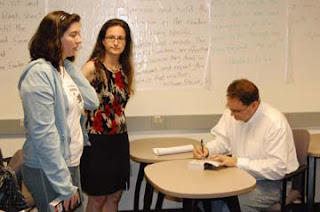 Finally, here's me signing a book. Unfortunately, I don't remember the name of the person in the blue jacket. Perhaps she'll read the blog and be kind enough to post her name for me. The woman behind her is Jeanne Cavelos, leader of the workshop. Jeanne is a terrific writing instructor. Many Odfellows have gone on to publish novels, me included. Hopefully you'll one day be reading the novels of this years grads. (And, if you'll pardon a repeat plug, you can already read the words of Eric James Stone, not just in Prime Codex but in many other fine publications. See his blog for a more complete list of his stories.)

Here I am with Joy Marchand, who provided transportation for me yesterday and is also responsible for that silly grin on my face being a more or less permanent feature these days. Joy and I have known each other for years as fellow authors. I first read her work when she won WOTF and have long admired her writing style. We've been anthology mates before, sharing space in last year's Modern Magic anthology. She wrote me back in February after I posted the "Five Things Few People Know About Me" blogs. After that, we started swapping flirty emails, which led to phone calls, and now to full blown dating, despite the fact that she lives in Massachusetts and I live in North Carolina.

Speaking of anthology mates, the guy in the photo above is Eric James Stone, fellow Codexian, fellow Phobos award winner, fellow Boot Camp alumni, and soon to be fellow Odyssey grad. We share space in the anthology he's holding up, Prime Codex, which continues to recieve glowing reviews. Eric is also the person who sent me the "Five Things Few People Know About Me" challenge, so he gets partial credit for Joy and I getting together. What a weirdly interconnected world we live in.
 After the discussion, I signed books. Lots and lots of books. Fortunately, I had just purchased a fresh inkpen for the event. Note to IRS: I kept the receipt for the pen. So far this year, I've been really good about keeping receipts.
  Finally, here's me signing a book. Unfortunately, I don't remember the name of the person in the blue jacket. Perhaps she'll read the blog and be kind enough to post her name for me. The woman behind her is Jeanne Cavelos, leader of the workshop. Jeanne is a terrific writing instructor. Many Odfellows have gone on to publish novels, me included. Hopefully you'll one day be reading the novels of this years grads. (And, if you'll pardon a repeat plug, you can already read the words of Eric James Stone, not just in Prime Codex but in many other fine publications. See his blog for a more complete list of his stories.)
Monday, July 02, 2007
Return to Odyssey
I attended the Odyssey Fantasy Writer's Workshop as a student back in 1998. Tomorrow, I'm going back to talk to this year's class as someone who has managed to build at least a modest career out of fiction.
As a result, I find myself in an introspective mood, thinking about what I've learned in the intervening nine years, trying to figure out if I have any useful advice for the current batch of students.
While advice from me may not be as valuable as advice from J. K. Rowling, I do have one nuggets I can share with the class:
The worst book you put onto paper is more valuable than the best book you keep in your head. Twice in my life, I've found myself in positions where I've been asked to show my work on short notice. The first time, Keith Olexa, the editor at Phobos, called me up to tell me I'd won a Phobos Award and asked if I'd written any novels. The year before I'd written "Nobody Gets the Girl." The novel at the time was short, only 55K words long. And, the ending was just dumb, nothing at all like the published ending. Before I sent it to him, I tacked on a new ending that was even worse, in which Rail Blade gets killed when the World Trade Towers fell on 9-11. A few months later, Keith called me back and said they wanted to publish the book, but the ending really needed to change. Knowledge that the book would see print proved a powerful creative force and I was able to arrive at the published ending, which I'm still quite proud of.
The second time, of course, came about when Nadia Cornier went from being an intern with an agency to being a full agent, if she could build a portfolio of clients. When this news reached me via the Codex boards, I was able to send her "Bitterwood," but a much shorter, less developed work than what is seeing print today. Still, while I look back on that version now as being amazingly devoid of setting details and shockingly thin on character development for the supporting cast, it still had the plot, pacing, theme, and energy that the final book has.
Can I write better novels than Bitterwood and Nobody? I think I can. I've got one book in my head that I think may be the book that turns me into a household name. Unfortunately, you can't read this book. I can't show it to an editor, and I've never been able to share more than a brief outline with my agent. It's a book I always feel I need to do just a little more research to write. It's a book I've become intimidated by. And, as a result, my perfect, fantastic book has never been read by anyone, while the good-but-could-be-better books I've published have been (or will be) read by thousands of people.
As a result, I find myself in an introspective mood, thinking about what I've learned in the intervening nine years, trying to figure out if I have any useful advice for the current batch of students.
While advice from me may not be as valuable as advice from J. K. Rowling, I do have one nuggets I can share with the class:
The worst book you put onto paper is more valuable than the best book you keep in your head. Twice in my life, I've found myself in positions where I've been asked to show my work on short notice. The first time, Keith Olexa, the editor at Phobos, called me up to tell me I'd won a Phobos Award and asked if I'd written any novels. The year before I'd written "Nobody Gets the Girl." The novel at the time was short, only 55K words long. And, the ending was just dumb, nothing at all like the published ending. Before I sent it to him, I tacked on a new ending that was even worse, in which Rail Blade gets killed when the World Trade Towers fell on 9-11. A few months later, Keith called me back and said they wanted to publish the book, but the ending really needed to change. Knowledge that the book would see print proved a powerful creative force and I was able to arrive at the published ending, which I'm still quite proud of.
The second time, of course, came about when Nadia Cornier went from being an intern with an agency to being a full agent, if she could build a portfolio of clients. When this news reached me via the Codex boards, I was able to send her "Bitterwood," but a much shorter, less developed work than what is seeing print today. Still, while I look back on that version now as being amazingly devoid of setting details and shockingly thin on character development for the supporting cast, it still had the plot, pacing, theme, and energy that the final book has.
Can I write better novels than Bitterwood and Nobody? I think I can. I've got one book in my head that I think may be the book that turns me into a household name. Unfortunately, you can't read this book. I can't show it to an editor, and I've never been able to share more than a brief outline with my agent. It's a book I always feel I need to do just a little more research to write. It's a book I've become intimidated by. And, as a result, my perfect, fantastic book has never been read by anyone, while the good-but-could-be-better books I've published have been (or will be) read by thousands of people.
Wednesday, June 27, 2007
The jockey lot lives!
My name appeared in the Independent Weekly in an article about the closing of the Jockey Lot. They quoted me toward the end of the article talking about the exotic nature of the place, and how you could take a five minute drive and suddenly find yourself in a South American country. Apparently, even though the buildings are closed, the action is still hot in the tents outside. I seldom went into the sheds anyway. The tents are where the good stuff could be found.
Also, I just posted to my Bitterwood blog an article called "Building a Better Dragon." If you ever worried that playing D&D as a teen will doom you to an adulthood of geekiness, this article should remove all doubt.
Finally, Solaris has just posted an interview with me on their features page. I would like to assure my mother should she read it that I make reference to dirty pictures on the internet purely in jest, and I've never, ever, I promise, used my computer for such a disgusting practice.
Also, I just posted to my Bitterwood blog an article called "Building a Better Dragon." If you ever worried that playing D&D as a teen will doom you to an adulthood of geekiness, this article should remove all doubt.
Finally, Solaris has just posted an interview with me on their features page. I would like to assure my mother should she read it that I make reference to dirty pictures on the internet purely in jest, and I've never, ever, I promise, used my computer for such a disgusting practice.
Sunday, June 24, 2007
Dragon sightings...
Dragons have been sighted here in North Carolina.


First, there's this photo, taken right here in Hillsborough.
This isn't a trick photo. When Joy Marchand visited last month, we were taking some photographs of the water tower in Hillsborough that looks like a UFO (below), and by chance happened to get a snap of this oddly draconian looking creature as well.

Then, of course, there are dragons in my living room and in bookstores. Check out my Bitterwood blog for more.
Tuesday, June 19, 2007
My goal is to have to buy a new bookshelf
I got my contributors copy of the Prime Codex anthology in the mail today. Last week, I got 4 contributors copies of the UK version of Bitterwood, though I'm still waiting on the US version. My bookshelf is starting to fill up nicely with books that contain my words. Most are anthologies, two are novels. In order of publication, roughly, they are:
Empire of Dreams and Miracles
Absolutely Brilliant in Chrome
Nobody Gets the Girl (novel)
All the Rage This Year
The Urban Bizarre
Modern Magic
Prime Codex
Bitterwood (novel)
Waiting in the wings are the Blood and Devotion anthology, the IGMS anthology, and the Solaris Book of New Fantasy. Not bad, considering my first publication was only 2002.
Empire of Dreams and Miracles
Absolutely Brilliant in Chrome
Nobody Gets the Girl (novel)
All the Rage This Year
The Urban Bizarre
Modern Magic
Prime Codex
Bitterwood (novel)
Waiting in the wings are the Blood and Devotion anthology, the IGMS anthology, and the Solaris Book of New Fantasy. Not bad, considering my first publication was only 2002.
Friday, June 15, 2007
Jockey Lot no more?
So, apparently the weekend I reported about the Jockey Lot was the last weekend they were open according to a news report I learned of this week. Apparently the buildings were in violation of zoning codes (having been there, I'd say, yeah, probably), so they were shut down by the fire department. But I'm less clear on the fate of the tents and open air vendors. I'll try to journey out this weekend and learn the truth, if I can find time to spare from my work on the Bitterwood sequel.
Tuesday, May 29, 2007
More reasons to move to Hillsborough
 #7, the Jockey Lot. Not technically in Hillsborough, but only a few minutes away, the Jockey Lot is a big flea market on Buckhorn Road just outside of Efland. North Carolina is currently experiencing a major demographic change as an influx of workers from Mexico have flooded in over the last decade or so, working in agriculture, the mills, construction, etc. Take a drive down Highway 70 toward Burlington and you'll find a dozen business that were once empty now occupied by Mexican grocers and restaurants. Spanish language newspapers are easy to find.
The full impact of the Mexican immigration really hits home when you go to the Jockey Lot.
Flea Markets used to be as lilly white a gathering place as you can imagine. Now, walking through the central tent mainstreets of the Jockey Lot has the feel of walking through an open air market in Mexico (or so I imagine, not having actually been to Mexico). Vendors are set up hawking everything from lingerie to bootleg videos to seafood. You can walk past several tents without seeing or hearing a single word of English.
I went there Saturday with Joy Marchand (pictured above), fellow Codexian and culinary artiste. We browsed among stands full of the most amazing fresh vegetables you can imagine. Ripe, juicy tomatoes were fifty cents a pound. Avacados at the perfect peak of ripeness were going for eighty cents each. Limes were ten for a buck. We bought some shrimp that looked like they'd been swimming in the ocean a few hours before, and some fresh cat fish, whiskers and all. Later that day we made salsa and ceviche that rivaled anything I've had in a restaurant, and we chased it down with fresh mangos and watermelon. Yum!
Since the internet has yet developed a way for me to transmit the tastes and smells of the rewards of Jockey Lot shopping, I hope you'll be content with the following photos, snapped by Ms. Marchand, who turns out to be as talented with a camera as she is with a keyboard. Get ready to feel hungry....


Friday, May 25, 2007
Prime Codex is Go!
This weekend sees the debut of Prime Codex! This is an anthology collecting the best published short stories of the Codexwriters group. You can buy a copy at Balticon this weekend, or order from the website linked to above for books that will start shipping on May 30. The title is also live on Amazon. All codexians have published at least one short story at professional rates, or, at a minimum, have graduated from a major workshop like Clarion or Odyssey. You can hardly blink these days without another Codexian selling a novel. Follow this link for a Codex Library.
My story in the anthology is a reprint of my first sale to Asimov's, "To the East, a Bright Star." Of the short stories I've published to date, "Bright Star" is at top of works I'm most proud of, dancing on the head of that pin with "Perhaps the Snail" and "Empire of Dreams and Miracles." It's the story about the choices we make when we are most aware that life is finite--much of the story unfolds in the last fifteen minutes before a comet is going to strike the planet, and our protagonist, a former circus tightrope walker named Tony, is faced with the choice of meeting his destiny the way he's imagined for the last ten years, since learning of the date and hour the comet would strike, or detouring from that dream in order to rescue a damsel in distress. One of the questions I'm faced with most often as an atheist is, why live a "moral" life? In the absence of the reward of heaven or fear of hell, what does it matter if you're kind to your fellow human beings or not? Do the choices you make matter in the absense of hope? This story is my most successful attempt to answer that question.
No reviews yet of the anthology, but you can read a review of my story at Emerald City. My story is the last one reviewed, so if you don't want to read about the entire issue of Asimov's just scroll to the bottom.
Speaking of Codexians, I get to meet one today, Joy Marchand. She doesn't have a story in Prime Codex, but we share a table of contents in Modern Magic and I've read her story in Interfictions, "Pallas at Noon." I can safely report she's insanely talented, writing rich, image-filled prose at a level of talent I can only dream of. If you're interested in Prime Codex and want to qualify for free shipping, throw in a copy of either of the above two anthologies, although if you have to pick one, pick Interfictions, since "Pallas at Noon" is such a strong work. The final scene, and the final line, are amazing (in the context of the story, natch... don't just read the last line and think, "What's so amazing about this?").
My story in the anthology is a reprint of my first sale to Asimov's, "To the East, a Bright Star." Of the short stories I've published to date, "Bright Star" is at top of works I'm most proud of, dancing on the head of that pin with "Perhaps the Snail" and "Empire of Dreams and Miracles." It's the story about the choices we make when we are most aware that life is finite--much of the story unfolds in the last fifteen minutes before a comet is going to strike the planet, and our protagonist, a former circus tightrope walker named Tony, is faced with the choice of meeting his destiny the way he's imagined for the last ten years, since learning of the date and hour the comet would strike, or detouring from that dream in order to rescue a damsel in distress. One of the questions I'm faced with most often as an atheist is, why live a "moral" life? In the absence of the reward of heaven or fear of hell, what does it matter if you're kind to your fellow human beings or not? Do the choices you make matter in the absense of hope? This story is my most successful attempt to answer that question.
No reviews yet of the anthology, but you can read a review of my story at Emerald City. My story is the last one reviewed, so if you don't want to read about the entire issue of Asimov's just scroll to the bottom.
Speaking of Codexians, I get to meet one today, Joy Marchand. She doesn't have a story in Prime Codex, but we share a table of contents in Modern Magic and I've read her story in Interfictions, "Pallas at Noon." I can safely report she's insanely talented, writing rich, image-filled prose at a level of talent I can only dream of. If you're interested in Prime Codex and want to qualify for free shipping, throw in a copy of either of the above two anthologies, although if you have to pick one, pick Interfictions, since "Pallas at Noon" is such a strong work. The final scene, and the final line, are amazing (in the context of the story, natch... don't just read the last line and think, "What's so amazing about this?").
Wednesday, May 23, 2007
Skink in Bed
I came home Monday and found a skink sitting on the end of my bed. Skinks are small, slinky lizards, this one about 6 inches long. They are insanely fast, so, alas, I failed to catch this one.
I feel really let down by my cats. I've been providing them cat food and kitty litter for the better part of a decade now, and, really I don't ask for a whole lot in return. I would say the minimum duty I expect of my cats, though, is to be vigilent in keeping my bedroom free of reptiles.
Now, I'm sleeping a bit lighter than I was, knowing there's a lizard sneaking around somewhere among the dirty socks on the floor. Or, worse, that there's some hole I'm unaware of between the inside of my bedroom and the outside of my house. What's coming in next?
I feel really let down by my cats. I've been providing them cat food and kitty litter for the better part of a decade now, and, really I don't ask for a whole lot in return. I would say the minimum duty I expect of my cats, though, is to be vigilent in keeping my bedroom free of reptiles.
Now, I'm sleeping a bit lighter than I was, knowing there's a lizard sneaking around somewhere among the dirty socks on the floor. Or, worse, that there's some hole I'm unaware of between the inside of my bedroom and the outside of my house. What's coming in next?
Saturday, May 19, 2007
Ungraceful follow up
With my last entry being one about Laura, I've been feeling a little restrained on my next blog posting. I couldn't think of any graceful way to move from a reflection on love and death and memory to a post about current events. So, I've just decided to do it gracelessly.
I am not a republican, and in NC that means I can't vote in the republican primary. Which is a shame, because I finally found someone I could imagine voting for among the major parties--Ron Paul. In the last debate, one of the big news items was how strong Rudy Guiliani came out of it because he had smacked down Ron Paul for daring to suggest that American foriegn policy somehow led to 9-11.
I was barely aware of Ron Paul before the news started reporting what an idiot he was. After the debate, I heard commentators on the radio saying his campaign was probably over now--not that it had ever been alive before. I was vaguely aware he was the only republican running for president who had opposed the war in Iraq from the start, and that he had been the Libertarian candidate for president back in 88. Outside of this, I didn't much care to spend the time to learn his opinions.
I didn't watch the debate, but I've since gone and read transcripts and have to conclude, despite the reaction of the crowd, Guiliani was wrong and Ron Paul was right. Guiliani, Bush, and countless others on the right seem to have the public position that 9-11 was caused purely due to evil. Osama bin Ladin devoted his time and attention to killing American's because he's evil personified, an agent of the devil, utterly without any motivation other than wickedness.
The US, on the otherhand, is incapable of wrongdoing. Sure, we kill a lot of people. Dating back to the first gulf war, we've unquestionably killed tens of thousands of Islamic civilians with bombings, and made life miserable for millions with sanctions and destruction of infrastructure and by funnelling support to dictators in places like Saudi Arabia and Pakistan. This has nothing to do with evil though... it's all perfectly rational and virtuous responses to evil.
Here's the thing: I think that most of our reactions are rational. It's not that hard to rationalize supporting the Saudi's when the world's energy supply depends on stability. It's not so hard to rationalize invading Afghanistan when they shelter terrorists who've successfully struck us at home. There's even a certain logic that can be followed into overthrowing Saddam Hussein and plunging a country into chaos and war for a decade or more, causing the death of hundreds of thousands and economic and political turmoil. The invasion has the same logic as chemotherapy--it's going to cause a lot of pain and suffering now, but in the gamble that it will eliminate a larger threat. And, it's possible to rationalize embracing and supporting the only dictatorship absolutely proven to have developed nuclear weapons and illegally transferring the technology to our enemies--Pakistan--since Pakistan publicly supports us, and in diplomacy what you say overrides what you do.
I'm NOT arguing that US foreign policy is evil. I won't proclaim it virtuous, but I will say that I believe it is designed by men who believe themselves to be virtuous and reasonable and acting for the long-term good of mankind. Of course, I also think this is the basic mindset of terrorists as well. They are certain that they are virtuous, rational, and that their actions are the only long-term hope of mankind.
The opinions in that last paragraph are my own, and I have no idea how Ron Paul would feel abot them. I'm pretty certain Giuliani or Bush or McCain would shout them down. If I were writing these ideas in Iraq or Afghanistan, most republicans would probably feel perfectly comfortable with arresting me and putting me in a cell in Cuba with no hope of trial or appeal. (Side note: Right now, per square mile of Cuban soil, who do you think is holding more people in jail with no trials--Castro or Bush? I don't know the answer, but isn't it bothersome that this is even a question at all?)
So, I salute Ron Paul for being thoughtful, honest, and courageous enough to say what he said to an audience he must have known would be hostile. I don't think he'll win the nomination; I don't even know if he'll be invited to future debates. But, if some sort of mysterious plague strikes and he winds up being the last surviving republican candidate... I could vote for him without holding my nose. I haven't felt his way about a major party candidate for twenty years.
I am not a republican, and in NC that means I can't vote in the republican primary. Which is a shame, because I finally found someone I could imagine voting for among the major parties--Ron Paul. In the last debate, one of the big news items was how strong Rudy Guiliani came out of it because he had smacked down Ron Paul for daring to suggest that American foriegn policy somehow led to 9-11.
I was barely aware of Ron Paul before the news started reporting what an idiot he was. After the debate, I heard commentators on the radio saying his campaign was probably over now--not that it had ever been alive before. I was vaguely aware he was the only republican running for president who had opposed the war in Iraq from the start, and that he had been the Libertarian candidate for president back in 88. Outside of this, I didn't much care to spend the time to learn his opinions.
I didn't watch the debate, but I've since gone and read transcripts and have to conclude, despite the reaction of the crowd, Guiliani was wrong and Ron Paul was right. Guiliani, Bush, and countless others on the right seem to have the public position that 9-11 was caused purely due to evil. Osama bin Ladin devoted his time and attention to killing American's because he's evil personified, an agent of the devil, utterly without any motivation other than wickedness.
The US, on the otherhand, is incapable of wrongdoing. Sure, we kill a lot of people. Dating back to the first gulf war, we've unquestionably killed tens of thousands of Islamic civilians with bombings, and made life miserable for millions with sanctions and destruction of infrastructure and by funnelling support to dictators in places like Saudi Arabia and Pakistan. This has nothing to do with evil though... it's all perfectly rational and virtuous responses to evil.
Here's the thing: I think that most of our reactions are rational. It's not that hard to rationalize supporting the Saudi's when the world's energy supply depends on stability. It's not so hard to rationalize invading Afghanistan when they shelter terrorists who've successfully struck us at home. There's even a certain logic that can be followed into overthrowing Saddam Hussein and plunging a country into chaos and war for a decade or more, causing the death of hundreds of thousands and economic and political turmoil. The invasion has the same logic as chemotherapy--it's going to cause a lot of pain and suffering now, but in the gamble that it will eliminate a larger threat. And, it's possible to rationalize embracing and supporting the only dictatorship absolutely proven to have developed nuclear weapons and illegally transferring the technology to our enemies--Pakistan--since Pakistan publicly supports us, and in diplomacy what you say overrides what you do.
I'm NOT arguing that US foreign policy is evil. I won't proclaim it virtuous, but I will say that I believe it is designed by men who believe themselves to be virtuous and reasonable and acting for the long-term good of mankind. Of course, I also think this is the basic mindset of terrorists as well. They are certain that they are virtuous, rational, and that their actions are the only long-term hope of mankind.
The opinions in that last paragraph are my own, and I have no idea how Ron Paul would feel abot them. I'm pretty certain Giuliani or Bush or McCain would shout them down. If I were writing these ideas in Iraq or Afghanistan, most republicans would probably feel perfectly comfortable with arresting me and putting me in a cell in Cuba with no hope of trial or appeal. (Side note: Right now, per square mile of Cuban soil, who do you think is holding more people in jail with no trials--Castro or Bush? I don't know the answer, but isn't it bothersome that this is even a question at all?)
So, I salute Ron Paul for being thoughtful, honest, and courageous enough to say what he said to an audience he must have known would be hostile. I don't think he'll win the nomination; I don't even know if he'll be invited to future debates. But, if some sort of mysterious plague strikes and he winds up being the last surviving republican candidate... I could vote for him without holding my nose. I haven't felt his way about a major party candidate for twenty years.
Sunday, May 06, 2007
One year
Laura died one year ago today. I remember that morning, driving home from the hospital, listening to "The Coroner's Gambit" on my car stereo, watching the morning getting lighter after an all night vigil at the hospital. My emotions that morning weren't so much sorrow as exhaustion. I had a hard time thinking or feeling anything about what had happened that night. I just wanted to get some sleep, then deal with the grief at a later time.
I have grieved over the past year, but the experience wasn't anything like what I imagined during Laura's final months. I expected to be devastated, to have a difficult time getting out of bed, to be, at the very least, depressed for weeks and months.
But, in the immediate aftermath, I discovered that the predominant thing I felt was busy. There were phone calls to be made and arrangements to be decided on and a houseful of people who had needs that would have to be addressed. Then, once all that was gone, I had a whole different rush of stuff. I had a book under contract I needed to rewrite, I had to find a new place to live, then I had to renovate a house, then move in, then more writing, and then it was Valentine's Day and then Laura's Birthday and now the anniversary of her death and I find myself wondering if I somehow did it wrong. I didn't go out and wear black for a year. I made several trips to Laura's grave and placed flowers, but I didn't sit by the grave and have long conversations the way you see in movies.
I visited the grave today, the photos of the flowers are flowers that Simon and Veronica picked for her yesterday. I bought some vases and arranged the flowers and we placed them at the grave as a light rain fell. Then, last night the rain really came down, and I woke up this morning certain that the vases had fallen over. I drove back out this morning and found that my suspicions were correct and I propped the vases back up and fixed the flowers. My hunch is I won't be the only person to visit the grave today, and I wanted it to look nice.
It struck me that even today it wasn't grief that motivated my visit as much as it was an immediate task, doing something that needed to be done.
I think Laura would understand. Laura was the person who had to face the reality that she wasn't going to beat the cancer. Her main mechanism for coping with the darkness in her future was to concentrate on her present. She couldn't let despair pin her to the bed, because she had to get up to drive her kids to school, then do laundry, then go shopping, and she did these things well past the point where she felt comfortable doing them. A large secret to her living with cancer as long as she did was simple momentum. She just stayed too busy to die. But, eventually, her energy began to wane.
The picture below of Laura on the couch with Yoshi is from March 17 of last year. This is a fairly representative picture of Laura during the last few months of her life. She's stretched out on the couch because she didn't really have the energy to do much else. Yoshi, her cat, really bonded with her during this time. And, you can tell from the smile, she was still happy. She wasn't healthy any more, and it hurt her to walk or sit or lie still or breathe, and somehow she was, on the whole, still happy. Even on the last day I spent with her while she was conscious, she was cracking jokes, and happy to see visitors. She enjoyed her life. She lived each day to whatever degree her body allowed.
A few weeks before she died, she was laying on the couch in a pose much like this. It was on the weekend, mid-afternoon, and she was still in her pajamas. I asked her if she wanted to go get something to eat. She didn't. She really had no appetite at all by that point. She was always dealing with a certain amount of pain, and didn't feel like going anywhere or seeing anyone, but she was also tired of being in the house. So, I told her we could just go drive around in the country and enjoy the nice spring weather. I wanted to see her up and active, for her to feel like she was living instead of just surviving.
She changed clothes and we went out to the car. She leaned the car seat back as we drove up 54 and I kept turning down side roads to take us deeper into the country. There are a lot of roads that go off 54 and I'd always wondered where they led to. We passed countless rolling fields of yellow and blue wildflowers and wound up in Saxapahaw and drove over the river there, a nice little scenic gorge. We later wound up at a fruit stand near Mebane where I went in and bought her a Jarito's mineral water, and on the way home we found a Sonic Drive-in and she asked me to stop so she could get some tater tots.
I know it's crazy, but I don't think I've ever had a moment of such clear and wonderful hope as I did watching her eat those tater tots. She was hungry, and she was happy, and the fresh spring air and beautiful scenery seemed to have revived her, at least for the moment. I knew, I knew she was dying, but I believed in the healing power of weekend drives, and fields of wildflowers, and fresh air and sunshine and tater tots, and I thought we would be making these trips for a long, long time.
It's that day I remember, more than the hospital. It's that day I remember, more than the funeral home, or the church, or the cemetary. It's a drive I've taken several times since, or a drive like it, sometimes alone, sometimes with friends. I'll just go out for a drive in the country, and I'll see a road, and wonder, where does that go? And I turn the wheel, and follow the new road, and I watch the fields pass by.


I have grieved over the past year, but the experience wasn't anything like what I imagined during Laura's final months. I expected to be devastated, to have a difficult time getting out of bed, to be, at the very least, depressed for weeks and months.
But, in the immediate aftermath, I discovered that the predominant thing I felt was busy. There were phone calls to be made and arrangements to be decided on and a houseful of people who had needs that would have to be addressed. Then, once all that was gone, I had a whole different rush of stuff. I had a book under contract I needed to rewrite, I had to find a new place to live, then I had to renovate a house, then move in, then more writing, and then it was Valentine's Day and then Laura's Birthday and now the anniversary of her death and I find myself wondering if I somehow did it wrong. I didn't go out and wear black for a year. I made several trips to Laura's grave and placed flowers, but I didn't sit by the grave and have long conversations the way you see in movies.
I visited the grave today, the photos of the flowers are flowers that Simon and Veronica picked for her yesterday. I bought some vases and arranged the flowers and we placed them at the grave as a light rain fell. Then, last night the rain really came down, and I woke up this morning certain that the vases had fallen over. I drove back out this morning and found that my suspicions were correct and I propped the vases back up and fixed the flowers. My hunch is I won't be the only person to visit the grave today, and I wanted it to look nice.
It struck me that even today it wasn't grief that motivated my visit as much as it was an immediate task, doing something that needed to be done.
I think Laura would understand. Laura was the person who had to face the reality that she wasn't going to beat the cancer. Her main mechanism for coping with the darkness in her future was to concentrate on her present. She couldn't let despair pin her to the bed, because she had to get up to drive her kids to school, then do laundry, then go shopping, and she did these things well past the point where she felt comfortable doing them. A large secret to her living with cancer as long as she did was simple momentum. She just stayed too busy to die. But, eventually, her energy began to wane.
The picture below of Laura on the couch with Yoshi is from March 17 of last year. This is a fairly representative picture of Laura during the last few months of her life. She's stretched out on the couch because she didn't really have the energy to do much else. Yoshi, her cat, really bonded with her during this time. And, you can tell from the smile, she was still happy. She wasn't healthy any more, and it hurt her to walk or sit or lie still or breathe, and somehow she was, on the whole, still happy. Even on the last day I spent with her while she was conscious, she was cracking jokes, and happy to see visitors. She enjoyed her life. She lived each day to whatever degree her body allowed.
A few weeks before she died, she was laying on the couch in a pose much like this. It was on the weekend, mid-afternoon, and she was still in her pajamas. I asked her if she wanted to go get something to eat. She didn't. She really had no appetite at all by that point. She was always dealing with a certain amount of pain, and didn't feel like going anywhere or seeing anyone, but she was also tired of being in the house. So, I told her we could just go drive around in the country and enjoy the nice spring weather. I wanted to see her up and active, for her to feel like she was living instead of just surviving.
She changed clothes and we went out to the car. She leaned the car seat back as we drove up 54 and I kept turning down side roads to take us deeper into the country. There are a lot of roads that go off 54 and I'd always wondered where they led to. We passed countless rolling fields of yellow and blue wildflowers and wound up in Saxapahaw and drove over the river there, a nice little scenic gorge. We later wound up at a fruit stand near Mebane where I went in and bought her a Jarito's mineral water, and on the way home we found a Sonic Drive-in and she asked me to stop so she could get some tater tots.
I know it's crazy, but I don't think I've ever had a moment of such clear and wonderful hope as I did watching her eat those tater tots. She was hungry, and she was happy, and the fresh spring air and beautiful scenery seemed to have revived her, at least for the moment. I knew, I knew she was dying, but I believed in the healing power of weekend drives, and fields of wildflowers, and fresh air and sunshine and tater tots, and I thought we would be making these trips for a long, long time.
It's that day I remember, more than the hospital. It's that day I remember, more than the funeral home, or the church, or the cemetary. It's a drive I've taken several times since, or a drive like it, sometimes alone, sometimes with friends. I'll just go out for a drive in the country, and I'll see a road, and wonder, where does that go? And I turn the wheel, and follow the new road, and I watch the fields pass by.


Subscribe to:
Posts (Atom)


 Posts
Posts


