

I was reading the paper yesterday when an ad caught my eye. The headline of the ad read "Which of the Following Sins Would Most Likely Send a Person to Hell?" The four choices were 1) Murder, 2) Stealing, 3) Adultery, and 4) Homosexuality. You were then invited to engage in free Bible correspondence to discover the answer. The bottom lines of the ad read, "No time limit. Certificate upon completion."
The reason the ad caught my attention was that beside the words "Send a Person to Hell" there was a drawing of a bearded man in a robe that I'm guessing is meant to be God. God in medieval art is frequently portrayed with a stern, serious expression, but this God is drawn with a broad smile. The juxtaposition of words and image implies, to me at least, that God is gleeful at the thought of sending a person to Hell for one of the above sins. He looks like he's laughing at his own joke. "You want to get into Heaven? Well of course, come on... NOT! You're going to Hell! HAHAHAHA!"
It's not so much God as an authority figure as God as a supervillian. Which, I'm doubting was the intent of the ad.
I tore the ad out of the paper and brought it home. I intended to scan it and post it on my blog. I launched my scanner and got the preview image. I hit the scan button... and my scanner died. It's kaput. My computer doesn't even recognize that it's plugged in any more. It seems to have no power to it at all.
When I took the ad off the scanner, I kind of expected a FIFTH ANSWER:
5) Scanning God's image with the intent of mocking him on the internet.
Oh well, when it comes to Hell, in for a penny, in for a pound, I guess. Because, if I understand the Christian theology of my youth, the answer to the checklist in the ad is both "All of the above" and "None of the above." "None of the above" in the two ways. First, you can do all these sins, and worse, then repent and accept Jesus and get your get out of Hell free card. Second, if you don't do any of these sins, but still don't repent and accept Jesus, you're going to Hell anyway. You are born, after all, with original sin. You could slip and hit your head as a toddler and live 80 years in a coma and ZOOP, off to Hell with you when you die. Going to Hell is the default position... it requires an active decision to change that fate.
This all or nothing element of damnation is one reason I'm mystified by conservative Christian stands against certain sins in particular. Homosexuality, for instance. If you talk to conservative Christians who oppose homosexuality, they will tell you that they are just trying to save the fags from Hell. Homosexuality is listed as a sin, after all. But, of course, so is eating pork, and you don't see them running through McDonald's smacking bacon cheeseburgers out of people's hands. And don't get me started about coveting. Coveting is right there on the big ten list of no-no's. Unfortunately, it seems to me, especially during the holidays, that the entire American economy is built on coveting. People want the hottest toys and gadgets so much they get into fist fights in the parking lot. Why aren't conservative Christian's standing in front of Walmart warning people that excessive desire for a material thing is a sin?
I should probably write in and ask the free Bible correspondence people. I'm thinking that certificate would look nice on the wall.
Saturday, December 09, 2006


Monday, December 04, 2006
A banjo quilted
I've been playing around with altvista.com's babelfish translator and just tried translating the opening lines of my story Silent as Dust. I randomly chose Portuguese as the language to translate to and from. The results were interesting:
The Company That I remain myself. I am judging a sample of talent in the attic of seven chimneys. We are close to the chimney master, we enter one maze of the boxes, gray with grime. Moonlight through the round window serves as spotlight for ours contestants. First above of it is Dan, a fulled hart dirige with five antlers of the point and startled the look in its glass eyes. Dan sings of the "a rock jailhouse" as if one was ballad blue of the gram, folloied for Binky, a monkey of sock with a banjo quilted. It comes after that the professor To blink, a bear of teddy 65-year-old with an eye and half of its original skin. The professor To blink is to juggler, keeping in high a rammer of crochet, a light bulb broken of washes, and ceramic manger of the decorations of christmas. When all the three articles are in air, grasp an old sphere of bowling and launch it in the cool mixture with one grace that points gain it.
The original, for comparison:
The Company I Keep. I'm judging a talent show in the attic of Seven Chimneys. We're near the master chimney, amidst a maze of boxes, gray with grime. The moonlight through the round window serves as the spotlight for our contestants.
First up is Dan, a stuffed deer head with five point antlers and a startled look in his glass eyes. Dan sings "Jailhouse Rock" as if it were a blue grass ballad, accompanied by Binky, a sock monkey with a quilted banjo.
Next comes Professor Wink, a 65-year-old teddy bear with one eye and half his original fur. Professor Wink is a juggler, keeping aloft a crochet mallet, a broken lava lamp, and the ceramic manger from the Christmas decorations. When all three items are in the air, he grabs an old bowling ball and tosses it into the mix with a cool grace that earns him points.
How did I ever waste the precious hours of my life before the internet?
The Company That I remain myself. I am judging a sample of talent in the attic of seven chimneys. We are close to the chimney master, we enter one maze of the boxes, gray with grime. Moonlight through the round window serves as spotlight for ours contestants. First above of it is Dan, a fulled hart dirige with five antlers of the point and startled the look in its glass eyes. Dan sings of the "a rock jailhouse" as if one was ballad blue of the gram, folloied for Binky, a monkey of sock with a banjo quilted. It comes after that the professor To blink, a bear of teddy 65-year-old with an eye and half of its original skin. The professor To blink is to juggler, keeping in high a rammer of crochet, a light bulb broken of washes, and ceramic manger of the decorations of christmas. When all the three articles are in air, grasp an old sphere of bowling and launch it in the cool mixture with one grace that points gain it.
The original, for comparison:
The Company I Keep. I'm judging a talent show in the attic of Seven Chimneys. We're near the master chimney, amidst a maze of boxes, gray with grime. The moonlight through the round window serves as the spotlight for our contestants.
First up is Dan, a stuffed deer head with five point antlers and a startled look in his glass eyes. Dan sings "Jailhouse Rock" as if it were a blue grass ballad, accompanied by Binky, a sock monkey with a quilted banjo.
Next comes Professor Wink, a 65-year-old teddy bear with one eye and half his original fur. Professor Wink is a juggler, keeping aloft a crochet mallet, a broken lava lamp, and the ceramic manger from the Christmas decorations. When all three items are in the air, he grabs an old bowling ball and tosses it into the mix with a cool grace that earns him points.
How did I ever waste the precious hours of my life before the internet?
Thursday, November 23, 2006
Long shot Hail Mary
Tonight, I sent my first ever submission to the New Yorker. A few months ago I wrote a story called "Silent as Dust" for the Codexwriters Halloween contest. This was my third time entering the contest. The first two years, I came in second place. In fact, I split second place one year with Tom Pendergrass, so if you are a glass half empty kind of person, I tied for third the first year. So, this year, I was hungry to win. I'm not positive why... it's not like there's money involved. The stories don't get published. (At least, not a guaranteed publication... several contest stories have gone on to sales at various outlets.) But, my short story output has waned over the years. I find, as I've become a better writer, I have a harder and harder time finding stories I can get excited about writing. Ten years ago, any idea I had seemed like a pretty good one. Now, if find I'm much more picky. There are professional writers who can sit down and write a story about just about anything. They could take the headings from the spam in their email boxes and find inspiration. I don't have that kind of drive. So, the Codex contests keep me cranking out short fiction. Of the four contests I've entered, I've sold two of the stories, one of them twice, and have faith that the other two will find a home eventually.
Silent as Dust was my submission this year to the contest. I had a vibe when I submitted it that it would probably win. It turned out to be a landslide. In the aftermath, I had half a dozen people tell me I should submit the story to some prestigious market like the New Yorker or Playboy. And, I figure, what have I got to lose? It turns out the New Yorker takes email submissions. It can't even claim I'm wasting postage.
Still, the New Yorker rejects about a thousand stories for every one they accept. Pretty lousy odds, but better than the lottery. And, I don't exactly write a lot of stories that would fit in the pages of the New Yorker... I'm not positive this one does either, but it's a quirky little ghost story with very subdued supernatural elements. It's a more likely fit than, say, Final Flight of the Blue Bee.
Speaking of Blue Bee, I got my copy of ESLI with the story in Russian. It's utterly bizarre to open a magazine and not even be able to read my own name. I can only recognize my story by the illustration and the copyright containing the Asimov's first publication acknowledgement. I hope it eventually appears online and I can translate it using babelfish.
Silent as Dust was my submission this year to the contest. I had a vibe when I submitted it that it would probably win. It turned out to be a landslide. In the aftermath, I had half a dozen people tell me I should submit the story to some prestigious market like the New Yorker or Playboy. And, I figure, what have I got to lose? It turns out the New Yorker takes email submissions. It can't even claim I'm wasting postage.
Still, the New Yorker rejects about a thousand stories for every one they accept. Pretty lousy odds, but better than the lottery. And, I don't exactly write a lot of stories that would fit in the pages of the New Yorker... I'm not positive this one does either, but it's a quirky little ghost story with very subdued supernatural elements. It's a more likely fit than, say, Final Flight of the Blue Bee.
Speaking of Blue Bee, I got my copy of ESLI with the story in Russian. It's utterly bizarre to open a magazine and not even be able to read my own name. I can only recognize my story by the illustration and the copyright containing the Asimov's first publication acknowledgement. I hope it eventually appears online and I can translate it using babelfish.
Tuesday, November 21, 2006
Talk the Talk
My friend Luc Reid has recently published a book called Talk the Talk. It's a dictionary of subculture terms, examining specific phrases unique to groups such as rock climbers, role play gamers, drug pushers, and homosexuals. It's being pushed by the publisher, Writer's Digest, as a reference book for authors. But, I think it's also going to be of interest to anyone with an interest in slang and obscure cultural references. It's well researched and attractively packaged, and would make a good coffee table book, or, let's be blunt, excellent bathroom reading. Also, I think it would make an excellent gift for a crossword puzzle fanatic, since I bet crossword puzzle editors dig through books like this for fresh clues. Check it out.
Monday, November 13, 2006
I'm moved! For real this time!
I carried in the last boxes from my car tonight. Everything that used to be in my old apartment is now either at my new house or in the dump. Next time I move, I hope I'm in a strong enough financial position to pay someone to do it for me. I sincerely appreciate all the people who've helped me move these last few weeks, but dragging it out over the course of weeks has been exhausting. When you hire pros, they sweep in a box everything in a few hours, whether you want it boxed or not. There's a certain appeal to this.
Saturday, November 11, 2006
Gridlock! I hope. Maybe.
It's been ages since I've done a political post. I think there's been one since Laura passed away. I find that my interest in politics has waned during the last year. Part of it has been the unrelenting sameness of the news. During the Clinton administration, I was fired up over what I saw as government abuse of power. Things like the slaughter of children at Waco, the Clinton's pulling the IRS records of their political enemies to dig for dirt, the allegations of government monitoring of international traffic, and the involvement in a war against a country that posed absolutely no threat to us (Bosnia) seemed like the beginning of the end of what we think of as democracy. So, of course, all these practices continued, and were often taken to a whole new level by the Bush administration. Worse, Clinton had faced a hostile congress and actually was unable to pass any huge new spending initiatives like big health care plans. Bush with a friendly congress went out and spent money as if it was just some imaginary number on a government spreadsheet. And, he did it while cutting taxes, more or less. (Tax revenues are actually increasing, so I'm hesitant to call his tax cuts tax cuts. When the government has less money to spend next year than it did the year before, I'll call that a tax cut.) Bush and the Republicans are spending like a typical American consumer... they are living on credit cards, buying a lifestyle they can't afford at present by mortgaging the future.
I don't think the Democrat takeover of congress will signal an end to any of this. But, maybe it will slow it down with gridlock for at least a couple of years. Bush and the Dems can be like squabbling spouses arguing whether or not to use the credit cards for a big screen TV or to send the kids to summer camp. Maybe in the end one of them will end up sleeping on the couch and neither purchase will get made, though I recognise the risk that maybe they'll make nice and buy both.
I confess, though, I have lost most of my interest in politics due to a growing despair that we'll ever see the birth of sensible government. (I won't say a return to... when has our goverment ever been sensible.)
How would I define sensible government? Here are three things I'd like to see government do:
1. STOP KILLING PEOPLE. Seriously, the world just doesn't pose that big of a threat to us. Canada isn't going to invade, Mexico IS invading, but as near as I can tell their takeover mainly involves lawncare and hanging drywall, and the Chinese aren't going to mess with us because they are too busy selling shoes. And how, exactly, was Iraq supposed to invade us? Did they even have a navy? Using our military to try to stop terrorism is a bit like trying to use a sledgehammer to kill a nest of fireants. You can flatten that anthill, and probably kill a lot of ants, but it's not going to solve he problem on anything but a temporary cosmetic measure. And, was it a problem? Yes, terrorists had a big symbolic hit. They hurt a lot of people. But sending our troops out to stop a future attack has killed more American troops than the people who died on 9-11, and cost a lot more economically. Not to get all Christian on you or anything, but there is a certain strategic wisdom, at times, to turning the other cheek. We would have made much more of a blow to the passion of the terrorists if we'd just carried on with life.
2. STOP PORKING US! Okay, I'm a realist. I know that the big money in government is being spent on big projects... Social Security, Medicare, Defense, and paying interest on the debt. The money being set aside as earmarks for local projects is relatively trivial. But trivial adds up in the long run. If we have to spend federal money, we should be spending it on national projects only. Sending money that benifits only one district by building a bridge or a museum or a golf course is a misuse of Federal money. State and local money should finance state and local projects.
3. FLIP HEALTH CARE. Okay, here's why I'm not strictly a libertarian anymore. My close involvement with the health care system during Laura's illness has made me think that, yes, maybe there is a government role to be played here. But, I think that all government schemes I've seen for "universal" health care are awful. I think that any scheme that has the government getting involved in all aspects of health care is doomed to be wasteful. Some will argue that if we cover the costs of the small stuff, the preventive medicine, it will save money in the long run. This is such nonsense. Money isn't the main obstacle to people getting preventive health care. An annual check up, better diet, and excercise cost a couple of hundred bucks. It's not lack of funds that are keeping people away from the doctor, it's American's natural apathy towards their own health, which doesn't have a government solution. So, let's get rid of government plans that concentrate on the small scale spending, and pay attention to catastrophic illnesses.
The details of the plan can be worked out by people with actual facts and figures. But, one approach would be to set an arbitrary number and decide that government would pick up costs beyond that number, no questions asked in the case of life threatening illness. So, the first fifty thousand bucks of a person's illness would be the responsibility of the sicko and the insurance company. Or maybe the first 1oo grand. Or the first ten grand. A second approach would be to scale this number based on the persons income. Major illnesses shouldn't bankrupt people, but it's silly for the government to be picking up the bill for Dick Cheney's heart attacks. Trust me, Cheney can pay for his own health care. My dad, on the other hand, would probably not survive the economic hit of Cheney's health problems. So, maybe the scale should be based on a person's most recent tax return. If you earned $20k last year, the number where the government would step in would be low, maybe $5k. If you were Bill Gates, maybe the goverment wouldn't step in until you were.... well, let's be blunt. If you had a health condition serious enough to risk your wealth at Bill Gates level, the most merciful approach to your health care might be to drag you out behind the shed and hit you with a sledgehammer.
The odds of getting this passed, by the way, are precisely zero. But, thought I'd toss it on the table anyway.
I don't think the Democrat takeover of congress will signal an end to any of this. But, maybe it will slow it down with gridlock for at least a couple of years. Bush and the Dems can be like squabbling spouses arguing whether or not to use the credit cards for a big screen TV or to send the kids to summer camp. Maybe in the end one of them will end up sleeping on the couch and neither purchase will get made, though I recognise the risk that maybe they'll make nice and buy both.
I confess, though, I have lost most of my interest in politics due to a growing despair that we'll ever see the birth of sensible government. (I won't say a return to... when has our goverment ever been sensible.)
How would I define sensible government? Here are three things I'd like to see government do:
1. STOP KILLING PEOPLE. Seriously, the world just doesn't pose that big of a threat to us. Canada isn't going to invade, Mexico IS invading, but as near as I can tell their takeover mainly involves lawncare and hanging drywall, and the Chinese aren't going to mess with us because they are too busy selling shoes. And how, exactly, was Iraq supposed to invade us? Did they even have a navy? Using our military to try to stop terrorism is a bit like trying to use a sledgehammer to kill a nest of fireants. You can flatten that anthill, and probably kill a lot of ants, but it's not going to solve he problem on anything but a temporary cosmetic measure. And, was it a problem? Yes, terrorists had a big symbolic hit. They hurt a lot of people. But sending our troops out to stop a future attack has killed more American troops than the people who died on 9-11, and cost a lot more economically. Not to get all Christian on you or anything, but there is a certain strategic wisdom, at times, to turning the other cheek. We would have made much more of a blow to the passion of the terrorists if we'd just carried on with life.
2. STOP PORKING US! Okay, I'm a realist. I know that the big money in government is being spent on big projects... Social Security, Medicare, Defense, and paying interest on the debt. The money being set aside as earmarks for local projects is relatively trivial. But trivial adds up in the long run. If we have to spend federal money, we should be spending it on national projects only. Sending money that benifits only one district by building a bridge or a museum or a golf course is a misuse of Federal money. State and local money should finance state and local projects.
3. FLIP HEALTH CARE. Okay, here's why I'm not strictly a libertarian anymore. My close involvement with the health care system during Laura's illness has made me think that, yes, maybe there is a government role to be played here. But, I think that all government schemes I've seen for "universal" health care are awful. I think that any scheme that has the government getting involved in all aspects of health care is doomed to be wasteful. Some will argue that if we cover the costs of the small stuff, the preventive medicine, it will save money in the long run. This is such nonsense. Money isn't the main obstacle to people getting preventive health care. An annual check up, better diet, and excercise cost a couple of hundred bucks. It's not lack of funds that are keeping people away from the doctor, it's American's natural apathy towards their own health, which doesn't have a government solution. So, let's get rid of government plans that concentrate on the small scale spending, and pay attention to catastrophic illnesses.
The details of the plan can be worked out by people with actual facts and figures. But, one approach would be to set an arbitrary number and decide that government would pick up costs beyond that number, no questions asked in the case of life threatening illness. So, the first fifty thousand bucks of a person's illness would be the responsibility of the sicko and the insurance company. Or maybe the first 1oo grand. Or the first ten grand. A second approach would be to scale this number based on the persons income. Major illnesses shouldn't bankrupt people, but it's silly for the government to be picking up the bill for Dick Cheney's heart attacks. Trust me, Cheney can pay for his own health care. My dad, on the other hand, would probably not survive the economic hit of Cheney's health problems. So, maybe the scale should be based on a person's most recent tax return. If you earned $20k last year, the number where the government would step in would be low, maybe $5k. If you were Bill Gates, maybe the goverment wouldn't step in until you were.... well, let's be blunt. If you had a health condition serious enough to risk your wealth at Bill Gates level, the most merciful approach to your health care might be to drag you out behind the shed and hit you with a sledgehammer.
The odds of getting this passed, by the way, are precisely zero. But, thought I'd toss it on the table anyway.
Sunday, November 05, 2006
Email working again
My earthlink email account was accidentally deactivated when I switched by cable internet from my old address to my new address. I had a very frustrating experience Thursday trying to reactivate it without success. But, this morning I tried again, got the right person, and had the whole thing taken care of in ten minutes. I was going to post the transcript of the first chat I had with the sucky customer service, but at this point, the good service this morning cancels the bad earthlink karma. I've gotten calls from people wondering why their emails were bouncing. If you were one of the people who tried to email me, try again. I'm back.
Monday, October 30, 2006
Dining Room/Office/Tribute to Dad
The dining room/office was radically transformed with the assistance of my Dad. In one of the white cinder block photos, you'll see a chimney. This is now enclosed by the closet Dad is standing in front of in the photo below. The house had no closets except for the bedrooms, so having a place to stash stuff is immensely helpful. Also, the closet hides the exposed gas line that ran across that corner.
With Cheryl's help, I painted the room red. I wanted a red room because my writers group meets at a place called Fuse in Chapel Hill that has a red room, and I liked the vibe there. The red and orange rooms go well together. Moving from one to the other is a pleasant visual experience. I also think I was pushed toward the bright red and orange scheme of the house by the prison starkness that had been there when all the walls were white cinderblock. Before, the place had an institutional vibe. Now it's very warm and energetic.
The floor was laid by me with the help of Greg, Dona, and Jesse. I don't have photos of the bathroom (I do, but the room is so small I couldn't really get far enough away to photograph things with any kind of context), but Greg deserves recognition for helping me lay real tile in there. The bathroom is actually very nice, despite being smaller than the one in my old apartment. Dad wired me another socket in there... I'm thinking of doing something funky with the lighting eventually, maybe rope lights hidden around the edges of the medicine cabinet that would glow blue. It would feel like I was shaving in the future! Or maybe not.
I've mentioned Dad a couple of times now, but I don't think I can overstate how important he was to this project. He turned out to be a font of knowledge on drywall, wiring, framing, and other stuff. And, he also has proven to always have the right tool for the job at hand. So, hats off to Sidney W. Maxey, Jr., master carpenter, font of wisdom, and terrific father.


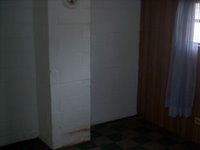

With Cheryl's help, I painted the room red. I wanted a red room because my writers group meets at a place called Fuse in Chapel Hill that has a red room, and I liked the vibe there. The red and orange rooms go well together. Moving from one to the other is a pleasant visual experience. I also think I was pushed toward the bright red and orange scheme of the house by the prison starkness that had been there when all the walls were white cinderblock. Before, the place had an institutional vibe. Now it's very warm and energetic.
The floor was laid by me with the help of Greg, Dona, and Jesse. I don't have photos of the bathroom (I do, but the room is so small I couldn't really get far enough away to photograph things with any kind of context), but Greg deserves recognition for helping me lay real tile in there. The bathroom is actually very nice, despite being smaller than the one in my old apartment. Dad wired me another socket in there... I'm thinking of doing something funky with the lighting eventually, maybe rope lights hidden around the edges of the medicine cabinet that would glow blue. It would feel like I was shaving in the future! Or maybe not.
I've mentioned Dad a couple of times now, but I don't think I can overstate how important he was to this project. He turned out to be a font of knowledge on drywall, wiring, framing, and other stuff. And, he also has proven to always have the right tool for the job at hand. So, hats off to Sidney W. Maxey, Jr., master carpenter, font of wisdom, and terrific father.


Living room transformation
I'm having some frustrations getting my photos to appear in the sequence I want them to on the page for some reason. But, below are before and after photos of the living room. The "after" is the orange wall, the "before" is the white cinterblock. I've put drywall over the cinderblock ot hide the exposed conduits. The old ratty AC unit has been carted off (I'll worry about what to replace it with in May or June). The drywall was painted orange and trimmed in white. The floor was covered with linoleum planks that do a very convincing imitation of wood.
You can't see it much, but Dad built out boxes above both windows that give the room a little extra flare. And, the effect is tough to capture on a camera phone, but the room looks much bigger in orange than it did in white. I was advised to go with orange by Dona, Cheryl, and Becky, and their advice proved worthwhile. My mom, dad, and brother all pitched in and helped with this room. Kudos all around.


You can't see it much, but Dad built out boxes above both windows that give the room a little extra flare. And, the effect is tough to capture on a camera phone, but the room looks much bigger in orange than it did in white. I was advised to go with orange by Dona, Cheryl, and Becky, and their advice proved worthwhile. My mom, dad, and brother all pitched in and helped with this room. Kudos all around.


Sunday, October 29, 2006
Magnetic poem by Laura
I bought Laura's refridgerator from her parents. It had three or four magnetic poems she had composed on the side. I didn't have the heart to take them down, but they were on the side of the fridge next to the stove and that side of the fridge was greasy and spattered. My brother's girlfriend Becky volunteered to clean the fridge on moving day. I told her I didn't have the heart to take down the poetry, but I had taken pictures with my phone, so it was okay if she had to remove it. She didn't... she very sweetly and carefully cleaned all the little gaps around the poetry.
This poem strikes me as particularly representing Laura's take on life:

In case the picture is grainy, the poem reads,
girl you are it
not to ask why
but do life day in & out
& I will trudge and
for you
This poem strikes me as particularly representing Laura's take on life:

In case the picture is grainy, the poem reads,
girl you are it
not to ask why
but do life day in & out
& I will trudge and
for you
Wednesday, October 18, 2006
House blahs
I am so exhausted. Drywall is exhausting stuff to work with. It's heavy and dusty and crumbles with the slightest bump on a corner. But, I finally got the last of it on the walls tonight. Now, I'm left with sanding the mudding in the living room and mudding from scratch the dining room. I also have a patch of wall I'm planning to stucco. I did a little test patch the other night on a tiny sliver of wall behind a door. Results were promising. I may wind up using stucco for the bedroom, the last room in the house with exposed cinder block.
With luck, I'll be at a point where I have paint on the walls this Saturday, and fake wood on the floor by Sunday. Then, it's all detail work, and, of course, moving in.
With luck, I'll be at a point where I have paint on the walls this Saturday, and fake wood on the floor by Sunday. Then, it's all detail work, and, of course, moving in.
Sunday, October 08, 2006
Kitchen before, kitchen after


This is a before and after photo of the kitchen. I took my "before" pictures of the house before I bought it, during the home inspection. Sadly, I thought I had a better picture of the kitchen. The inspector kind of set up shop in there and I never told him to get out. So, I just snapped this one photo.
Basically, before, everything in the kitchen was brown wood and gray floor tile. I've now put black and white vinyl tiles on the floor, painted the walls white and the cabinets and trim black. The only thing I haven't tackled is the countertop, which is a yellowish cream color. Eventually, I'd like to cover it with white tile, but that would mean I'd have to raise the sink up to the level of the tile, and I don't know that I want to deal with that just now.
A big shout out to my friend Cheryl for pitching in and helping me paint and lay tile. She rocks!
Thursday, October 05, 2006
All me, all the time
I'm spending crazy hours at the new house, but making good progress. The paint job in the kitchen is probably the nicest paint job I've ever done in a room. It's also been the most time consuming... and I still have the rest of the house to go! I started putting down the new floor tonight in the kitchen. It says I should only apply it to floors at least 65 degrees warm... so, of course, they are calling for a cold snap tomorrow with a high of only 60. I'll probably press ahead anyway.
Since it will be a while before I put up a long blog post, anyone wanting more of me should check out two recent eruptions of my words upon the internet. First, Mur Lafferty interviewed me for her popular podcast "I Should Be Writing." Check it out here: http://shouldwrite.blogspot.com/
I just found it live ten minutes ago... I haven't listened to it yet. I hope I didn't say anything embarassing. We met and talked over dinner and the conversation was so natural I sort of forgot she had the recorder going.
Next, if you check out the link on the side of the page for Ed Shubert's IGMS blog, you'll find a link that will take you to the latest online edition of Intergalactic Medicine Show, where my story "To Know All Things That Are In The Earth" is now live. I wrote this story for the Codexian Idol contest last February. I think it's the first time I've ever written a story and had it appear in print in the same year. It's also one of the best stories I've written to date in my opinion. Again, this issue of IGMS just went live, so I haven't read any of the other stories, but fellow Codexians are well represented in the table of contents, so I have confidence in the quality of the issue. And, hey, Tim Pratt!
Finally, a few posts back I mentioned taking out the bathroom sink. I am pleased to report that I put a new bathroom sink back in with very little effort. An hour, tops. Now all I need to do is slap some tile down, put up a shower curtain, and I'll actually have a functional bathroom.
Since it will be a while before I put up a long blog post, anyone wanting more of me should check out two recent eruptions of my words upon the internet. First, Mur Lafferty interviewed me for her popular podcast "I Should Be Writing." Check it out here: http://shouldwrite.blogspot.com/
I just found it live ten minutes ago... I haven't listened to it yet. I hope I didn't say anything embarassing. We met and talked over dinner and the conversation was so natural I sort of forgot she had the recorder going.
Next, if you check out the link on the side of the page for Ed Shubert's IGMS blog, you'll find a link that will take you to the latest online edition of Intergalactic Medicine Show, where my story "To Know All Things That Are In The Earth" is now live. I wrote this story for the Codexian Idol contest last February. I think it's the first time I've ever written a story and had it appear in print in the same year. It's also one of the best stories I've written to date in my opinion. Again, this issue of IGMS just went live, so I haven't read any of the other stories, but fellow Codexians are well represented in the table of contents, so I have confidence in the quality of the issue. And, hey, Tim Pratt!
Finally, a few posts back I mentioned taking out the bathroom sink. I am pleased to report that I put a new bathroom sink back in with very little effort. An hour, tops. Now all I need to do is slap some tile down, put up a shower curtain, and I'll actually have a functional bathroom.
Sunday, October 01, 2006
Face O' Jesus?


There's a place in the living room where I think a lamp once sat that has left an interesting pattern on the wall. It looks a bit like a human face with long hair. I wonder if I should leave it and open myself up as a pilgrimage site? Of course, it looks about as much like a Star Wars Storm Trooper as it does the face of Jesus, so I'm worried I'd get the house filled with Star Wars geeks.
Manly Moments
So, not to brag or anything, but I felt particularly manly for a moment yesterday as I removed my grungy old bathroom sink using nothing but an adjustable wrench and my own two hands. I stared at the gutted remains as they sat in my dining room with the same sense of satisfaction that cavemen must have felt staring the the spear-riddled corpse of a sabretooth.
Now, I just hope I can have the corresponding feeling of being able to put the new one back in.
Now, I just hope I can have the corresponding feeling of being able to put the new one back in.
Monday, September 25, 2006
New house
I'm a homeowner again! Closed on a house in Hillsborough this afternoon. I'll eventually post some before and after pictures of my remodelling... right now, of course, all I have are the befores.
I'm bushed. I did a marathon cleaning session after the closing. Tomorrow, I start painting. I'm planning on five solid weeks of home improvement. I'll sleep in Novemember, I guess.
I'm bushed. I did a marathon cleaning session after the closing. Tomorrow, I start painting. I'm planning on five solid weeks of home improvement. I'll sleep in Novemember, I guess.
Tuesday, September 12, 2006
Solaris Launch
The Solaris website is finally starting to get some content. I'm especially excited to see the covers and blurbs of some of the books they are launching with. Check them out at:
http://www.solarisbooks.com/books-alphabetical.asp
I have to say I'm very pleased with the covers. Thief with No Shadow is especially eye-catching. It gives me good vibes about the treatment Bitterwood will get. I'm also happy that, of the five covers shown, four of them focus on human faces or forms and only one is the generic SF spaceship. I've long thought that SF could gain a greater readership if the covers focused more on people and less on spacecraft and alien landscapes. Don't get me wrong--I enjoy SF artwork, and think SF scenery in movies is compelling. But, even if a story is set on a spaceship, the story is seldom about that spaceship; it's about the people/lizardbeasts/big bugs living on it. Making spaceships and futuristic buildings the focus of SF covers is akin to marketing romance novels showing the cars and houses of the characters, with no actual glimpse of the people who will be getting together between the covers, double-meaning intended. So, I'm happy to see these early covers being so character-centric.
And, as long as you are checking out the covers, why not also check out the message boards and blog? This could grow into a nice little community. Now's your chance to get in on the ground floor.
http://www.solarisbooks.com/books-alphabetical.asp
I have to say I'm very pleased with the covers. Thief with No Shadow is especially eye-catching. It gives me good vibes about the treatment Bitterwood will get. I'm also happy that, of the five covers shown, four of them focus on human faces or forms and only one is the generic SF spaceship. I've long thought that SF could gain a greater readership if the covers focused more on people and less on spacecraft and alien landscapes. Don't get me wrong--I enjoy SF artwork, and think SF scenery in movies is compelling. But, even if a story is set on a spaceship, the story is seldom about that spaceship; it's about the people/lizardbeasts/big bugs living on it. Making spaceships and futuristic buildings the focus of SF covers is akin to marketing romance novels showing the cars and houses of the characters, with no actual glimpse of the people who will be getting together between the covers, double-meaning intended. So, I'm happy to see these early covers being so character-centric.
And, as long as you are checking out the covers, why not also check out the message boards and blog? This could grow into a nice little community. Now's your chance to get in on the ground floor.
Monday, September 11, 2006
Unknown flowers
Left flowers at Laura's grave today. I was driving home, listening to 9-11 remembrances, and suddenly felt the need to run into a store and buy some blossoms. Look, anyone out there reading this who has a loved on who might appreciate a bouquet, step away from the computer and go get them some flowers. Steal them from the neighbors window box if you have to. I've given flowers to Laura more frequently in the last four months than I did in the four years I shared with her, and that's just a very sad thing.
I had no vase, so I just laid them out one by one on the grave. They were a delicate orange flower, with a small blossom, with light brown stripes down their centers. They looked kind of antique... I have no idea what they were. They just appealed to me at the Food Lion flower case. At the grave, I couldn't help but think about how Laura would have known what they were. She knew the names of all the flowers.
Driving home, I had the Mountain Goats on (don't I always?) and "Twin Human Highway Flares" was playing:
I had no vase, so I just laid them out one by one on the grave. They were a delicate orange flower, with a small blossom, with light brown stripes down their centers. They looked kind of antique... I have no idea what they were. They just appealed to me at the Food Lion flower case. At the grave, I couldn't help but think about how Laura would have known what they were. She knew the names of all the flowers.
Driving home, I had the Mountain Goats on (don't I always?) and "Twin Human Highway Flares" was playing:
on the day that i become so forgetful
that all of this melts away
i will burn all the calendars that counted the years down
to such a worthless day
Wednesday, September 06, 2006
A Laura Post, Four Months Beyond
And now four months have passed since I last held Laura's hand.
This last weekend, I went to Atlanta to attend Dragon*con. I spent much of my time thinking of her; the first time I went as a guest to the con Laura went with me. This was right before the official launch of Nobody Gets the Girl. Laura wasn't a SF geek, but I think she still had a good time looking at all the costumes. We attended a "Church of the Subgenius" meeting together, and got to meet Danger Woman, a comedic superheroine. It was also a chance to hang out with Kieth Olexa and fellow Phobos novelist Adam Connell. Laura was too sick to go to Dragon*con the second time I attended. The whole time I was at the con that second year, I wanted most of all to just go home and be with Laura. I barely have any memories of the con at all, and this was a year when Harlan Ellison was a guest of honor.
This year, I again found myself wishing I could pick up the phone and call Laura and tell her everything that was happening. I had a good time this year thanks to the presence of a whole bevy of Codexians to hang out with. Still, on the night before I left the con, we were sitting on a couch in the hotel that Laura and I had stayed at, and I was looking at the elevators rising and falling and remembering riding that elevator with her, and I'm hard pressed to think of any point in my life where I've ever felt more alone.
Yet, I don't intend for the tone of this article to be a downer, woe-is-me kind of thing. Because, something happened on my trip to Atlanta that gave me new insight into the entire experience of Laura's death, something that answered a lot of the unanswered questions I had about how she had slipped from this world.
The hotel I stayed in this year was located across the street from the Atlanta science center. They were hosting a traveling show called "Bodies: the Exhibition." You may have heard of exhibits like this. The father of them all was BodyWorks in Germany. A scientist figured out how to "plasticize" a human cadaver, and then used human bodies to make works of art. I went to the Bodies show expecting it to be an art show... instead, it was focused almost exclusively on the science of the body, as befitting a show in a science museum.
Some people may find the notion of looking at flayed human corpses a bit gruesome or morbid. Maybe it is. But, I saw some things in this show that provoked a sense of wonder about the marvelous organisms we spend our time on Earth dwelling inside. One display that really made me feel like I was looking at the world in a new way was of a body where the red-dyed plasticizing agent had been injected throughout the veins of the body. Then, the body had been dipped in acid and disolved, leaving the entire circulatory system intact. What remained was a ghost of blood, the outline of the human form and its organs plainly visible as a tree of thin crimson threads all woven together. The lungs were especially prominent in this work. Laura died from bleeding in her lungs. It's easy to understand how this can happen, looking at such a display.
And, of course, there were the lungs. In another room, there was a female head, throat, and lungs. The lungs were tiny. I had this mental picture of lungs being big things that fill up almost all the space beneath the rib cages. Instead, they are actually small enough to fit in my hands, and kind of squashed up and compressed by all the other organs stuffed into the torso. One thing I never understood as Laura's illness progressed was why such small tumors were killing her. The radiology reports were talking about tumors only millimeters long. Tiny things. Yet, this exhibit made me understand, at last, the scale that these tiny things were operating in. Laura had lost about half of her lung capacity to tumors. It's shocking to see how little this left her with.
Finally, there were the cancers. Lungs, breasts, livers, bones... all ridden with cancer, all preserved forever. As Laura was fighting her disease, I often wished for x-ray vision. I wanted so badly to see what was going on inside her body. Now, I feel like I finally have some insight. I'm torn as to whether I'm happy I didn't see it until afterwards, or whether I might have been more useful to Laura if I'd seen it before she passed away. I couldn't have saved her by seeing these cancer ravaged lungs. But, I might have understood what she was up against better.
A lot of people, when they lose a loved one, are left with the haunting question, "Why?" I don't know that science is all that effective in answering, "Why?" But, science is getting better and better at answering, "How?" I think I know something about how Laura passed away that I didn't four months ago. It helps.
This last weekend, I went to Atlanta to attend Dragon*con. I spent much of my time thinking of her; the first time I went as a guest to the con Laura went with me. This was right before the official launch of Nobody Gets the Girl. Laura wasn't a SF geek, but I think she still had a good time looking at all the costumes. We attended a "Church of the Subgenius" meeting together, and got to meet Danger Woman, a comedic superheroine. It was also a chance to hang out with Kieth Olexa and fellow Phobos novelist Adam Connell. Laura was too sick to go to Dragon*con the second time I attended. The whole time I was at the con that second year, I wanted most of all to just go home and be with Laura. I barely have any memories of the con at all, and this was a year when Harlan Ellison was a guest of honor.
This year, I again found myself wishing I could pick up the phone and call Laura and tell her everything that was happening. I had a good time this year thanks to the presence of a whole bevy of Codexians to hang out with. Still, on the night before I left the con, we were sitting on a couch in the hotel that Laura and I had stayed at, and I was looking at the elevators rising and falling and remembering riding that elevator with her, and I'm hard pressed to think of any point in my life where I've ever felt more alone.
Yet, I don't intend for the tone of this article to be a downer, woe-is-me kind of thing. Because, something happened on my trip to Atlanta that gave me new insight into the entire experience of Laura's death, something that answered a lot of the unanswered questions I had about how she had slipped from this world.
The hotel I stayed in this year was located across the street from the Atlanta science center. They were hosting a traveling show called "Bodies: the Exhibition." You may have heard of exhibits like this. The father of them all was BodyWorks in Germany. A scientist figured out how to "plasticize" a human cadaver, and then used human bodies to make works of art. I went to the Bodies show expecting it to be an art show... instead, it was focused almost exclusively on the science of the body, as befitting a show in a science museum.
Some people may find the notion of looking at flayed human corpses a bit gruesome or morbid. Maybe it is. But, I saw some things in this show that provoked a sense of wonder about the marvelous organisms we spend our time on Earth dwelling inside. One display that really made me feel like I was looking at the world in a new way was of a body where the red-dyed plasticizing agent had been injected throughout the veins of the body. Then, the body had been dipped in acid and disolved, leaving the entire circulatory system intact. What remained was a ghost of blood, the outline of the human form and its organs plainly visible as a tree of thin crimson threads all woven together. The lungs were especially prominent in this work. Laura died from bleeding in her lungs. It's easy to understand how this can happen, looking at such a display.
And, of course, there were the lungs. In another room, there was a female head, throat, and lungs. The lungs were tiny. I had this mental picture of lungs being big things that fill up almost all the space beneath the rib cages. Instead, they are actually small enough to fit in my hands, and kind of squashed up and compressed by all the other organs stuffed into the torso. One thing I never understood as Laura's illness progressed was why such small tumors were killing her. The radiology reports were talking about tumors only millimeters long. Tiny things. Yet, this exhibit made me understand, at last, the scale that these tiny things were operating in. Laura had lost about half of her lung capacity to tumors. It's shocking to see how little this left her with.
Finally, there were the cancers. Lungs, breasts, livers, bones... all ridden with cancer, all preserved forever. As Laura was fighting her disease, I often wished for x-ray vision. I wanted so badly to see what was going on inside her body. Now, I feel like I finally have some insight. I'm torn as to whether I'm happy I didn't see it until afterwards, or whether I might have been more useful to Laura if I'd seen it before she passed away. I couldn't have saved her by seeing these cancer ravaged lungs. But, I might have understood what she was up against better.
A lot of people, when they lose a loved one, are left with the haunting question, "Why?" I don't know that science is all that effective in answering, "Why?" But, science is getting better and better at answering, "How?" I think I know something about how Laura passed away that I didn't four months ago. It helps.
Tuesday, September 05, 2006
Now, for my longest post yet....
What a blur, these last two weeks. I finished Bitterwood, pushing it up to 116k words. I feel confident in saying that Bitterwood is the most fleshed out work of fiction I've ever created. Nobody Gets the Girl was written with a rather minimalist style. Comic book writing is actually rather terse; having to keep you dialogue into word balloons forces comic writers to be lean and mean. Of course, they have the advantage of art surrounding the word balloons. They don't have to describe a characters, a room, or an action sequence. It's all drawn out for them. With Nobody, I used my prose as a pencil, sketching out a lot of quick outlines and backgrounds, not adding a lot of color, presenting a world composed mostly of shades of grays. Dialogue carries much of the action and reveals most of the characters' thoughts.
Bitterwood, on the otherhand, is a painted novel. It involves races of dragons, in emerald, ruby, and azure hues. The characters in Nobody seldom think about eating; in Bitterwood, primary characters sometimes pause to savor licking the drying blood from beneath their claws. In a world dominated by inhuman creatures, I tried to weave a tapestry of tastes, odors, and textures to bring to life the sensual environment of the dragons.
Perhaps it would be easier to illustrate with examples. The following is the first scene from the first chapter of Bitterwood: (Note: This hasn't been professionally edited yet... any typos or infelicities are entirely my fault.)
The sad little fire gave out more smoke than warmth. The hunter crouched before it, turning a chunk of ash-flecked meat on the flat stone he’d placed amidst the coals. The movement of the stone stirred more smoke. The hunter coughed, and wiped soot from his eyes. He stretched his bony, knotted fingers above the embers, fighting off the chill. He was a thin man, hair shoulder-length and gray, the deep lines of his leathery face forming a permanent frown. He pulled his heavy cloak more tightly around him.
In the tree above him hung the body of a dragon, blood dripping from its mouth.
The creature was a sky-dragon--the smallest of the winged dragon species. Strip away the ten-foot wings and the long tail and a sky-dragon was no bigger than a man, and half again as light. They were known as sky-dragons both for their prowess in flight and their coloring, the pale, perfect blue of a cloudless day. The hunter had killed many sky-dragons over the years. They weren’t particularly dangerous. Despite talons ending in two-inch claws and crocodilian jaws full of saw-like teeth, sky-dragons prided themselves on being civilized. The beasts fancied themselves as artists, poets, and scholars; they considered it beneath their dignity to engage in such menial work as hunting.
The hunter had brought the sky-dragon down with a single arrow, expertly placed on the underside of the jaw, the iron tip coming to rest dead center in the dragon's brain. The beast had fallen from the air like a suddenly dead thing, catching in the crook of a tree. The hunter had climbed the tree and retrieved the leather satchel the dragon had slung over its back. He'd tugged at the beast's body, but found the corpse jammed too tight to budge. Lowering himself even with the beast's head, he'd stared into its glassy, cat-like eyes. Sky-dragon heads always reminded him of goat heads, albeit goats covered in smooth, opalescent scales. With a grunt, he'd cut out the beast’s tongue.
Moments later, he'd built a fire, and now the tongue sizzled on the flat rock at the center, giving the smoke an oily, fishy tinge. To pass the time as the tongue cooked, the hunter searched the contents of the dragon’s satchel. Food, of course. A bottle of wine wrapped in burlap, a loaf of rock hard bread powdered with flour, two apples, some eel jerky. He also discovered a fist-sized crock capped with oily parchment bound on with a string. He punched through the parchment and recoiled at the stench. The crock was filled with strong-smelling horch, a sort of paste that dragons loved that consisted of sardines, olives, and chilies, all ground together then buried in a ceramic jar and fermented. The hunter tossed the jar as far into the woods as his arm could heave it.
Turning his attention once more to the satchel, the hunter found a map, a rolled up blanket of padded green silk, and a small jar of ink. He sniffed the cap, and judged the ink to be made from vinegar and walnut husks. Several quills crafted from the dragon's own feather-scales were in the bag. No wonder the beasts fancied themselves scholars--they were covered with the tools of writing.
The hunter paused to examine a leather-bound book, the linen paper a pristine white, the opening pages covered with sketches and notes about flowers. The drawings were meticulous. Rendered in dark walnut ink, the flowers had a life and beauty. The blossoms swelled on the page seductively enough to tempt bees.
The hunter ripped out the pages and fed them to the crackling fire. The paper writhed as if alive, curling, crumbling into large black leaves that wafted upward with the smoke, the inky designs still faintly visible until they vanished in the dark sky.
The hunter used his knife to retrieve the roasted tongue and sat back against the tree, oblivious to the blood soaking the trunk. As he chewed his meal, he stared at the inkbottle. It stirred memories. Memories for the hunter were never a good thing.
After he finished the tongue, he wiped his fingers on his grungy cloak. He picked up the book, contemplating the blank pages. Opening the ink, he dipped the quill and drew a jagged, uneven line upon the page. He tried again, drawing a circle, the line flowing more evenly this time. Across the top of the page he began to write A B C D E . . . and it all came back to him.
Dipping the quill once more, he turned the page, and wrote in cautious, even letters, “In the beginning.” He stopped, and drew a line through the words. He turned the page, and stared at the fresh parchment, so white. White like an apple blossom. White like a young bride’s skin. He lowered the quill to the page.
Dear Recanna,
I have thought of you often. What I would say if I could see you again. What I should have said those many years ago.
Twenty years. Twenty years since last I heard your voice. Twenty years I’ve been at war, alone.
If only
Here the hunter stopped. If only. These were weak words, regretful. They had no room in his heart. This was not a night to lose himself in memory and melancholy. Tomorrow was an important day. The most honored ritual of the dragons was scheduled, and he had a special, unscripted role to play.
If only.
The hunter closed the cover on those cursed words, and placed the book upon the coals.
Flames licked the edges, dancing before his eyes like ghosts.
Compare this with the opening scene of the first chapter of Nobody Gets the Girl. Again, this is from the unedited version of the original draft, since it's what I had a copy of on this computer. The actual print version varied a bit, but you'll get the gist of the different stylistic approaches, I think:
"Yeah, all my life I've been lucky," Richard said, transitioning from jokes about driving into current event jokes. "Lucky I don't live in DC for one thing. You been following this? The dome?"
There were maybe twelve people in the audience now. A few were still laughing from the last punchline. A handful nodded their heads at the mention of the dome.
"I mean talk about a waste of money," said Richard. "Seventeen billion dollars this thing’s costing. Gonna put a big old dome over the entire city. Climate control year round. There's, what? Two million people living under this thing? Three million? You could buy umbrellas for everybody for a lot less than seventeen billion. Or maybe not, if the Pentagon was in charge of it. Then we'd be buying the XJ-11 combat ready umbrella. Not only rain proof but bullet proof. They'd weigh 45 pounds each."
He wielded the mike-stand like a very heavy umbrella and staggered a few feet across the stage, grunting under its weight. The audience laughed hard. One of the first lessons Richard had learned about stand-up comedy was that he could make anything seem funny if he attached it to a silly walk.
He straightened up and put the mike back into the stand. "Thanks! You've been a great audience! I'm Richard Rogers! I'll be back here next month!"
He bounded from the stage and shook a few hands. He felt wired, buzzing, full of the same manic energy that always hit him after a set. The charge was the same with twelve people in the audience as with a hundred. This is why he'd drive four hours on a weeknight to perform at the Stokesville Ramada's comedy bar open mike.
Making his way through the small crowd, he arrived at the bar.
"Good set," said Billy, the bartender, who was already filling a glass with Richard's usual beer.
"Thanks," said Richard as he took the glass. "Small crowd though."
"Eh," said Billy. "It's raining. Never a big crowd when it's this nasty out."
"Maybe I'll start driving to DC," said Richard. "Not many nasty nights there anymore."
"Thought you didn't like the dome," said Billy.
"Ah, who cares. It’s too weird to get really worked up about. Everyday I watch the news and think, 'They're just making this stuff up.’ They’ve a bunch of ex-comic book writers sitting in the back room cranking out these stories. Probably cheaper than hiring reporters."
Richard grew aware of a presence behind him as he spoke, someone stepping a little too closely into his personal space. He looked over his shoulder. It was a woman. She'd caught his eye a few times when he was on stage. She was tall, good looking, maybe a few years older than him, but very attractive.
"You were good up there," she said, taking the stool next to him. "My name's Rose."
"Thanks," he said. "I'm Richard."
"So what are you doing here on an open mike night?" she asked. "You're better than most of the pro's I've seen in here. You should be paid for this."
"Thanks again," said Richard. "I don't suppose you'd happen to be an agent, would you?"
"No. I'm the district sales rep for Oxford Financial. I travel a lot. When I'm in town I usually come here. Really, I've seen a lot of comedians, and you're very talented."
Richard shrugged. "I've thought about turning pro, but it's not likely to happen."
"Why not?"
"Oh, you know. I didn't really discover I enjoyed doing this until I was already neck deep in something else. I'm a network manager at FirstSouth. I can't afford to quit that and hit the circuits in hope of some big break. For the time being, the Stokesville Ramada's as far as I travel."
"I wish this was as far as I traveled," said Rose. "My counterpart in the Carolina's quit so I'm covering four states now. Yeesh. But it's not all bad. Some parts of life on the road I really like."
"Such as?"
"Meeting new people," said Rose. "I feel more like who I want to be when I'm talking to someone for the first time."
"Hmm," said Richard.
"You must understand," said Rose, lightly touching his arm. "Isn't it like you're a different person when you're on stage? On the road, you can be anyone you want to be."
Richard nodded. "Yeah. I do feel like a different person up there. Only it's not really different. It's like who I really am. It's everywhere else in my life I feel a bit out of place."
She touched his arm again. "So you do understand. Funny people are often the most insightful."
Richard looked at her hand on his arm. He suddenly felt rather warm.
"So," she said. "Do you have a room here?"
"Um," said Richard. "No. Actually I have to work in the morning. I'm driving home tonight."
"In this weather?" she asked. "Wouldn't you rather spend the night in a warm bed than out in that mess?"
Richard moved his left hand closer to her hand on his arm, to make sure she could see his wedding ring. "My wife would be worried," he said.
"Call her and tell you you're staying over because of the weather," said Rose.
"I'd never hear the end of it. You don't know my wife," said Richard.
"And you don't know my husband," said Rose with a sly grin, leaning closer. "Isn't it marvelous we have so much in common?"
She was looking directly into his eyes. Richard had a strong sense of déjà vu. This was a fantasy he'd played in his head many times over, being approached by a beautiful woman after he'd finished a set, a woman who found him sexy based purely on his ten minutes on stage. Now here his fantasy was, in the very attractive flesh. Did he dare pass this up?
He looked down at his wedding ring. Maybe Veronica wouldn't find out. One night, hours from home . . .. He shook his head.
"Sorry," he said. "I really need to be going."
Rose withdrew her arm. "Okay. Drive safe." She sounded a little miffed.
With Nobody, the world is our own modern, familiar world, with a slight comic book SF twist. I don't waste time describing a comedy club or the taste of a beer... I assume that the readers have experienced such things in their own life and can fill in the details.
Aside from the stylistic differences, and the fact that the two novels fit into two completely different genres, there are similarities between the two works that I hope readers of my work will recognize and identify with. In "Nobody," moral issues get muddied rather quickly. It's tough to say for certain who are the good guys and who are the bad guys, or even if the terms "good" and "bad" have any meaning at all. Yet, Nobody isn't a book dominated by people sitting around agonizing about what's right and wrong. It's driven by action and unfolding mysteries and plentiful cliffhangers. Bitterwood, despite the more textured prose, shares (I hope) the same page-turning pace as the protagonists struggle to survive in a world where everyone wants them dead. Once again, there are few easy moral choices. In a novel that boils down to dragons versus humans, it seems like a no-brainer that the humans should have our sympathy. Then again, dragons are just a helluva lot cooler than people, so they're easy to root for as well.
Both Nobody and Bitterwood are carried by protagonists who don't fit well into the label of 'hero." Nobody's Richard Rogers is, well, a nobody, completely overwhelmed by the strange superheroic world into which he's plunged. Bitterwood's protagonist is difficult to even pin down--is it the dragon king Albekizan, who seeks to avenge the murder of his beloved son at the hand of Bitterwood? Or is it Bitterwood, who seeks to avenge the murder of his family by the armies of Albekizan? Or is it Vendevorex, the dragon who, as Albekizan's most trusted advisor, has committed a long string of sinister deeds to help Albekizan grow in power, but now finds himself on the run after opposing Albekizan's latest schemes? Or Jandra, Vendevorex's human apprentice, who has been raised since infancy by Vendevorex and finds herself a permanent outcast, never able to be accepted by dragons as an equal, but also completely unable to connect with her fellow humans, who think of her only as Vendevorex's pet?
Whew! This has turned into a long post. I'll shut up now. More writing news will be revealed in the next few days, however. Also, a big Laura post coming up before the end of this week, I promise.
Bitterwood, on the otherhand, is a painted novel. It involves races of dragons, in emerald, ruby, and azure hues. The characters in Nobody seldom think about eating; in Bitterwood, primary characters sometimes pause to savor licking the drying blood from beneath their claws. In a world dominated by inhuman creatures, I tried to weave a tapestry of tastes, odors, and textures to bring to life the sensual environment of the dragons.
Perhaps it would be easier to illustrate with examples. The following is the first scene from the first chapter of Bitterwood: (Note: This hasn't been professionally edited yet... any typos or infelicities are entirely my fault.)
The sad little fire gave out more smoke than warmth. The hunter crouched before it, turning a chunk of ash-flecked meat on the flat stone he’d placed amidst the coals. The movement of the stone stirred more smoke. The hunter coughed, and wiped soot from his eyes. He stretched his bony, knotted fingers above the embers, fighting off the chill. He was a thin man, hair shoulder-length and gray, the deep lines of his leathery face forming a permanent frown. He pulled his heavy cloak more tightly around him.
In the tree above him hung the body of a dragon, blood dripping from its mouth.
The creature was a sky-dragon--the smallest of the winged dragon species. Strip away the ten-foot wings and the long tail and a sky-dragon was no bigger than a man, and half again as light. They were known as sky-dragons both for their prowess in flight and their coloring, the pale, perfect blue of a cloudless day. The hunter had killed many sky-dragons over the years. They weren’t particularly dangerous. Despite talons ending in two-inch claws and crocodilian jaws full of saw-like teeth, sky-dragons prided themselves on being civilized. The beasts fancied themselves as artists, poets, and scholars; they considered it beneath their dignity to engage in such menial work as hunting.
The hunter had brought the sky-dragon down with a single arrow, expertly placed on the underside of the jaw, the iron tip coming to rest dead center in the dragon's brain. The beast had fallen from the air like a suddenly dead thing, catching in the crook of a tree. The hunter had climbed the tree and retrieved the leather satchel the dragon had slung over its back. He'd tugged at the beast's body, but found the corpse jammed too tight to budge. Lowering himself even with the beast's head, he'd stared into its glassy, cat-like eyes. Sky-dragon heads always reminded him of goat heads, albeit goats covered in smooth, opalescent scales. With a grunt, he'd cut out the beast’s tongue.
Moments later, he'd built a fire, and now the tongue sizzled on the flat rock at the center, giving the smoke an oily, fishy tinge. To pass the time as the tongue cooked, the hunter searched the contents of the dragon’s satchel. Food, of course. A bottle of wine wrapped in burlap, a loaf of rock hard bread powdered with flour, two apples, some eel jerky. He also discovered a fist-sized crock capped with oily parchment bound on with a string. He punched through the parchment and recoiled at the stench. The crock was filled with strong-smelling horch, a sort of paste that dragons loved that consisted of sardines, olives, and chilies, all ground together then buried in a ceramic jar and fermented. The hunter tossed the jar as far into the woods as his arm could heave it.
Turning his attention once more to the satchel, the hunter found a map, a rolled up blanket of padded green silk, and a small jar of ink. He sniffed the cap, and judged the ink to be made from vinegar and walnut husks. Several quills crafted from the dragon's own feather-scales were in the bag. No wonder the beasts fancied themselves scholars--they were covered with the tools of writing.
The hunter paused to examine a leather-bound book, the linen paper a pristine white, the opening pages covered with sketches and notes about flowers. The drawings were meticulous. Rendered in dark walnut ink, the flowers had a life and beauty. The blossoms swelled on the page seductively enough to tempt bees.
The hunter ripped out the pages and fed them to the crackling fire. The paper writhed as if alive, curling, crumbling into large black leaves that wafted upward with the smoke, the inky designs still faintly visible until they vanished in the dark sky.
The hunter used his knife to retrieve the roasted tongue and sat back against the tree, oblivious to the blood soaking the trunk. As he chewed his meal, he stared at the inkbottle. It stirred memories. Memories for the hunter were never a good thing.
After he finished the tongue, he wiped his fingers on his grungy cloak. He picked up the book, contemplating the blank pages. Opening the ink, he dipped the quill and drew a jagged, uneven line upon the page. He tried again, drawing a circle, the line flowing more evenly this time. Across the top of the page he began to write A B C D E . . . and it all came back to him.
Dipping the quill once more, he turned the page, and wrote in cautious, even letters, “In the beginning.” He stopped, and drew a line through the words. He turned the page, and stared at the fresh parchment, so white. White like an apple blossom. White like a young bride’s skin. He lowered the quill to the page.
Dear Recanna,
I have thought of you often. What I would say if I could see you again. What I should have said those many years ago.
Twenty years. Twenty years since last I heard your voice. Twenty years I’ve been at war, alone.
If only
Here the hunter stopped. If only. These were weak words, regretful. They had no room in his heart. This was not a night to lose himself in memory and melancholy. Tomorrow was an important day. The most honored ritual of the dragons was scheduled, and he had a special, unscripted role to play.
If only.
The hunter closed the cover on those cursed words, and placed the book upon the coals.
Flames licked the edges, dancing before his eyes like ghosts.
Compare this with the opening scene of the first chapter of Nobody Gets the Girl. Again, this is from the unedited version of the original draft, since it's what I had a copy of on this computer. The actual print version varied a bit, but you'll get the gist of the different stylistic approaches, I think:
"Yeah, all my life I've been lucky," Richard said, transitioning from jokes about driving into current event jokes. "Lucky I don't live in DC for one thing. You been following this? The dome?"
There were maybe twelve people in the audience now. A few were still laughing from the last punchline. A handful nodded their heads at the mention of the dome.
"I mean talk about a waste of money," said Richard. "Seventeen billion dollars this thing’s costing. Gonna put a big old dome over the entire city. Climate control year round. There's, what? Two million people living under this thing? Three million? You could buy umbrellas for everybody for a lot less than seventeen billion. Or maybe not, if the Pentagon was in charge of it. Then we'd be buying the XJ-11 combat ready umbrella. Not only rain proof but bullet proof. They'd weigh 45 pounds each."
He wielded the mike-stand like a very heavy umbrella and staggered a few feet across the stage, grunting under its weight. The audience laughed hard. One of the first lessons Richard had learned about stand-up comedy was that he could make anything seem funny if he attached it to a silly walk.
He straightened up and put the mike back into the stand. "Thanks! You've been a great audience! I'm Richard Rogers! I'll be back here next month!"
He bounded from the stage and shook a few hands. He felt wired, buzzing, full of the same manic energy that always hit him after a set. The charge was the same with twelve people in the audience as with a hundred. This is why he'd drive four hours on a weeknight to perform at the Stokesville Ramada's comedy bar open mike.
Making his way through the small crowd, he arrived at the bar.
"Good set," said Billy, the bartender, who was already filling a glass with Richard's usual beer.
"Thanks," said Richard as he took the glass. "Small crowd though."
"Eh," said Billy. "It's raining. Never a big crowd when it's this nasty out."
"Maybe I'll start driving to DC," said Richard. "Not many nasty nights there anymore."
"Thought you didn't like the dome," said Billy.
"Ah, who cares. It’s too weird to get really worked up about. Everyday I watch the news and think, 'They're just making this stuff up.’ They’ve a bunch of ex-comic book writers sitting in the back room cranking out these stories. Probably cheaper than hiring reporters."
Richard grew aware of a presence behind him as he spoke, someone stepping a little too closely into his personal space. He looked over his shoulder. It was a woman. She'd caught his eye a few times when he was on stage. She was tall, good looking, maybe a few years older than him, but very attractive.
"You were good up there," she said, taking the stool next to him. "My name's Rose."
"Thanks," he said. "I'm Richard."
"So what are you doing here on an open mike night?" she asked. "You're better than most of the pro's I've seen in here. You should be paid for this."
"Thanks again," said Richard. "I don't suppose you'd happen to be an agent, would you?"
"No. I'm the district sales rep for Oxford Financial. I travel a lot. When I'm in town I usually come here. Really, I've seen a lot of comedians, and you're very talented."
Richard shrugged. "I've thought about turning pro, but it's not likely to happen."
"Why not?"
"Oh, you know. I didn't really discover I enjoyed doing this until I was already neck deep in something else. I'm a network manager at FirstSouth. I can't afford to quit that and hit the circuits in hope of some big break. For the time being, the Stokesville Ramada's as far as I travel."
"I wish this was as far as I traveled," said Rose. "My counterpart in the Carolina's quit so I'm covering four states now. Yeesh. But it's not all bad. Some parts of life on the road I really like."
"Such as?"
"Meeting new people," said Rose. "I feel more like who I want to be when I'm talking to someone for the first time."
"Hmm," said Richard.
"You must understand," said Rose, lightly touching his arm. "Isn't it like you're a different person when you're on stage? On the road, you can be anyone you want to be."
Richard nodded. "Yeah. I do feel like a different person up there. Only it's not really different. It's like who I really am. It's everywhere else in my life I feel a bit out of place."
She touched his arm again. "So you do understand. Funny people are often the most insightful."
Richard looked at her hand on his arm. He suddenly felt rather warm.
"So," she said. "Do you have a room here?"
"Um," said Richard. "No. Actually I have to work in the morning. I'm driving home tonight."
"In this weather?" she asked. "Wouldn't you rather spend the night in a warm bed than out in that mess?"
Richard moved his left hand closer to her hand on his arm, to make sure she could see his wedding ring. "My wife would be worried," he said.
"Call her and tell you you're staying over because of the weather," said Rose.
"I'd never hear the end of it. You don't know my wife," said Richard.
"And you don't know my husband," said Rose with a sly grin, leaning closer. "Isn't it marvelous we have so much in common?"
She was looking directly into his eyes. Richard had a strong sense of déjà vu. This was a fantasy he'd played in his head many times over, being approached by a beautiful woman after he'd finished a set, a woman who found him sexy based purely on his ten minutes on stage. Now here his fantasy was, in the very attractive flesh. Did he dare pass this up?
He looked down at his wedding ring. Maybe Veronica wouldn't find out. One night, hours from home . . .. He shook his head.
"Sorry," he said. "I really need to be going."
Rose withdrew her arm. "Okay. Drive safe." She sounded a little miffed.
With Nobody, the world is our own modern, familiar world, with a slight comic book SF twist. I don't waste time describing a comedy club or the taste of a beer... I assume that the readers have experienced such things in their own life and can fill in the details.
Aside from the stylistic differences, and the fact that the two novels fit into two completely different genres, there are similarities between the two works that I hope readers of my work will recognize and identify with. In "Nobody," moral issues get muddied rather quickly. It's tough to say for certain who are the good guys and who are the bad guys, or even if the terms "good" and "bad" have any meaning at all. Yet, Nobody isn't a book dominated by people sitting around agonizing about what's right and wrong. It's driven by action and unfolding mysteries and plentiful cliffhangers. Bitterwood, despite the more textured prose, shares (I hope) the same page-turning pace as the protagonists struggle to survive in a world where everyone wants them dead. Once again, there are few easy moral choices. In a novel that boils down to dragons versus humans, it seems like a no-brainer that the humans should have our sympathy. Then again, dragons are just a helluva lot cooler than people, so they're easy to root for as well.
Both Nobody and Bitterwood are carried by protagonists who don't fit well into the label of 'hero." Nobody's Richard Rogers is, well, a nobody, completely overwhelmed by the strange superheroic world into which he's plunged. Bitterwood's protagonist is difficult to even pin down--is it the dragon king Albekizan, who seeks to avenge the murder of his beloved son at the hand of Bitterwood? Or is it Bitterwood, who seeks to avenge the murder of his family by the armies of Albekizan? Or is it Vendevorex, the dragon who, as Albekizan's most trusted advisor, has committed a long string of sinister deeds to help Albekizan grow in power, but now finds himself on the run after opposing Albekizan's latest schemes? Or Jandra, Vendevorex's human apprentice, who has been raised since infancy by Vendevorex and finds herself a permanent outcast, never able to be accepted by dragons as an equal, but also completely unable to connect with her fellow humans, who think of her only as Vendevorex's pet?
Whew! This has turned into a long post. I'll shut up now. More writing news will be revealed in the next few days, however. Also, a big Laura post coming up before the end of this week, I promise.
Subscribe to:
Posts (Atom)


 Posts
Posts


